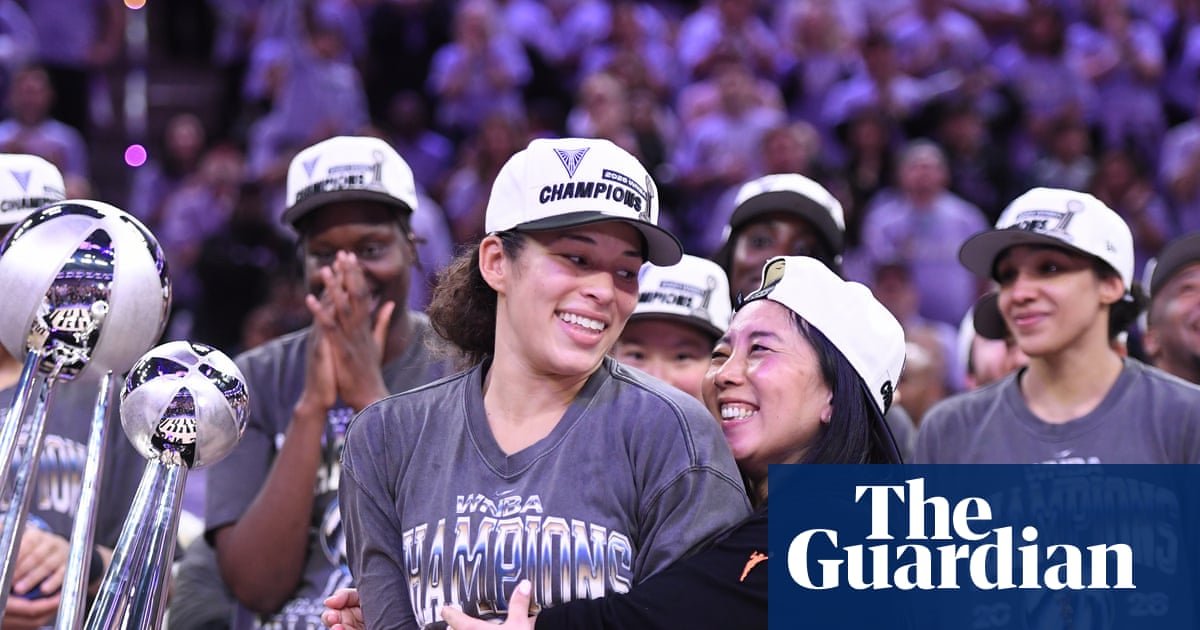
Veronica Burton and Natalie Nakase celebrate Golden State’s WNBA title.
A coach shaped by her circuitous basketball journey was uniquely suited to building the trust that made Golden State champions just 534 days after their first game The mighty, miserly Golden State Valkyries won their first WNBA title on Saturday night with a point guard Dallas had given up on and cast aside, a starting forward who had been waived five times and a late-blooming All-Star once passed over by every team in the league.
That made them a fitting match for their coach.
Natalie Nakase has pieced together a basketball life on making small openings count, turning a walk-on place at UCLA into a scholarship and an unsolicited scouting report into a coaching job in Japan’s top men’s league.
The Valkyries’ nerve-shredding 68-63 fightback over the Atlanta Dream in Game 7 did more than make them the fastest expansion team in major North American professional sports history to win a championship – as 45-1 preseason longshots in their second season of existence.
It was proof of concept for an organization that gave overlooked players the resources, responsibility and trust to become champions – and enlisted a leader whose own circuitous journey had taught her what those things could unlock.
Quick GuideWNBA finals 2026 ShowSchedule Best-of-seven series.
All times US Eastern Daylight Time (EDT).
Sat 17 Oct Game 1: Golden State 68, Atlanta 64 Mon 19 Oct Game 2: Atlanta 79, Golden State 65 Wed 21 Oct Game 3: Atlanta 97, Golden State 71 Sat 24 Oct Game 4: Golden State 67, Atlanta 62 Mon 26 Oct Game 5: Golden State 64, Atlanta 55 Thu 29 Oct Game 6: Atlanta 80, Golden State 69 Sat 31 Oct Game 7: Golden State 68, Atlanta 63 How to watch In the US, the series will air on NBC, USA Network and CNBC, with all games streaming on Peacock.
In the UK, it will be carried by Sky Sports.
In Australia, fans can watch through WNBA League Pass, with selected coverage also available through ESPN.
“We have unconditional love that’s fucking unbreakable, guys,” a keyed-up Nakase said during the trophy ceremony at a Chase Center that remained packed to the rafters, where Golden State’s 53rd home game had delivered their 53rd sellout crowd on a night that will be long remembered in the Bay Area as Ballhallaween.
“This is for all the people that have been underrated, misunderstood,” she said.
“This is for all y’all, because this is proof: if you put all your heart and all your soul, you fucking win championships!” From the first game in franchise history to a title in 534 days: the speed was extraordinary but the foundation was deliberate.
Golden State had built a place where players could expect investment, opportunity and the trust of their coach – and were expected to give something back.
Nakase’s declaration of love came with demanding basketball obligations: defend, compete and accept whatever role helped the team win.
Natalie Nakase led the Golden State Valkyries to a WNBA championship in only their second season.
Connecticut signed her, then left her unprotected in the expansion draft.
With Golden State, she became the league’s most improved player.
Kaila Charles had been cut five times in five seasons.
Back at her parents’ home, training with her brother and mulling her professional future, she was preparing to visit Trinidad for her grandmother’s 94th birthday when the Valkyries offered a seven-day hardship contract.
Now she was starting in the WNBA finals.
Kayla Thornton went undrafted, was shown the door by two different teams and spent years establishing herself as a dependable supporting player before becoming a first-time All-Star with Golden State at 32.
Cecilia Zandalasini had started only six WNBA games before joining Golden State and starting 44 across the team’s first two seasons.
Kaitlyn Chen, a relatively unheralded third-round draft pick, found a role backing up Burton and as the bench’s chief vibes officer.
Tiffany Hayes, a former sixth woman of the year, had played more WNBA games without winning a title than anyone else in history – until Saturday night.
These were careers transformed by opportunity – by a team willing to explore what its players could become.
Gabby Williams, the newly minted WNBA finals MVP and Golden State’s closest thing to an incandescent star, put it another way.
Natalie Nakase, right, guards Esperanza’s Kim Omer while playing for Marina High School in southern California.
“All we heard last year was we don’t have no stars.
We don’t have no talent.
Yeah, right!
We got good people.
We got winners.
We got people who are ready to put their bodies on the floor to win a game.” Nakase understood what it meant to have more to offer than others could see.
She had spent much of her own career proving it.
A 5ft 2in point guard from a basketball-obsessed Japanese-American family in southern California, she turned down a scholarship to UC Irvine to walk on at UCLA, her dream school.
A torn ACL delayed her start, but she earned a scholarship there anyway, became a starter and captained the Bruins for three seasons.
She never did make a WNBA roster.
Phoenix cut her in 2007, before another knee injury while playing in Germany spelled the end of her playing career.
She began coaching the Wolfenbüttel Wildcats of the Damen-Basketball-Bundesliga before moving to Japan, where she initially found a foothold watching Tokyo Apache practices.
A scouting report she prepared earned her a volunteer assistant’s job under former NBA coach Bob Hill, before she eventually became the first woman to lead a team in Japan’s top professional men’s league when she took charge of the Saitama Broncos.
Then came a return to California and an internship in the Clippers’ video department.
She spent a decade in the organization, working through video, development and coaching roles before Becky Hammon brought her to Las Vegas in 2022.
Two championships as a bench coach followed, giving her a front-row seat for one of basketball’s great dynasties.
Her intensity can work against her.
Nakase nearly fainted in the closing minute of the first-round decider against Dallas, prompting her to pay closer attention to rest, hydration and nutrition.
During the semi-finals, she took the unusual step of giving herself a full day off.
The coach who constantly urged her players to “empty the tank” had run up against her own limits.
Nakase traced both that relentless drive and her instinct to invest in people to her late father.
Natalie Nakase made history as the first female assistant coach in NBA Summer League history in 2014 and later became an assistant coach on the Los Angeles Clippers bench during the regular season.
I am crazy.
I am obsessive.
I am a workaholic,” she said.
“But it’s more just pouring into people, believing in people, helping people, that’s all come from my dad.” Her extended apprenticeship mattered for a roster assembled largely from other franchises’ spare parts.
Nakase and general manager Ohemaa Nyanin looked for competitiveness and character, studying even how players behaved when they returned to the bench.
They needed people who wanted more for themselves and could still accept what the team required.
They worked at those relationships.
On an early two-week road trip, the Valkyries organized dinners and games built around open, honest questions.
Basketball, Nakase said, was the last thing they wanted to discuss.
“I love to learn about people, so I can push their buttons and go crazy when I have to,” she said.
Williams remembered evenings nobody wanted to end.
“I knew we had something special on that trip.” skip past newsletter promotion after newsletter promotion “Strength in numbers” was one of Nakase’s recurring messages, alongside “Empty the tank”.
She backed it with her rotations, sometimes trusting the eighth or ninth player to finish games.
Shared responsibility gave Golden State the depth to sustain their suffocating defense – the best in the league by some distance – and made a larger role a real possibility for everyone on the active roster.
That extended to closing an elimination game with a rookie (Chen) while her starting point guard (Burton) watched from the bench.
Opportunity depended on what the game demanded, while established players had to trust that the same principle applied to everyone.
The finals tested that bargain.
Trailing Atlanta 2-1, Nakase moved Charles and Tiffany Hayes into the starting lineup, bringing Thornton and Zandalasini off the bench.
Golden State won the next two games, holding Atlanta to 62 and 55 points.
Trust had a practical application: players could lose their starting places without the team losing them.
There was individual greatness, too.
Williams poured in 28 of her 30 points after half-time in Saturday’s deciding game, the highest-scoring half in WNBA playoff history, and was the no-brainer pick for MVP.
Her explanation began with her coach.
Natalie Nakase and the Golden State Valkyries celebrate winning the WNBA title in only their second season after beating Atlanta in Game 7 at Chase Center.
I trust her with my life,” Williams said.
Williams had taken her own peripatetic journey to the summit, building a decorated career in Europe and with France while her WNBA progress came in interrupted stretches in Chicago and Seattle.
“I may have done things the hard way, took my own route, but I loved it,” she said.
“It built character, it built me into the person I am, and it landed me here.
It landed me with the best group of people I’ve ever been around.” The newly minted finals MVP explained Saturday what made Golden State different.
“I showed up new to the team, the team already had a culture and relationships established but I walked into a group full of love and that just changed the entire trajectory of my career,” she said.
The conditions for all this mattered.
Nakase linked up with an owner whose impatience matched her own and whose ambitions came with a pledge to provide the resources needed to fulfill them.
Joe Lacob’s requirement during her interview was straightforward: whoever took the job had to win a championship within five years.
“I’m impatient,” Nakase said after delivering it in two.
“I’m obsessive but it’s because he pushes me.” Natalie Nakase’s relentless intensity helped turn the Golden State Valkyries into WNBA champions in only their second season.
His investment gave the expectation substance.
“Someone who invests in women’s sports,” she said, “this is a result.” As the curtain falls on the WNBA’s milestone 30th season, the pattern is becoming impossible to miss.
Las Vegas paid Hammon $1m a year to leave the NBA and constructed a $40m training facility, backing a championship core with the infrastructure to flourish.
New York’s revival began when Joe and Clara Wu Tsai rescued the Liberty from willful neglect in Westchester, moved them to Brooklyn and invested in everything from recruitment to nutrition.
Golden State have followed the same principle: invest deeply in the conditions for success, then demand it.
Money alone cannot create the trust that lets a coach change her starting lineup midway through the finals, but culture needs material backing.
Players notice the quality of their facilities, the support around them and whether ownership’s ambitions extend beyond a speech.
Increasingly, the WNBA’s championship race is being shaped by which organizations understand that connection.
Golden State’s achievement is the most accelerated demonstration yet.
And this is hardly an exercise in altruism.
Golden State recently became the first women’s professional sports team to exceed $100m in annual revenue, according to Sportico.
The demand was reflected on the secondary market: Game 7’s cheapest available ticket was $364 roughly 24 hours before tipoff, outstripping every NFL and college football game this weekend, according to ticketing analyst Keith Smith.
Turns out taking women’s basketball seriously is good business.
Joe Lacob and Natalie Nakase celebrate Golden State’s WNBA title.
The owner gave his coach five years to win a championship; she needed two.
“Those three women made this happen,” he said during Saturday’s trophy ceremony, before turning his thanks to the supporters who had embraced the franchise before it had a single player – and filled the 18,064-capacity arena in Mission Bay to capacity one night after another.
The culture belonged to that whole enterprise.
Ownership supplied resources and expectations.
The front office identified players hungry for responsibility.
The coach created space for them to grow while demanding they make room for one another.
The fans gave a new franchise an immediate sense of belonging.
In the end Nakase was uniquely suite to connect those ambitions.
She had spent her career asking people to look beyond the obvious credentials, then rewarding their faith with the work.
She recognized that same hunger in the players Golden State brought together and it’s paid off faster than anyone could imagine.
The result was a championship in 534 days, built by people who knew how long a chance could take to come.
Explore more on these topicsGolden State Valkyries WNBA Atlanta Dream Basketball US sports features Share Reuse this content