CSIR-IIIM Jammu wins Pioneering Institution of the Year award at DIDAC India 2026: How the research institute is connecting scientific training with industry-ready skills A scientific institution is often judged by the research it produces, the discoveries it makes and the knowledge it contributes to its field.
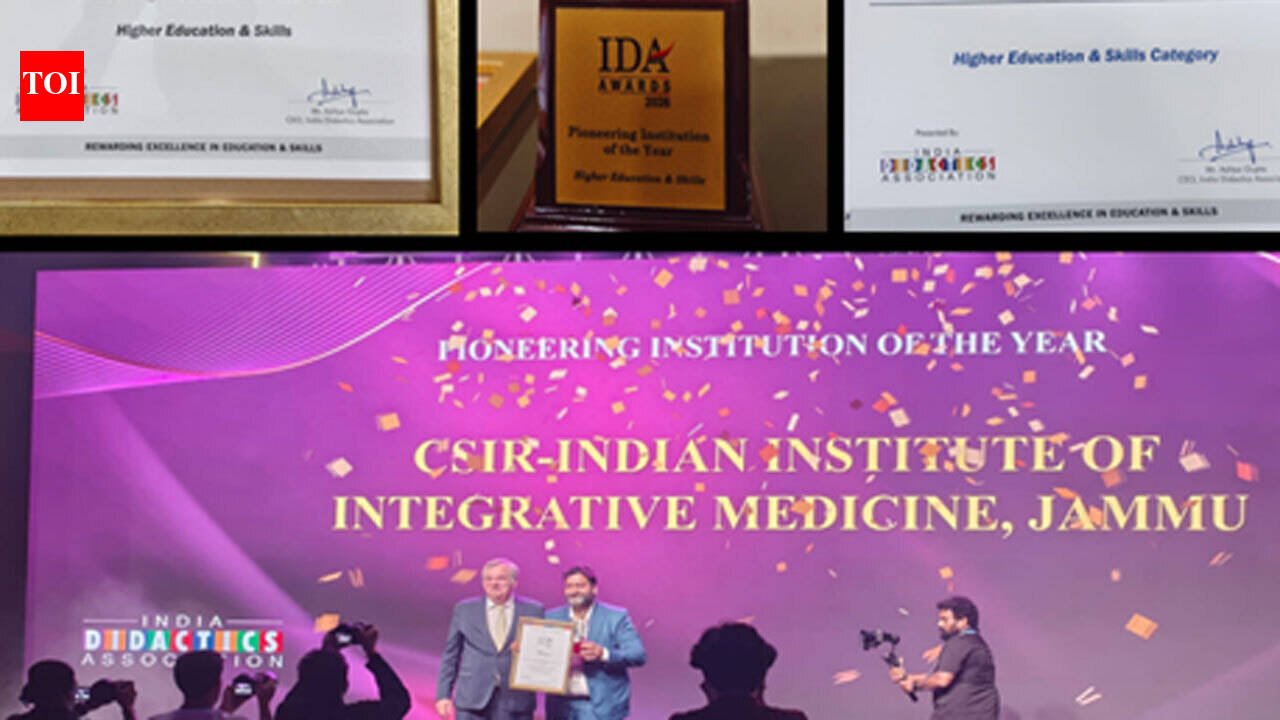
But what happens when that expertise begins to find a place beyond laboratories, in industrial workplaces and the hands of young people preparing for employment?That question is central to the work of the CSIR-Indian Institute of Integrative Medicine (CSIR-IIIM), Jammu, which has received the Pioneering Institution of the Year award in the Higher Education and Skills category at the DIDAC India Awards 2026.
The institute has also been recognised as a Torchbearer in Higher Education and Skills, placing its industry-oriented training and skill development efforts in the spotlight.Why the recognition goes beyond an institutional award The award follows multiple rounds of evaluation by the DIDAC Skills selection process and an expert jury, with CSIR-IIIM emerging as the winner among several shortlisted finalists.The recognition comes at a time when the relationship between academic knowledge and workplace requirements is receiving greater attention.
For young people entering the job market, qualifications alone may not always provide the practical exposure that employers seek.
Bridging that gap requires training that brings learners closer to the equipment, processes and expectations of actual workplaces.At CSIR-IIIM, this approach has been pursued through the CSIR Integrated Skill Initiative.
Rather than limiting training to conventional classroom instruction, the institute has been developing job-oriented programmes around industrial requirements, with an emphasis on hands-on learning, handling sophisticated equipment and industry exposure.
The objective is to make scientific education more closely aligned with employment opportunities and give participants access to skills that have relevance beyond the classroom.The people behind the institute's skilling push An important part of this effort has been the work of Dr.
Nasir-ul-Rasheed, Principal Scientist and Nodal Scientist for Skill Development at CSIR-IIIM.
His contribution has centred on expanding industry-linked training, institutional collaborations and practical learning opportunities for students.At the broader Council of Scientific and Industrial Research (CSIR) level, Dr.
Vinay Kumar, Nodal Scientist for the CSIR Integrated Skill Initiative, has been involved in coordinating and promoting the programme across CSIR laboratories.
He also congratulated the CSIR-IIIM skill development team, acknowledging its work in strengthening industry partnerships and translating the initiative's objectives into training programmes.The institute's director, Dr.
Zabeer Ahmed, has provided the institutional direction for this approach.
His emphasis has been on taking scientific research beyond laboratory boundaries and connecting it with societal requirements through industry partnerships, practical training, innovation, entrepreneurship and capacity building.This shift also reflects a broader ambition: making scientific institutions active participants in preparing young people for opportunities in industry, rather than limiting their contribution to research and academic knowledge.A wider platform for education and skills The recognition was announced during DIDAC India 2026, being held in Bengaluru from November 25 to 27.
According to the Press Information Bureau (PIB), the programme has brought together ministers and dignitaries from 19 countries, representatives of more than 500 industry partners and approximately 1,000 educational and other institutions participating in the programme and associated competitions.Join conversation Share your thoughts in the comments Be respectful · TOI community guidelines Congratulating CSIR-IIIM, Dr.
N.
Kalaiselvi, Director General of CSIR and Secretary of the Department of Scientific and Industrial Research (DSIR), appreciated Dr.
Zabeer Ahmed and the institute's team for their contribution to skill development and higher education.For CSIR-IIIM, the award marks recognition of an approach that seeks to connect scientific expertise with practical capabilities.
Its significance, however, will ultimately extend beyond the ceremony.
The more important measure will be whether the training opportunities created through such initiatives continue to help young people acquire relevant skills, find employment and participate in the region's economic development.For a research institution, that represents another way of taking science out of the laboratory and making it useful in everyday life.