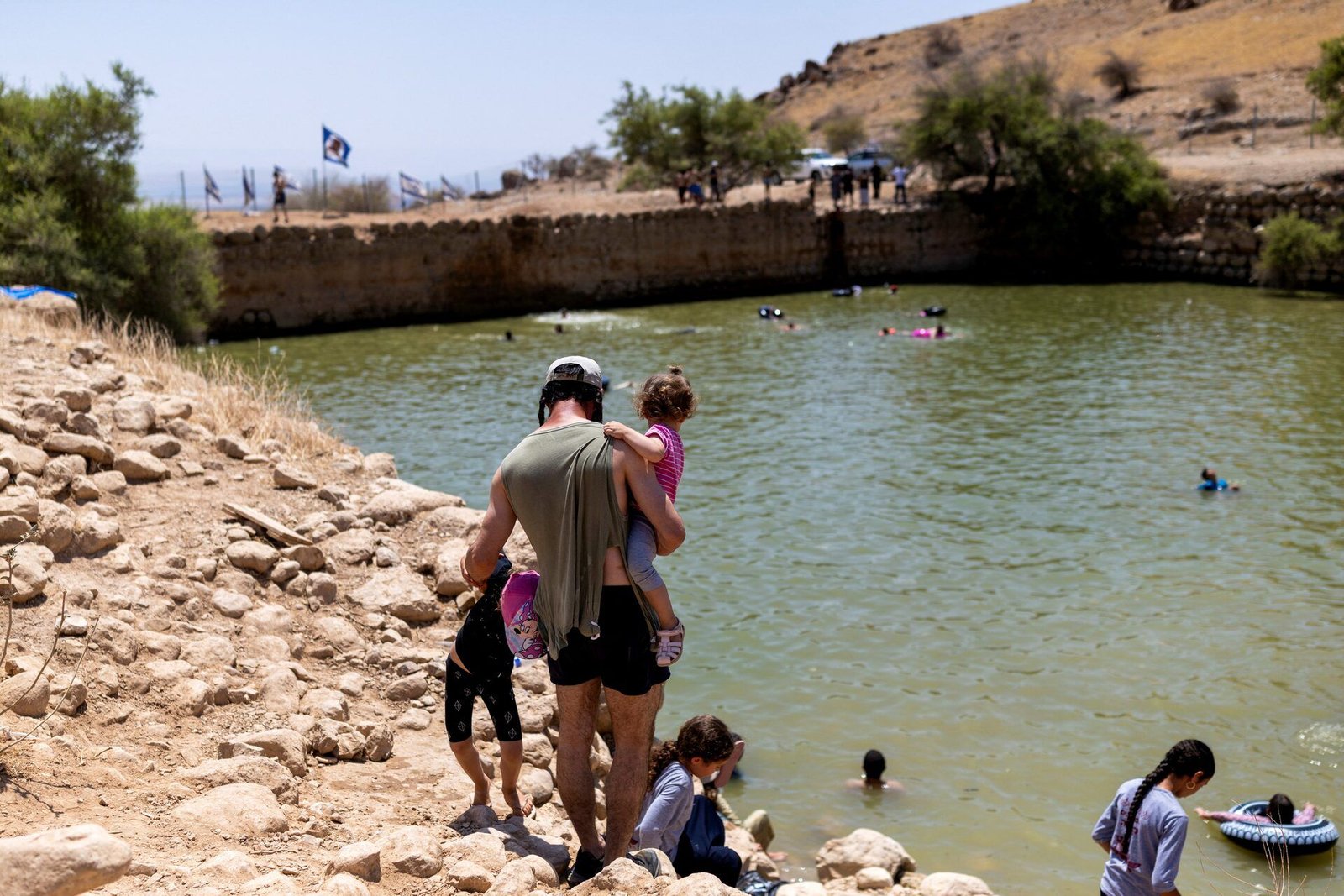
Israeli settlers swim in an ancient water reservoir in the occupied West Bank [File: Ronen Zvulun/Reuters] By Al Jazeera Staff Published On 5 Oct 20265 Oct 2026 Israel says that work has begun on a development project around an outdoor pool in the occupied West Bank filled after settlers illegally diverted water from a Palestinian village over the summer.
Instead of restoring the water to the village of Fasayil, near Jericho, Israeli authorities are working to formalise what has now been termed “Herod’s Pool”, named after an ancient Jewish king.
On Sunday, Israeli Finance Minister Bezalel Smotrich, a far-right settler, announced that “development and preservation” of Herod’s Pool had commenced, connecting it to a larger project to “strengthen [Israel’s] hold” on and preserve historical sites.
“The Settlement Revolution continues!” he declared in a social media post that carried an image of workers and wheelbarrows near the site.
The announcement follows Smotrich’s June pledge of more than three million shekels (almost $1m) to develop the site, even though the pool sits on privately-owned Palestinian land belonging to a farmer.
The illegal diversion of water to the pool is part of Israel’s monopolisation of water resources in the occupied West Bank’s fertile Jordan Valley.
It also marks the latest Israeli seizure of Palestinian land in the name of archaeological heritage.
Here’s what we know about the Herod’s Pool project.
What is ‘Herod’s Pool’?
Herod’s Pool is the name Israeli settlers have given an ancient reservoir that lies in the Palestinian village of Fasayil.
It is named after Herod the Great, a Jewish king from the first century BC.
The reservoir sits next to a natural spring.
Advertisement Although settlers claim it once belonged to King Herod, archaeologists have not established when the pool was built.
Alon Arad, executive director of Emek Shaveh, an Israeli NGO that defends cultural heritage rights and monitors the political use of archaeology, told the Reuters news agency that the pool’s origins are unclear.
“We see in many cases the use of archaeology … to create this feeling that the West Bank is exclusively Jewish,” he said.
Israeli politicians and settlers have also sought greater Israeli control over “Solomon’s Pools”, three ancient reservoirs in Bethlehem governorate, which have been used by Palestinians for generations.
Palestinians say the targeting of their water sources is part of a comprehensive plan to seize the resources of the occupied West Bank and force them off their land.
Israelis at a spring near the Palestinian village of Fasayil in the occupied West Bank on August 9, 2026.
Residents say Israeli settlers diverted water from the spring, causing crops to die [Mohamad Torokman/Reuters] Who owns the pool?
The reservoir sits on land belonging to Palestinian farmer Saad Nemer and his family.
Nemer says that his grandfather purchased the property more than a century ago.
Israeli-issued documentation and older title records reviewed by Reuters support the family’s ownership claim.
Nemer said that settlers had been repeatedly redirecting water from his farm to swim in the pool.
He explained that settlers had stolen his irrigation pipeline for the task, and over time the theft had left his farmland scorched and his greenhouses empty.
Nemer also said that settlers had threatened him and beat one of his employees.
The Israeli military body that administers the occupied West Bank, COGAT, has acknowledged that the water was diverted “without authorisation” and said it would investigate, even as Smotrich and other Israeli politicians celebrate the pool.
Nemer told The New York Times that he had been informed by COGAT that his water would be restored, but said it returned for only one day before being cut off again.
He is now fearful of approaching the reservoir to reconnect his pipeline due to settler violence.
Saad Nemer visits his arid farm in the Palestinian village of Fasayil in the Israeli-occupied West Bank, August 9, 2026 [Mohamad Torokman/Reuters] How have Israeli settlers invoked Herod?
While there is no proven link to Herod, the name features prominently in Israeli heritage projects across the occupied West Bank, which Israel refers to as “Judea and Samaria” in an attempt to separate it from its Palestinian population.
Advertisement Critics, including archaeological rights groups, say such projects are increasingly being used to extend Israeli control over Palestinian land and heritage sites.
There is Herodium, a sprawling hilltop structure south of Jerusalem, said to be the ruins of a fortress the king erected.
It has been under Israeli control for decades and operates as a national park, despite Palestinian protests that it is part of their heritage.
In Sebastia – ancient Samaria – Israel has dedicated large amounts of funding since 2023 to excavate the city’s archaeological park and develop it as an Israeli “national park“, usurping Palestinians who have long showcased the archaeological ruins as part of their history.
Israeli Minister of Heritage Amichai Eliyahu, who himself lives in an illegal West Bank settlement, has said it would be “first and foremost a Jewish heritage site”.
His office cited excavation of “the magnificent Roman city built by King Herod” when describing the archaeological periods the project intends to expose.
The Ibrahimi Mosque in Hebron – where Israel has repeatedly restricted Muslim access – stands on land considered to be Prophet Abraham’s burial place by Muslims and Jews.
Part of it is believed to have been built during the Herodian era.
In 2017, UNESCO recognised Hebron’s Old City as a Palestinian heritage site, and warned that it was endangered by Israeli settler encroachments.
Ahead of UNESCO’s decision, prominent Hebron settler Yishai Fleisher – who has served as an adviser to Israeli National Security Minister Itamar Ben-Gvir – objected to the designation on the grounds that it was “built by a Jewish king”, referring to Herod.