What does the notification say?
The Delhi government has notified a permanent set of winter pollution rules that will be in force from November 1 to February 28 every year, dated June 23 and made public in the first week of July.
Unlike the ad hoc orders issued each winter so far, these rules stand automatically, year after year, without a fresh notification.
It’s the purported ‘permanence’ of the mechanism, as Chief Minister Rekha Gupta framed it, that lends novelty to this government attempt at tackling Delhi’s annual winter blight.
Delhi govt. notifies ‘Proactive Winter Air Quality Management Framework’ The core prohibitions run through the peak-pollution window.
From November 1 to January 31, motor vehicles registered outside Delhi that fall below BS-VI standards are barred from the city, except CNG and electric vehicles and emergency services.
The same period brings a ban on dust-generating demolition and outdoor civil construction, sparing essential public infrastructure; finishing, plumbing and electrical work may continue within the site under existing dust-control norms.
A tighter window will take hold between 10 December and 20 January – treated as the severe stretch – when construction and demolition are expected to stop almost entirely, save urgent government projects and emergencies.
204 of 238 Indian cities did not meet air quality standards: CREA Which are the most significant measures?
Two provisions are the most ambitious.
The first is on fuel.
Throughout the year — not only in winter — every petrol, diesel and CNG/LPG outlet in Delhi may dispense fuel only to vehicles carrying a valid Pollution Under Control Certificate (PUCC).
Vehicles caught without one, whether flagged by automatic number-plate recognition (ANPR) cameras or otherwise, are to be penalised.
This turns the fuel pump into an enforcement point and makes the PUCC, long treated as a formality, a condition for refuelling.
The second is offices.
From November 1 to January 31, government and private offices must mandatorily run at 50% work-from-home.
The exemptions are narrow and functional: hospitals and healthcare establishments, fire services, prisons, public transport, and electricity, water, sanitation and allied municipal services.
Alongside these, parking charges at authorised sites double to discourage private vehicle use, with Delhi Metro Rail Corporation lots left out.
Delhi govt. announces ₹8,300-crore clean air plan How does this sit with GRAP, and which one takes precedence?
The Graded Response Action Plan (GRAP) is a separate, emergency instrument.
It is a stage-wise set of curbs invoked by the Commission for Air Quality Management (CAQM) in the National Capital Region and Adjoining Areas, tightened or eased according to the air-quality forecast at a given moment.
The two are designed to complement.
The Delhi winter rules kick in automatically on November 1 and run to February 28, irrespective of GRAP and serve as a kind of baseline.
GRAP sits above that floor: the winter framework operates alongside GRAP, with the stricter GRAP measures prevailing whenever they are invoked.
The notification is explicit that the Delhi government remains bound by CAQM directions issued from time to time.
So where the two differ, the tougher central measure governs.
Scheme to speed up adoption of cleaner transport in Delhi-NCR gets Cabinet nod How bad is Delhi’s air, and what have the analyses found over the years?
According to the Grant Thornton Bharat report Delhi–NCR air quality: A data-driven point of view, the city’s pollution is no longer episodic or seasonal but structural and persistent.
The report identifies an inflection between 2009 and 2011: before 2010, air quality showed real gains after public transport was converted to CNG and polluting industries were relocated, and dispersion could still “reset” pollution between winters.
After 2011 that recovery faded — days rated “Poor”, “Very Poor” and “Severe” climbed sharply after 2014.
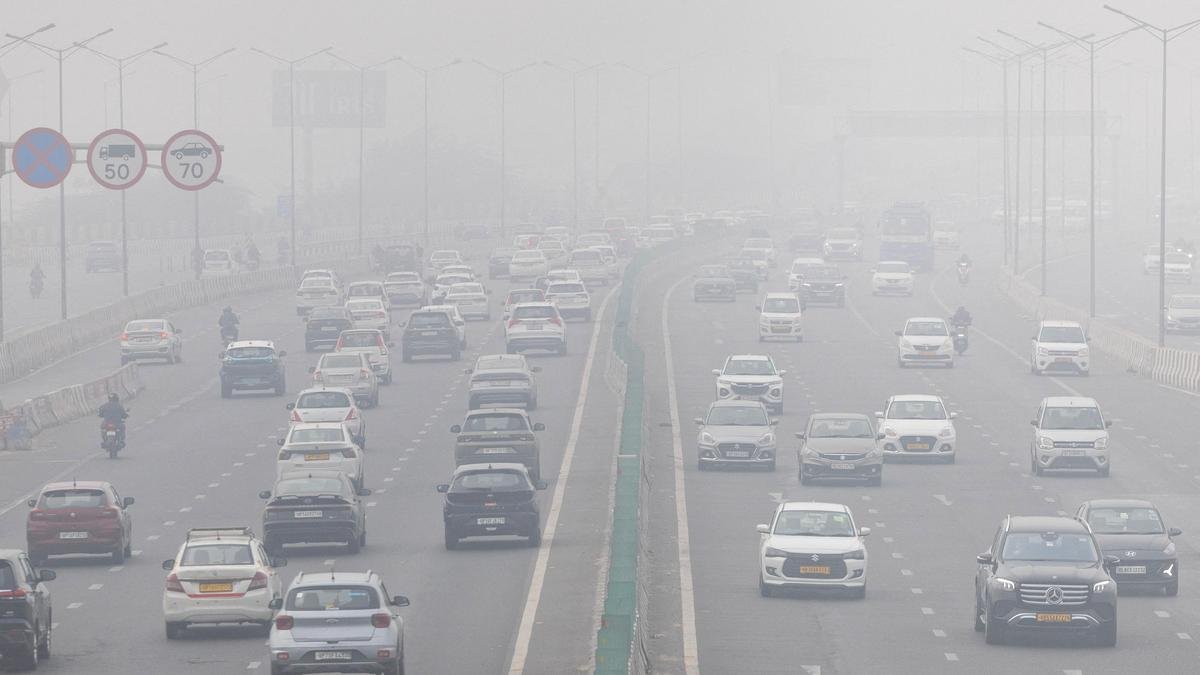
By the report’s account, Delhi now routinely sees 30 to 40 days of “Very Poor” or “Severe” air between November and January, with December the most consistently polluted month, and the high-pollution window opening earlier, in October, and running deeper into January.
In 2025, only 0.84% of the year’s days fell within WHO’s safe limits.
Delhi’s annual average AQI stood at 191 in 2025, which the CAQM plan aims to bring down to 177, a targeted 15% reduction against the previous five-year average.
Nov.
1-Feb.
28 annual curbs in place to check Delhi pollution What do source apportionment studies say is driving it?
The most consequential finding concerns composition.
Drawing on the real-time source apportionment work submitted to the Delhi Pollution Control Committee by IIT Kanpur, IIT Delhi, TERI and Airshed (Winter Season Report, 2023), the Grant Thornton report notes that secondary inorganic aerosols — formed in the atmosphere from precursor gases such as nitrogen oxides, sulphur dioxide and ammonia — now account for roughly 30–35% of winter PM2.5.
Crucially, as much as 80–85% of that secondary-aerosol formation in winter traces to sources beyond Delhi’s boundaries, carried in on regional winds.
After secondary aerosols come transport emissions, biomass and stubble burning, road dust, construction, industry, coal and fly ash, waste burning, residential fuel use and emissions from neighbouring NCR regions.
The operative point is that no single source dominates enough to be a silver bullet.
Freight is one strand of this: the A-PAG, IIT Delhi and TERI study Towards Cleaner Freight in Delhi (June 2026) assesses interstate truck emissions and the mitigation levers — entry bans on pre-BS-VI trucks, ANPR and payload-sensor enforcement, and a shift to electric trucks — that sit directly behind the notification’s out-of-Delhi vehicle ban.
Delhi Cabinet approves new EV policy with a ₹15,000-crore budget Is the union government also acting this year?
It appears to be moving in parallel and earlier than usual.
The CAQM has pushed its own vehicular measures NCR-wide: Petrol pumps and CNG stations across the NCR must install tracking cameras, and from October 1 2026, vehicles without a valid PUCC will be refused fuel — the regional version of Delhi’s city measure.
Industrial units breaching a 50 mg/Nm³ particulate limit face enforcement from August 1 for large and medium units and October 1 for the rest, and diesel auto-rickshaws are to be phased out of every NCR district by December 31 2026.
At the ministerial level, Union Environment Minister Bhupender Yadav has directed NCR civic bodies to submit 2026 action plans with monthly and weekly monitoring, while the CAQM is constituting an expert committee on vehicular pollution.
Roughly 3,400 electric buses are already running, with the fleet expected to cross 5,000 by March.
This supports the National Clean Air Programme, revised toward a nationwide 40% reduction in particulate levels by 2026.
The Grant Thornton report adds that in December 2025 the World Bank approved nearly $600 million (about ₹5,000 crore) for clean-air programmes in Uttar Pradesh and Haryana — an acknowledgement that Delhi’s air is an airshed problem, not a city one.
What will decide whether it works?
Enforcement remains the stumbling block for attempts by the government to rein in air pollution.
Prarthana Bohra, fellow at the Council on Energy, Environment and Water (CEEW), notes that Delhi’s pollution peaks from early November to late February as local and regional sources combine with cold, still air that traps pollutants near the ground — and that CEEW estimates put the city at more than 15 “severe” AQI days in this window in each of the past three years.
The framework, is “a welcome step”, but “its success will depend on stronger compliance, regular enforcement, and continuous monitoring”, with particular attention to the open burning of waste by security staff and outdoor workers, and to giving them safe heating alternatives.