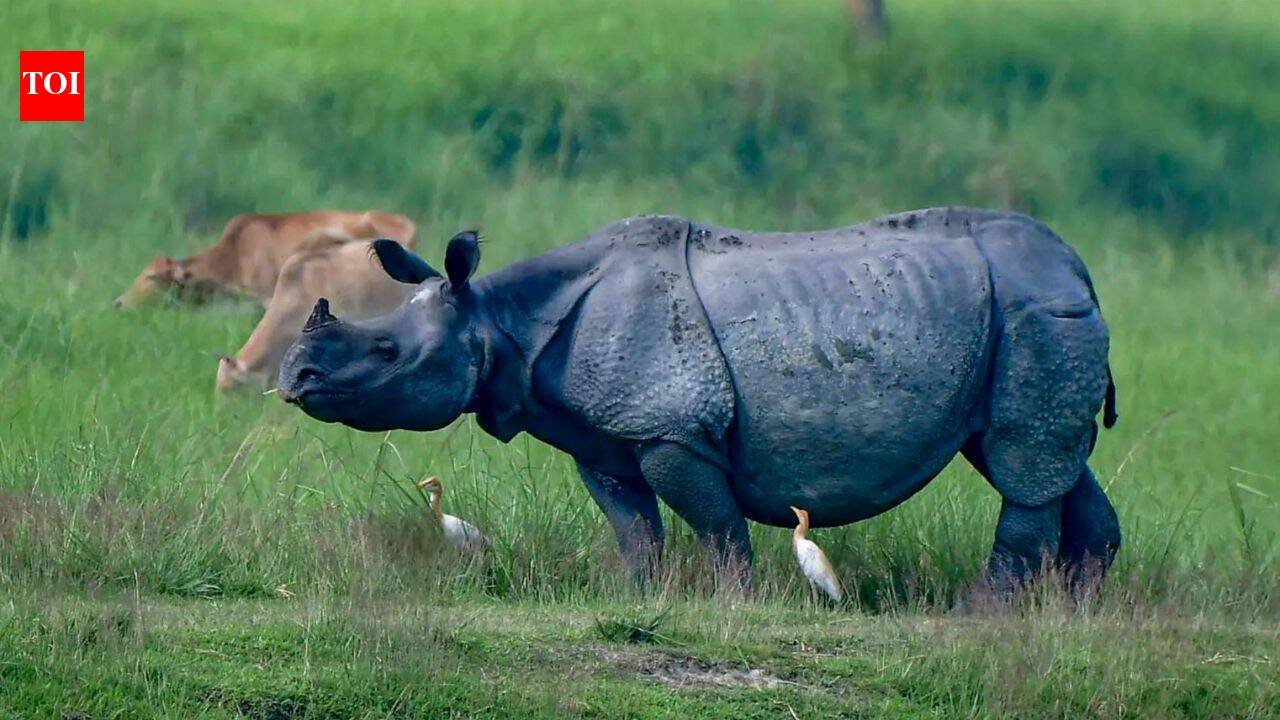
A one-horned rhinoceros grazes in the Burapahar Range of Kaziranga National Park (PTI Photo) At dawn, Kaziranga wakes to mist rising over its tall grasslands.
Elephants move through the wilderness as jeep tracks wind past marshes, while one-horned rhinos emerge from the grass.By afternoon, the landscape transforms into a trail of wildlife sightings, wild water buffalo, deer, elephants and, for visitors, glimpses of one of India's most celebrated natural habitats.But beyond the park's boundary, another debate is unfolding.
How much space should be left between Kaziranga's protected landscape and the towns, homes and businesses that surround it?The Assam government has proposed replacing the existing default 10-km eco-sensitive zone (ESZ) around Kaziranga National Park and Tiger Reserve with a site-specific ESZ extending between one and three kilometres from the park boundary.The proposal has triggered a debate over how far conservation restrictions should extend beyond a protected area and how the needs of communities living alongside Kaziranga can be balanced with wildlife protection.The state government says the proposal will ease restrictions on housing, healthcare, infrastructure and local businesses while continuing to protect Kaziranga.
It has also maintained that the move will not alter the boundary of the national park or its status as a UNESCO World Heritage Site.
The opposition and conservationists, however, have raised concerns that a narrower ESZ could weaken safeguards around an ecosystem whose ecological footprint extends beyond the park's legal boundary.What is an eco-sensitive zone?
An eco-sensitive zone (ESZ) is a regulatory buffer around protected areas such as national parks and wildlife sanctuaries.
It acts as an additional layer of protection for ecologically sensitive areas outside the protected area's boundary.ESZs are declared by the ministry of environment, forest and climate change based on proposals submitted by state governments and in accordance with the 2011 guidelines for declaring ESZs.The idea is to create a “shock absorber” around protected areas, providing a transition between areas requiring a high level of protection and those where human activity is more intensive.Importantly, an ESZ is regulatory rather than automatically prohibitive.
Activities within an ESZ are classified based on their environmental impact and may be prohibited, regulated or permitted under the applicable rules.The declaration of an ESZ does not, by itself, mean that local communities can no longer carry out activities such as farming or building houses.
The specific restrictions depend on the ESZ notification and the nature of the activity.Assam has proposed a site-specific 1–3 km ESZ around Kaziranga instead of the default 10-km zone.
Why Assam wants a smaller ESZ Chief minister Himanta Biswa Sarma has repeatedly argued that the 10-km ESZ around Kaziranga is a default arrangement, rather than a site-specific zone determined after assessing local conditions.On August 8, Sarma said the state government would submit a proposal to the Centre to reduce the ESZ from 10 km to 1 km, citing the need to facilitate development around Kaziranga, including the construction of a stadium.He later clarified that the existing 10-km ESZ would remain in force until the state's proposal is formally notified."The Supreme Court has said that around a wildlife sanctuary, the eco-sensitive zone will normally be 1 km, and if required, it can go up to three kilometres.
Until the state notifies it, the eco-sensitive zone will remain 10 km.
The moment it is notified, it will be reduced to 1 km," Sarma said.If people living around Kaziranga are displaced, who will protect Kaziranga?
CM Himanta Biswa Sarma Oriental darter birds seen at Kaziranga National Park, in Nagaon, on Tuesday. (ANI Photo) Sarma has argued that retaining a uniform 10-km buffer would bring large populated areas under the regulatory framework and restrict development.
"If we maintain 10 km all around Kaziranga, then everything in Kaliabor, Doboka, Jakhalabandha will be finished," he added."Local people have to run businesses to survive.
Even the Numaligarh Refinery will have to be closed down if the 10 km area around Kaziranga is notified as ESZ," he said.
"If people living around Kaziranga are displaced, who will protect Kaziranga?" Sarma added.The chief minister has also said residents should be able to pursue livelihood opportunities, including businesses involving GI-tagged products, while continuing to coexist with wildlife.Sarma has pointed to the geographical spread of Kaziranga and its adjoining areas, saying the park extends beyond the Kohora range towards Biswanath Ghat.A uniform 10-km zone from the park boundary, he said, could affect areas towards Gohpur and Biswanath Chariali.The government has similarly cited development requirements in Bokakhat, including a proposed modern stadium and other civic infrastructure, as examples of projects that could face restrictions under the existing arrangement."Since Kaziranga has not yet been finally notified, the default eco-sensitive zone is 10 km.
Once the notification is completed, we will propose a scientifically defined 1-km eco-sensitive zone.
That will remove unnecessary restrictions and allow us to undertake development works in Bokakhat while continuing to protect wildlife," Sarma said, according to local news reports.In June 2022, the Supreme Court directed that an ESZ of at least 1 km should be declared around protected forests, national parks and wildlife sanctuaries.The court subsequently modified aspects of that order after states and the Centre argued that a uniform approach was not practical in all areas.It also recognised that a rigid approach could create difficulties for people living around protected areas and potentially increase human-animal conflict.The one-kilometre figure, therefore, should not be understood as an automatic instruction that every protected area must have exactly a 1-km ESZ.The extent of an ESZ can vary according to local conditions.
This is the basis on which the Assam government is seeking a site-specific approach for Kaziranga.Until the proposed ESZ is formally notified, however, the existing default 10-km arrangement continues to apply, according to the state government.What is Assam government's stand?
The Assam government maintains that an eco-sensitive zone (ESZ) is not a blanket ban on construction or tourism.
While activities considered environmentally harmful, including mining and certain polluting activities, face restrictions, other development can be permitted subject to prescribed regulations.The government also argues that ESZs need not be uniform and can vary according to the ecological and developmental conditions of a particular area.
It has cited existing ESZs in Assam to support its case.Around Amchang Wildlife Sanctuary, for instance, the notified ESZ varies from 170 metres to 8.1 km from the sanctuary boundary.
Around Hollongapar Gibbon Wildlife Sanctuary, it ranges from zero kilometres along the interstate boundary with Nagaland to 22.54 km in other areas.The state says Kaziranga should similarly have a site-specific ESZ based on its ecological characteristics and the needs of surrounding communities.The ESZ debate has also become intertwined with a separate controversy over tourism infrastructure near Kaziranga.
CM Himanta Biswa Sarma has rejected allegations that the proposed reduction is aimed at facilitating a five-star hotel project near the park.“There is no connection between the hotel project and the ESZ debate.
The ESZ framework primarily restricts mining and certain polluting and environmentally damaging activities, rather than prohibiting hotels or tourism facilities.
If somebody is protesting against the hotel on the grounds that it will fall within an ESZ, they do not understand what an ESZ is,” he said.Sarma has argued that tourism is important to Kaziranga's economy and cited Jim Corbett as an example of tourism infrastructure around protected areas.However, the regulations do impose restrictions on certain tourism projects.
A 2025 Gauhati high court record concerning tourism infrastructure noted that new commercial hotels and resorts are prohibited within one kilometre of the protected-area boundary or the applicable ESZ limit, whichever is nearer.
Tourism projects beyond that distance but within the ESZ remain subject to applicable regulations and plans.Kaziranga is recognised as the world's major stronghold of the Indian one-horned rhinoceros.
A balance between wildlife and people At the heart of the Assam government's argument is the question of how conservation rules affect people living around Kaziranga.Thousands of residents live in the park's surrounding areas, with livelihoods linked to agriculture, tourism, local businesses and other economic activities.
The state government has argued that the existing 10-km arrangement can make it difficult for communities to build homes and develop basic infrastructure.That argument has also found support among some residents.
On August 18, hundreds of people from areas including Bagori and Kuthori rallied from Kuthori to Haldhibari in support of the proposed reduction.
Residents said restrictions associated with the 10-km zone had affected their everyday lives and backed a site-specific approach.They argued that communities living alongside Kaziranga should have room to build homes, pursue livelihoods and improve basic infrastructure while continuing to coexist with wildlife.The rally came a day after Assam Congress workers held a demonstration near Kaziranga opposing the proposal, underscoring the wider debate over where to draw the line between protecting a fragile ecosystem and allowing communities around it to grow.Congress raises mining concerns The Assam Congress has strongly opposed the proposed reduction.
State party president and Lok Sabha deputy leader of opposition Gaurav Gogoi led a protest at the Kohora range and demanded that the proposal be withdrawn.Gogoi alleged that the move could provide a "legal cover" for mining and weaken wildlife conservation."Rampant illegal coal, stone and sand mining patronised by the ruling dispensation has triggered catastrophic floods across upper Assam, destroying over 4,000 houses and claiming more than 100 lives," Gogoi alleged.He also claimed that deforestation and hill mining had pushed tigers and elephants towards human settlements, worsening human-animal conflict.The allegations have been rejected by the state government.
Sarma has accused the opposition of politicising the issue and argued that criticism should be based on an assessment of the proposed ESZ's likely environmental impact.Mining is particularly significant in the debate because it is among the activities subject to strict restrictions within ESZs.The Gauhati high court's March 2026 order noted that mining was prohibited within the applicable 10-km ESZ under the prevailing arrangement.Reducing the ESZ could therefore change the regulatory framework applicable to areas that currently fall within the 10-km zone.Why conservationists are concerned Kaziranga's wildlife does not always remain within the park's legal boundary.
Every year, when floodwaters rise, animals move towards higher ground outside the park.For conservationists, this makes the landscape surrounding Kaziranga an important part of the larger ecosystem.Wildlife conservationist Jadav Payeng said, "[Kaziranga National Park] is not just Assam’s pride, but it’s a world heritage site.
The proposal, if implemented, would have a drastic effect on wildlife in the national park."He said rhinos, deer and elephants leave Kaziranga during annual floods and move towards nearby higher areas for safety.According to Payeng, reducing the ESZ could restrict these movements and leave animals vulnerable.
He also questioned the need to reduce the ESZ to facilitate construction activities near the national park.Terming it as trespassing into the animal territory would be fair as reducing the eco-sensitive zone from 10 km to 1 km is disheartening to the wildlife and local community.
Environmentalist Kavita Ashok Environmentalist Kavita Ashok also raised concerns over the proposed reduction.
"Terming it as trespassing into the animal territory would be fair as reducing the eco-sensitive zone from 10 km to 1 km is disheartening to the wildlife and local community," Kavita said.“The routes will be disrupted and animals would be displaced from their terrain.
Traffic, development and maybe even construction of any sort will create imbalance in the otherwise peaceful Kaziranga zone,” she added.The concern is particularly relevant because Kaziranga is a flood-dependent ecosystem.
Annual floods replenish its wetlands and grasslands, but severe flooding can also become deadly for wildlife.More than 130 wild animals, including at least six rhinos, died during the 2024 floods, according to the conservation assessment.
The deaths included 117 hog deer, two sambar deer, a rhesus macaque and an otter.In 2017, more than 350 animals died during floods and vehicle collisions as wildlife moved through corridors towards higher ground.This makes the landscape outside Kaziranga more than just a development zone.
For animals moving out during floods, the surrounding areas can become temporary refuge and passage routes to safer ground.
Nagaon: A herd of deers graze in the Burapahar Range of Kaziranga National Park. (PTI Photo) Ecosystem that extends beyond boundary The debate is therefore not simply about whether the ESZ should be 1 km, 3 km or 10 km.
The larger question is what lies within those boundaries.Kaziranga is recognised internationally for its exceptional biodiversity.
Unesco describes the park as an important habitat for the one-horned rhinoceros and other threatened species, including wild water buffalo, swamp deer, elephants and tigers.The 2025 Conservation Outlook Assessment also highlights Kaziranga's importance for rare and endangered mammals and birds.
It describes the park as the world's major stronghold of the Indian one-horned rhinoceros and notes its significant populations of wild water buffalo, swamp deer and Bengal tigers.The assessment identifies several pressures on the landscape, including flooding, traffic along the highway bordering the park, tourism pressure, wildlife movement through corridors, invasive species, livestock grazing and human-wildlife conflict.Unplanned tourism infrastructure around the park has also raised concerns because construction can affect animal movement through wildlife corridors.This makes the exact mapping of the proposed 1–3 km ESZ critical.
A smaller zone may not necessarily mean weaker conservation if it is scientifically designed to protect the most sensitive areas.Its effectiveness, however, will depend on whether important wildlife corridors, flood escape routes, wetlands, grasslands and other ecologically sensitive areas are included in the final notified zone.The Assam government has repeatedly stressed that reducing the ESZ would not reduce the area of Kaziranga National Park.Kaziranga was inscribed on the Unesco World Heritage List in 1985.
The World Heritage property covers 42,996 hectares and is recognised for its exceptional biodiversity and its importance as a habitat for the one-horned rhinoceros.The proposed ESZ lies outside the protected-area boundary.
A change in the ESZ therefore does not, by itself, change the boundary of the national park or its World Heritage status.At the same time, Unesco has historically stressed the importance of protecting areas around Kaziranga and encouraged India to provide a legal basis to protect the buffer zone south of the park, including the Mikir Hills and Karbi Plateau.What happens next?
The Assam government has said its proposal will go through the prescribed process involving the Centre and scientific examination before a final ESZ is notified.Until then, the existing default 10-km arrangement will continue to apply.
The final notification will be crucial because it will determine not just the width of the ESZ, but also which villages, roads, development projects, wildlife corridors and ecologically sensitive areas fall within it.Join conversation Share your thoughts in the comments Be respectful · TOI community guidelines That is likely to be the real test of the proposal.For Kaziranga, the challenge is to protect a landscape that does not end at a line on a map while ensuring that communities living alongside one of India's most important national parks have space for homes, livelihoods and essential infrastructure.The debate over 1 km versus 10 km is therefore not merely about a number.
It is about finding the point where the needs of people and the movement of wildlife can coexist without one coming at the cost of the other.