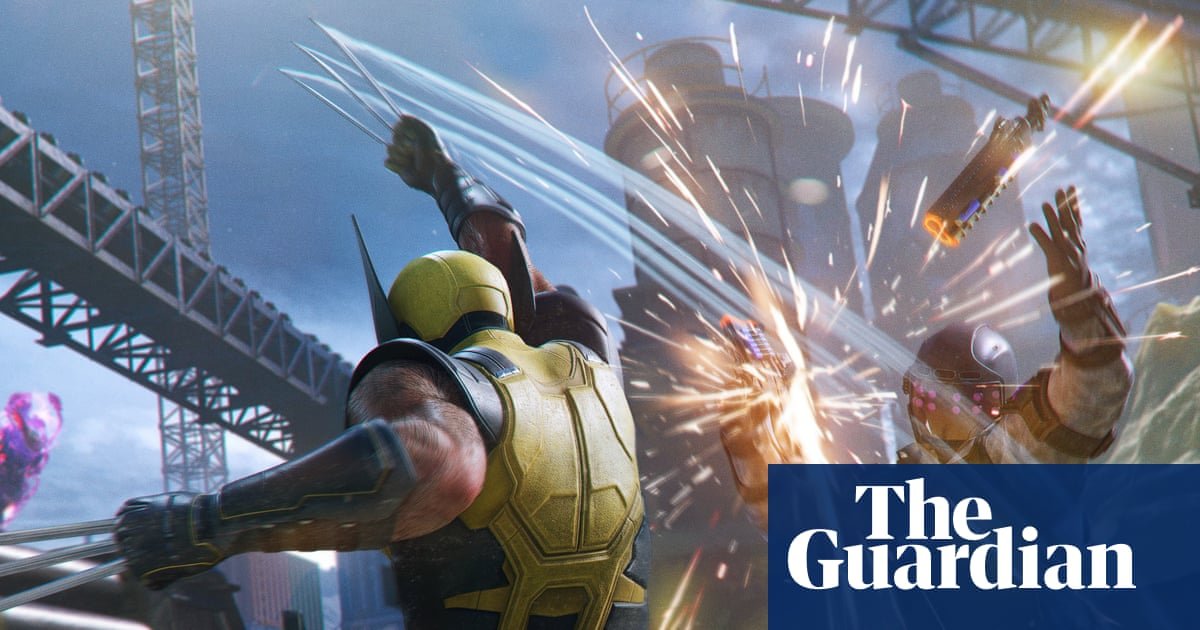
No friction … Marvel's Wolverine.
Photograph: Sony Why fans are digging their claws into Wolverine over its patronising gameplay From highlighted ledges to characters telling you what to do, blockbuster games are increasingly taking the challenge out of playing – and players are pushing back Don’t get Pushing Buttons delivered to your inbox?
Sign up here Marvel’s Wolverine, the latest action game from Sony’s stable of expensive blockbuster-factory studios, has had an unfortunate launch.
Reviews were decent, if not stellar, but a series of viral video clips from reviewers and streamers have made it the scapegoat for a patronising flavour of game design that gamers have hated for decades.
This clip, from Skill Up’s review, shows the player entering a beautiful wintry landscape before being overwhelmed by visual cues telling them what they’re supposed to be doing there.
Sonar pulses point you in the direction of objectives.
Targets – which, it bears emphasising, are shaped like targets – get an extra reflective visual effect so you know you’re supposed to pay attention to them.
A trail shows you not just where to go, but where the level’s sole hidden collectible is.
It is hand-holding to the point of parody.
Indeed, it reminded me of the sniggersome Mario in Unreal Engine satirical videos that makes the social media rounds every few months (“A mushroom?
I should take a look at this”).
Skill Up’s clip has been followed by hundreds of others, gleefully ripping into Wolverine with ironic savagery.
In one much-copied clip, a streamer simply lays down his controller during a motorbike chase sequence and watches as Wolverine speeds on regardless, bouncing off the scenery as the game plays itself.
People really detest this kind of thing.
It’s impossible to pinpoint exactly when big-budget games started assuming that players were irredeemably stupid, but throughout the late 00s and 2010s it became more and more common to see obvious GPS trails showing you where to go, and for characters to talk to themselves to remind you what to do.
At the same time, there’s been a cyclical discussion over the difficulty of games: every time a notably challenging game comes out, we rehash the same talking points about whether all games should have easy modes.
Is it acceptable for games to shut players out if they aren’t prepared to “git gud”?
I am not a game designer, but as a critic who loves challenging games and has thought a lot about them, for me there is a difference between a game’s difficulty and its friction.
A game might be difficult for all kinds of reasons, intentional or otherwise: perhaps the controls or camera aren’t great; perhaps there’s a mid-game boss with a bafflingly massive health bar and one devastating unblockable attack; perhaps the balancing is off.
But a game’s friction is always an intentional part of its design.
Friction is about how much a game helps you achieve its tasks.
Games with perfect friction are clear about showing you what to do, but not overbearing about helping you do it: there is intentional distance, distance that you must broach with agency, strategy and skill.
Friction leaves space for frustration and learning, and a sense of achievement.
‘A game is only fun if you have to do something’ … 007 First Light.
Not sure where to go?
Here – follow this brightly coloured trail of fart gas.
Not sure how to climb that building?
We’ve helpfully painted the ledges yellow.
Have you stood still for 30 seconds?
We’ll have another character talk in your ear and tell you exactly what you need to do.
Playing through the opening hours of 007 First Light recently, I was dismayed when Bond inevitably acquired a watch that magically highlights important things in his vicinity with the press of a button.
At its best, game design like this helps players avoid becoming irrevocably stuck.
At its worst, it totally removes agency and challenge – you know, the reasons that many of us play games in the first place.
Fundamentally, a game is only fun if you have to do something.
I don’t play games for passive entertainment.
That’s what binge-watching Netflix is for.
If you don’t have to invest anything to reap the rewards, the experience just washes over you.
Games can be difficult and have high friction.
In Hollow Knight: Silksong, you are constantly figuring out what to do, where the next boss might be, how to open that tantalisingly blocked path.
Achieving those goals is then also very challenging, requiring practice and mastery of whip-fast fighting and precise jumping.
Or they can be high-friction, low-difficulty: Blue Prince tells you literally nothing about how to make your way to its mansion’s secret 46th room, but it’s not difficult to walk around and try out ideas.
An example of a low-friction, high-difficulty game, meanwhile, would be a combat-focused one like Devil May Cry (or most shooters), where the aim is always “kill all the guys to open the next area” but actually killing all those guys is majorly demanding.
Low-friction, low-difficulty games hold very little interest.
Many mobile games fall into this category, where you barely have to do anything save prod the screen to provoke a dopamine-shower of flashy visual effects (I’m looking at you, Monopoly Go).
It’s unfair to lump Wolverine in with these almost entirely valueless games – but it is instructive that it has been subjected to such ridicule.
The infamously challenging Dark Souls, a dramatically influential game that turned 15 years old this week, seemed to remind the entire games industry that you can actually trust players: that they won’t drop the controller and storm off as soon as they get skewered by a skeleton.
That there’s immense and unique pleasure in participating in a game, unravelling it, conquering it little by little with skill and understanding.
I hope that the reaction to Wolverine will serve as another reminder of that fact, for any executives who need to hear it.
What to play Psychosocial dread … Silent Hill: Townfall.
The Silent Hill 2 remake was very well received (with a few exceptions, including our critic), last year’s feminist, small-town Japanese horror story Silent Hill: f was excellent, and now Silent Hill: Townfall has succeeded in sending the series to a new setting: an island off the Scottish coast.
Per our reviewer Lewis Gordon: “This is a taut, smart tale, less about psychosexual terror than psychosocial dread… Townfall seems to understand that some things should remain shrouded in fog.
The fate of St Amelia naturally festers in our imagination.
How very Silent Hill.” Available on: PS5, Xbox, PC Estimated playtime: 12-15 hours skip past newsletter promotion after newsletter promotion What to read Pikachu in spaaaaaace … a toy Pikachu floats inside the International Space Station.
Photograph: S Adenot/ESA/NASA/SWNS Pikachu is now an astronaut, thanks to a collaboration between Pokémon and the European Space Agency as part of the franchise’s seemingly endless series of 30th birthday celebrations.
Human astronaut Sophie Adenaut brought a Pikachu plush up to the International Space Station, where it spent 67 days in orbit.
According to Sonic Team boss Takashi Iizuka, Sega was once poised to kill off the whole Sonic franchise.
It was the success of 2020’s live-action Sonic movie that saved it.
“I had to fight within the organization to keep the franchise as long as possible,” he told One More Game.
The new Resident Evil movie is out, and it’s going down well.
Aftermath describes it as like watching your inept stoner roommate play the games; certified horror-game enjoyer Keith Stuart says it’s one of the best video game adaptations he’s seen.
The Tokyo Game Show had to wrap up one day early last week due to an incoming typhoon.
Gamesindustry.biz has a slightly depressing rundown of the show, which was heavily dominated by AI.
There have been yet more dramatic changes at Microsoft’s Xbox division.
The company is all but closing Halo Studios and moving Halo’s development to Activision, which will also now be in charge of storied British studio Rare.
Multi-BAFTA-winning studio Ninja Theory is starting consultations on a proposed closure, having failed to find a funding deal to return itself to independence.
What to click Silent Hill: Townfall – shame and suffering on the Scottish coast | ★★★★☆ Resident Evil – Zach Cregger’s rebooted action horror is a wild rollercoaster ride | ★★★★☆ Control Resonant – save New York from paranormal phenomena | ★★★☆☆ Roman Sands RE:Build – marooned in a crumbling vaporwave dream | ★★★☆☆ Question Block Surreally European … Clair Obscur: Expedition 33.
Photograph: Kepler Interactive Reader Mike asks: “I just finished reading your article about the GameCube, which ironically got me thinking about the PS1 & 2, marvellous machines which I remember fondly.
The game I got bundled with my PS2 was ‘Shadow of Memories’ which sticks with me to this day, the story was magnificent and also beautifully rendered, with multiple endings.
Are there any similar ‘timeywimey’ games set in beautiful European villages, evoking memories of this game, out there today?
Either on Android or PS5?” This question unearthed a bunch of half-remembered fragments from the early days of the PS2 – I definitely played Shadow of Memories as well.
It’s a Konami game about a young German travelling through time, trying to solve his own murder.
You mentioned games available on PS5, so here are a few that have some of the same elements.
The Adventures of Elliot involves travelling through different eras to prevent a catastrophe.
None of these have the same strange adventure-game atmosphere as Shadow of Memories, though – that’s something that felt really specific to the PS2 era.
Readers, have you any more suggestions for Mike?
If you have a question for Question Block – or anything else to say about the newsletter – email us at pushingbuttons@theguardian.com.
Explore more on these topicsGames Pushing Buttons newsletter Marvel features Share Reuse this content