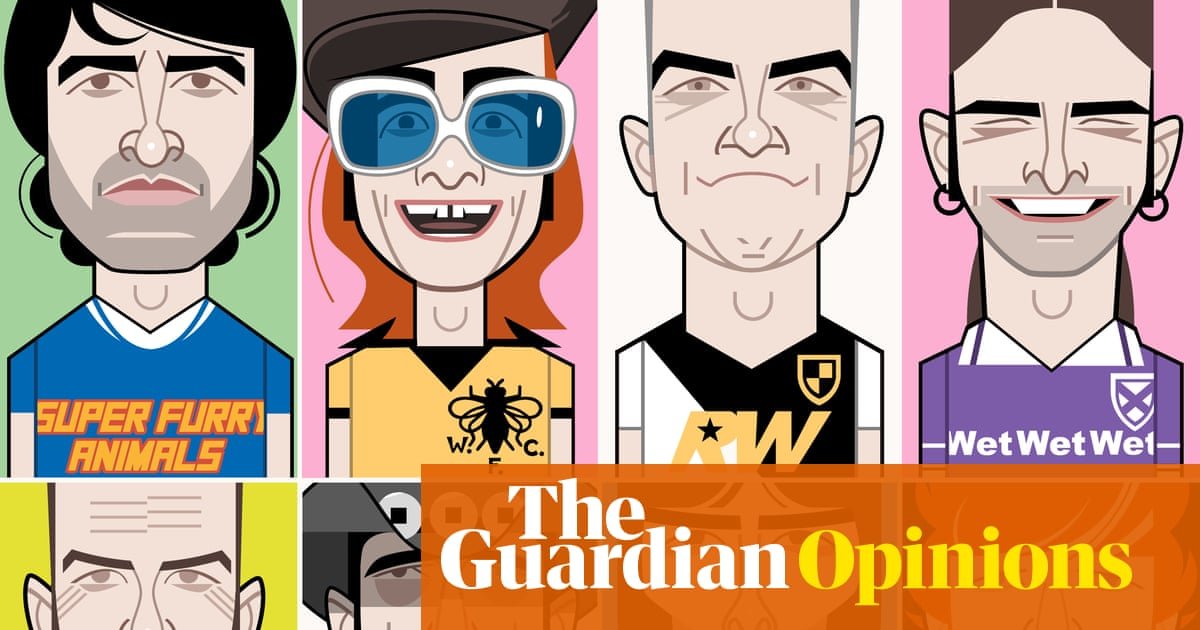
The sponsorship deal between Cwmbran Celtic and the Welsh indie-rockers is part of a trend to monetise ‘adjacent audiences’ as much as it is a nostalgia trip
As someone born on the cusp of the gen X-millennial divide, I am the perfect target for today’s 90s nostalgia. I played my modest, teenage part in the Battle of Britpop (verbal skirmisher, Blur division); I fervently sang – and, God help me, believed – that Things Can Only Get Better. Super Furry Animals were a band I knew only distantly, via the transgressive thrill of that song they had with all the swearing in. And yet the news they’ll be shirt sponsor for a Welsh football club this season has managed to whisk me straight back to a time when things seemed simpler, kinder and more hopeful.
Nearly three decades have passed since Super Furry Animals last had their logo on a football kit. Back in 1999, their frontman Gruff Rhys and bassist Guto Pryce, both Cardiff City fans, persuaded their Bangor-born bandmates to lay down their north Wales allegiances for the duration of the Bluebirds’ Welsh Cup run – which was, incidentally, all they could afford. The cup shirts cost them £2,000 and were, according to Rhys, knock-offs made for ice hockey. This year’s beneficiaries are a more modest outfit: Cwmbran Celtic, just relegated from Wales’s second tier. Cwmbran is the town where the band send their stage props for repair, and given the props in question are giant inflatable bears, you wonder whether they could get one installed in goal.
Super Furry Animals aren’t the only 90s band involved: Scottish post-rockers Mogwai have sponsored the men’s away strip, with 10% of the profits from all shirt sales going to a grassroots music charity.
There has traditionally been an element of patronage when famous musicians do football, from Elton John’s time as chair of Watford, to Robbie Williams’s 2024 elevation to Port Vale club president. The pattern is a repeating one: local lads (they’re usually lads) make good, and want to give back to the team they’ve followed since they were little. Wet Wet Wet were the first to go down the shirt-sponsorship route with Clydebank in 1993. The team’s shirts turned out to be a more timeless design than the loud, oversized suits that Marti Pellow’s crew wore the day they unveiled them.
Slapping your logo on your home side’s shirt was a charitable endeavour, rather than an investment. Nothing underscored this point better than Fatboy Slim’s relationship with Brighton & Hove Albion. The DJ’s record label first sponsored their shirts in the late 90s, back when the team’s financial straits had left them flirting with extinction, and Tony Bloom’s billions were still waiting to be won. It was particularly appropriate back then that Micky Adams’s men should run out on to the field with their chests declaring them SKINT.
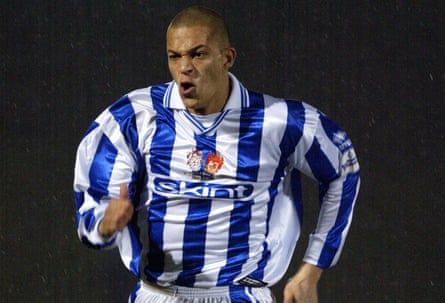
Musical match-ups have tended, therefore, towards the endearing, not the cool. Jake Bugg sponsored Notts County not to market his own music, but to evangelise the Midlands team on his global tours. And it’s even cuter when bands have sponsored kids’ teams. The late Lemmy of Motörhead was tickled by the thought of a Lincolnshire under-10s team sporting his Snaggletooth skull mascot on their fronts; unfortunately the resultant all-black kit too closely resembled referees’ uniforms and the children were banned from wearing it in league matches. Still, the idea had an enduring appeal: the Prodigy, Biffy Clyro, Sleaford Mods and Franz Ferdinand have all paid for youth kits.
In the last couple of years, though, the relationship between bands and football teams has turned serious. The move to monetise the “adjacent audiences” of pop and sporting fandom means shirt sponsorship is no longer a way of artists showing their support, but a marketing and merchandising opportunity in its own right.
Spotify’s deal with Barcelona got the ball rolling, with Coldplay, Karol G, Rosalía and Travis Scott each briefly appearing on the shirtfront, and limited-edition replicas costing more than £340 a pop. The footie-kit-as-streetwear trend means bands aren’t “sponsors” any more, they’re “collaborators”. Hence Manchester United’s pre-match shirts don’t bear the name of the Stone Roses, just their album artwork. And while that may have baffled a few younger fans – the club’s website ran a post explaining who the Madchester group were for the gen Z-ers – it still reflects a genuine connection. Ian Brown is a lifelong Red, and the team has walked out to This Is the One since Gary Neville first requested it two decades ago.
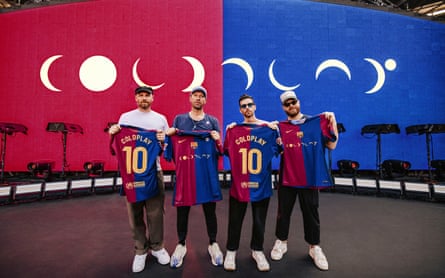
Whereas a year ago, if you’d been asked at a pub quiz what Paris Saint-Germain had in common with a K-pop band, or what Pink Floyd had to do with a Serie A team, you’d have been within your rights to say “nothing”. The answer, now, is clothing ranges – PSG teamed up with the girl group Blackpink to optimise fan engagement in Asia, while Inter marked the 50th anniversary of the album release of Wish You Were Here.
All this can be confusing for the simple-minded sports lover like me. What is a culture-forward lifestyle capsule, anyway? It sounds like something Musk and Bezos want to blast to Mars in. Creating a sporting look now involves an advanced understanding of fashion arithmetic: at last year’s Euros it was Admiral x Spice Girls, now it’s the Rolling Stones x England Cricket x Castore. These are powerful equations, as when a 2025 Bohemian FC x Fontaines DC shirt (raised to the power of Greta Thunberg when she wore it on her flotilla to Gaza) = £££££ for charity. Maybe Ed Sheeran’s Mathematics tour top for Ipswich was an omen. Or perhaps this is a fad, and the music industry will soon move on to something new. GQ, which has declared “blokecore” over, says we’ll be wearing classic rugby tops by autumn/winter. Sounds delightfully 90s to me.