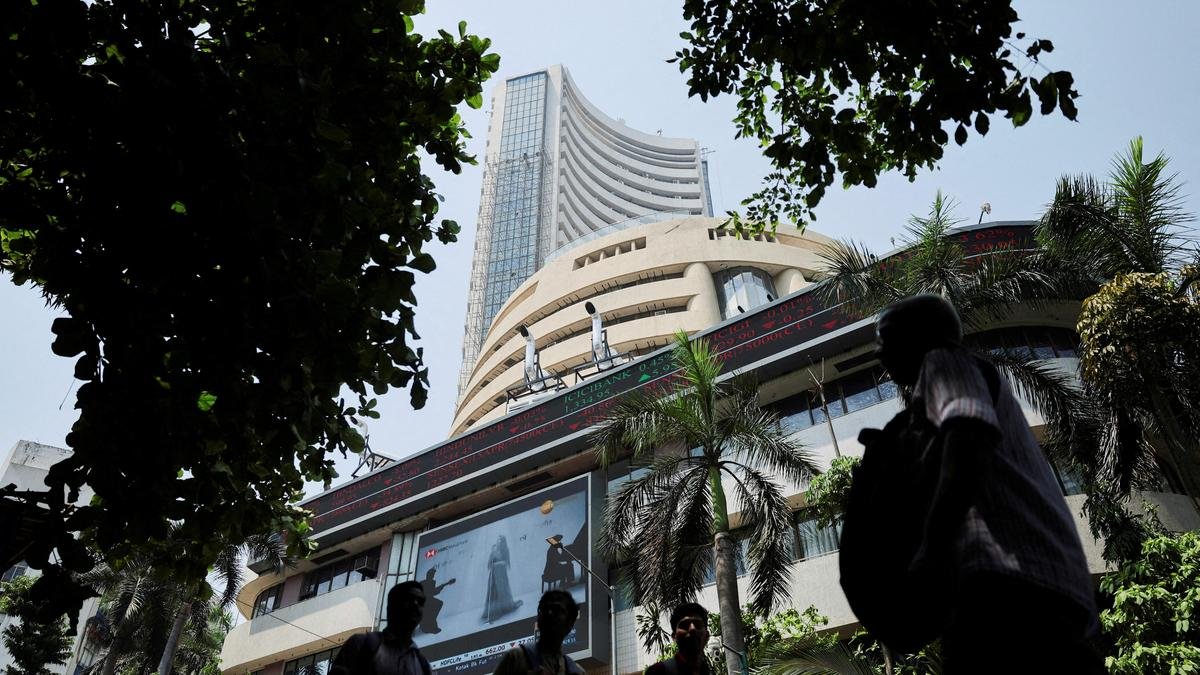
The Indian equity market's recent rally ran out of steam on Friday, with benchmark indices ending sharply lower and breaking a five-session winning streak. Selling pressure in IT stocks, weak global cues, and other concerns weighed on sentiment.
The Sensex dropped 607 points to settle at 76,802.90, while the Nifty50 fell 155 points to close at 24,013.10. The decline came after both indices had surged as much as 5% over the previous five trading sessions. Here are five key factors that could shape market sentiment in the days ahead.
1. ) US-Iran peace deal on thin ice?
Although the United States and Iran had agreed to a 60-day ceasefire to facilitate negotiations, tensions remained high after Iran's Islamic Revolutionary Guard Corps (IRGC) announced on Saturday that the Strait of Hormuz had been closed. The U.S. military, however, said commercial shipping traffic through the strategic waterway remained uninterrupted.
The developments threaten to complicate efforts to secure an interim peace agreement brokered by Pakistan and signed on Wednesday by U.S. President Donald Trump and Iranian President Masoud Pezeshkian, aimed at ending nearly four months of conflict.
Negotiators from both countries were scheduled to begin talks in Switzerland on Sunday, even as U.S. officials rejected Tehran's claims that the Strait of Hormuz had been shut.
2. ) Will oil rise again?
Brent crude prices advanced on Friday after scheduled talks between the United States and Iran in Switzerland were abruptly cancelled, highlighting ongoing uncertainty around efforts to convert a temporary agreement into a lasting peace arrangement.
Brent crude futures gained 0.9% to close at $80.57 a barrel. West Texas Intermediate futures were trading 1.23% higher at $77.54 earlier in the day. Oil prices had briefly moved lower after Israel and Iran-backed Hezbollah agreed to a ceasefire.
Switzerland's foreign ministry said the US-Iran talks planned at Bürgenstock on Friday would no longer take place.
3. ) IT selloff to continue?
IT stocks bore the brunt of Friday's selloff, with Infosys, TCS, Tech Mahindra and HCL Tech tumbling as much as 7%.
The weakness followed an 11% slide in Accenture's shares on Wall Street after the consulting giant revised its FY26 revenue growth forecast to 3-4% from its earlier guidance of 3-5%. The company also projected fourth-quarter revenue of $17.75 billion-$18.4 billion, below analysts' expectations of $18.47 billion, according to LSEG data.
The index continues to trade below its key short- and long-term moving averages, while the RSI has slipped below 40, indicating bearish momentum. Additionally, DI- has crossed above DI+ on the ADX indicator, reflecting growing seller dominance. The 27,050–27,000 zone remains a crucial support zone. Any sustainable move below this zone can lead Index extending its weakness further on the downside. The resistance is placed in the 28,250–28,300 zone.
4. ) Will rupee strengthen more?
The rupee ended almost unchanged against the US dollar on Friday after a volatile session. Gains from the unwinding of long dollar positions were offset by weakness in regional currencies and outflows linked to index rebalancing. The currency closed at 94.32 per dollar, little changed from the previous session.
Even so, the rupee registered its strongest weekly performance in 11 weeks, aided by debt inflows. It also recorded its fourth weekly gain in the last five weeks. The currency touched an intraday high of 94.21 as traders cut long dollar positions, but later gave up those gains as the dollar strengthened globally and index-related outflows weighed on sentiment.
"The recent RBI measures together with favourable oil prices following the easing of Middle East tensions helped the rupee remain in positive territory despite significant dollar strength today," Dhaval Shah, Founder and Managing Director of De-Risk Forex Consultancy, told Reuters.
According to Shah, recent price action suggests that sentiment towards the rupee has improved. "The bias for the rupee has changed and we continue to maintain our forecast of 93.50," he said.
The rupee has been trending higher since the Reserve Bank of India unveiled measures aimed at attracting dollar inflows two weeks ago.
5. ) FII turn net buyers
Foreign institutional investors turned net buyers during the week, bringing in cumulative inflows of around Rs 3,400 crore despite fluctuations in daily flows. The shift signals an improvement in overseas investor sentiment after a prolonged period of selling and provides support to domestic equities at a time when global risk appetite has improved and geopolitical tensions have eased, says Ponmudi R, CEO of Enrich Money.
Domestic institutional investors continued to provide strong support to the market, purchasing shares worth around Rs 7,100 crore during the week. Their steady buying helped cushion periods of volatility and underpinned the recent market recovery. Combined with the return of positive foreign flows, sustained institutional participation is likely to remain supportive for sentiment in the near term.
According to Sudeep Shah of SBI Securities, the broader trend in the Nifty remains positive as the index continues to trade above its 20-day and 50-day exponential moving averages. The daily RSI is at 58 and remains above its nine-day moving average, indicating that underlying momentum is still favourable despite recent consolidation.
On the downside, the 23,850-23,800 zone is expected to act as immediate support since it coincides with both the 50-day EMA and the 50% Fibonacci retracement level of the recent rally. A decisive break below 23,800 could increase selling pressure and push the index towards the next support level at 23,500.
On the upside, the 24,150-24,200 zone, which aligns with the 100-day EMA, is likely to act as an immediate resistance area. A sustained move above 24,200 could improve bullish sentiment and pave the way for a rally towards the 24,500 mark in the near term.