The difference between sportsfolk who make it and sportsfolk who don’t is not talent. Which, for those of us with none, is hard to fathom, but the reality is more people have it than we think. What separates those who succeed from those who don’t – apart, from opportunity – is mentality.
Everyone is struggling with something – a fact we do well to remember when sitting in judgment, whether on ourselves or others. More or less, whatever our particular thing is, it will relate to emotional regulation and letting big feelings manage us, instead of the other way around. Whether we’re prone to anger or sadness, excitability or apathy, recklessness or anxiety, the challenge is not to ignore those sensations – feeling feelings is good for us – but to note their arrival, process their meaning, then let them pass because everything does.
Generally speaking, these are tests imposed on us in front of a live or global audience – but it’s fun to imagine the reactions if they were! Sportsfolk, on the other hand, act out hyperreal fantasies, experiencing the very best and very worst, buzzing or gutted, gutted or buzzing, butted or guzzing, and are asked to deliver the best version of themselves before, during and after. We can understand playing brilliantly because we see it as something innate that we simply can’t do, just as those who can may not be able to do whatever it is we do on a daily. But life asks all of us to keep ourselves in check when circumstances are adverse, and, er, um, well.
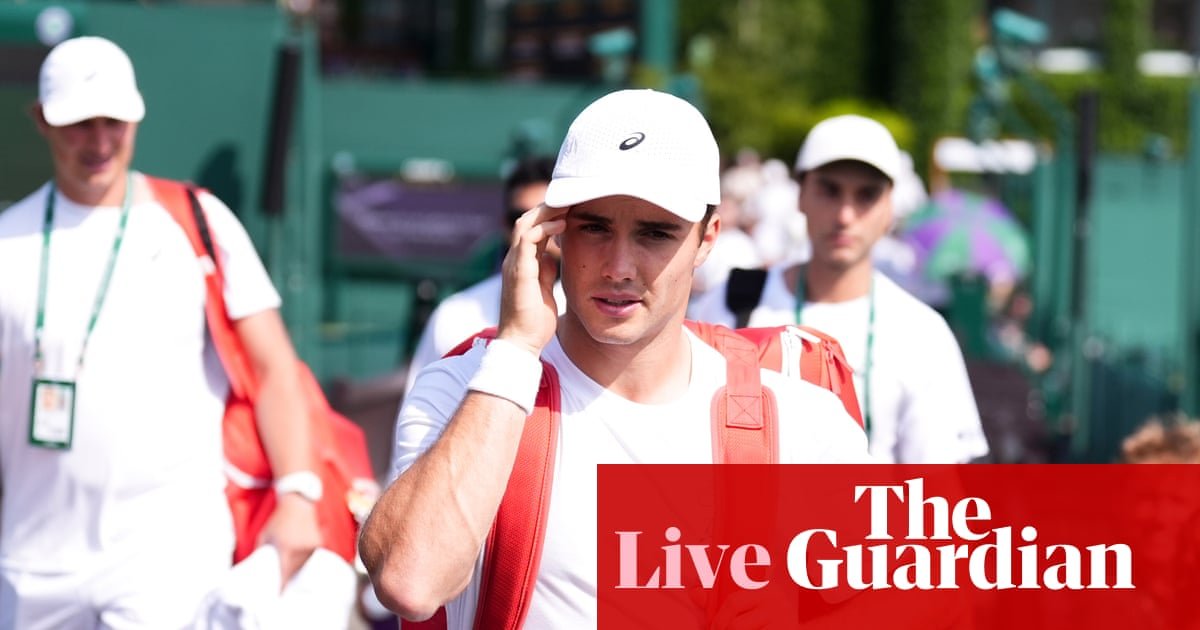
Arthur Fery is so good at this it’s almost disconcerting. His first four matches in this tournament were won from behind and in fifth-set deciders, two of which required match tiebreakers, Then, in the last eight and as Flavio Cobolli – who, just a month ago, went five sets in the French Open final – disintegrated, he again showed no sign of nerves or panic, calmly but viciously charging through the tape like it was nothing. It was not nothing.
So this afternoon, the first British wildcard to reach the semis faces Alexander Zverev and you know what? He’s got a chance. Obviously the Roland-Garros champ is the favourite – he looked ominously good in dismantling Taylor Fritz the other day – but though they’ve improved, his forehand and volleying are still weaknesses, and though, now finally a grand slam winner, he may be able to compensate with confidence, he is still not entirely comfortable on grass.
Fery, though is a natural. His backhand, in particular, is a sensational shot, one he takes so early it’s almost prehumous and which he can use to rush Zverev – who, let us not forget, remains unrenowned for equilibrium under pressure. With the crowd behind him, he’ll believe he can do anything – another feeling beyond the ambit of those of us not cut out for elite sport – and maybe, just maybe, he’ll create history.
Following them on to court we’ve Jannik Sinner and Novak Djokovic, a classic match-up of great and greatest. When the former won this title a year ago, he looked to have upped his level beyond the rest of the field, but since then, things have changed. Carlos Alcaraz beat him comfortably in the US open final, Djokovic saw him off in the Australian semi, and in Paris, his body shut down in the heat – so emphatically, he lost to the unheralded Juan Manuel Cerúndolo from two sets and 5-1 up. Never has he looked so pregnable and so pervious, the preternatural composure that defined him suddenly undermined by circumstance; the sense of trepidation once felt by his opponents might just have passed to him, a cyborg humanised.
And there is no one better placed to exploit that than Djokovic, a doubt bloodhound, fear vampire, and the greatest matchplayer in the history of sport. He’s played brilliantly to get here, the surface suits him, and he knows he may never have a better chance to make it 25. But though he’s absolutely rabid for it, ability and mentality cohabiting in perfect harmony, question still begs: will his body comply? Even the strongest mind and most celestial talent can’t stop the time.