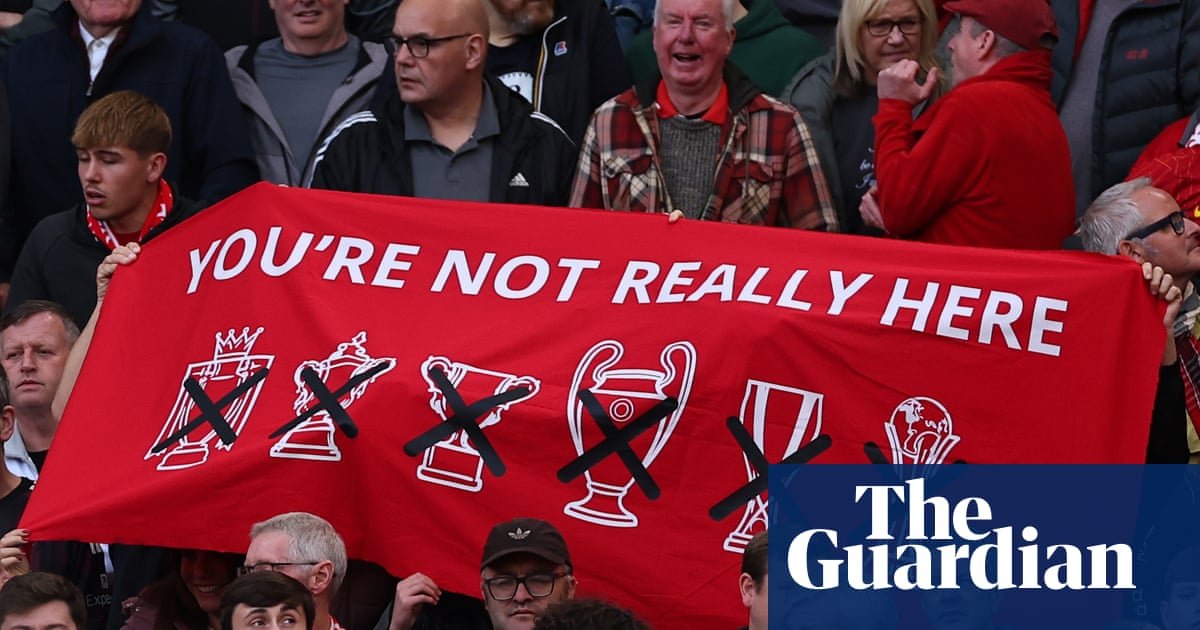
Man City’s win over Liverpool came amid off-field problems.
Composite: Guardian Design, Getty Images Man City’s win over Liverpool came amid off-field problems.
Composite: Guardian Design, Getty Images Winning is not enough for Manchester City to move on from this crisis It’s not just that the club’s recent charges themselves are unprecedented – it’s the language used to describe them too Sign up for our free newsletter here The language of football is a fine and highly nuanced dialect.
The majority of people involved in the game speak it with a high degree of sophistication.
Minor deviations from the familiar, almost imperceptible to outsiders, can set off alarm bells: what’s really going on there?
Why isn’t he happy?
What’s she hinting at?
But it’s an argot developed to talk about football, and when applied to other subjects, it can sound extremely jarring.
Erling Haaland is one of the brighter, more engaging players.
There’s an appealing quirkiness to him that suggests he has a higher-than-usual level of self-awareness.
He doesn’t mind stepping outside the norms, being a bit different.
But consider his assessment of Manchester City’s 3-0 win at Liverpool on Sunday.
“It was tough,” he said.
“It was hard but we showed amazing character from back to front.
So proud of everyone. [It’s] important to stay strong mentally, stick together and do what you can do something about, and the thing we can do something about is to play good football and fight together.
That’s the only thing we can do.” Strip away the context and he could be talking about an injury crisis, or perhaps the resignation of a manager or a suspension to a key player.
The tropes are familiar: it was hard but we stuck together and so we prevailed.
“You want to win games, it’s as simple as that,” he went on.
“Perform well, play good football and win games.
This was a mental battle, [it’s] never easy coming back from internationals.” But of course this wasn’t really about coming back from internationals; that’s not what made this difficult for City.
This was about the verdict of the independent panel looking into the charges brought against City, the fact that the club have been found guilty of the greatest act of sustained cheating in the history of English football.
Nobody knows what’s coming next.
The gravity of the situation still seems to have not dawned on many in football.
City, as is their right, continue to maintain their innocence and have appealed.
The propaganda battle goes on.
But this is no longer about whether the financial regulations were fair.
If City had objected to the regulations they had every opportunity to raise objections and vote against them.
They did not.
They agreed to the regulations, and while everybody else played to them, they did not.
The excuse that they only spent what others did but that they operated under stricter controls because of a lack of historic success is not merely irrelevant but entirely bogus: in the nine years under investigation, City’s net spending on transfers, before taking into account wages, was over £1.2bn ($1.6m), around 50% more than any other Premier League side.
And for all their talk of being proud disruptors, of rebels taking on the “red cartel”, that spending transformed City into the most dominant side English football has ever known, with six league titles in seven years.
They are, precisely, an argument for why spending controls are necessary.
None of that, of course, is Haaland’s fault.
He is a footballer offered a very competitive salary to play alongside very good players for a very good manager for a club for which his father played.
This is another of football’s absurdities: it’s always the manager and players who end up becoming the faces of the institution, being quizzed about things that have very little to do with them as the executives and directors responsible lurk away from public scrutiny.
“My message to the players since we were together three days ago, when they all came back from their national teams, has been quite clear,” Enzo Maresca said.
“Guys, the noise will always be there so it’s about how we learn to deal with the noise and it’s our duty to make our noise.
Our noise is to win games in the way we did today and to be happy.” Which on the one hand is absurd: nobody knows whether the three points City claimed at Anfield will still be theirs by Christmas.
Nobody knows what division they will be playing in next season.
Nobody knows how bad the sanction could be.
And this is not some unfortunate event that has befallen City; this is the direct consequence of the actions of their directors.
But on the other, what else can players and managers do?
How else can they respond to this situation other than by being professional and trying to win games, even if none of it ultimately means anything? skip past newsletter promotion after newsletter promotion What this is emphatically not, though, is just another football crisis from which City can move on by winning football matches.
This is a crisis unlike anything English football has ever known, and it is one with which football’s language is struggling to cope.
This is an extract from Soccer Desk, a newsletter from the Guardian US.
Subscribe for free here.
Explore more on these topicsPremier League Soccer with Jonathan Wilson Manchester City Liverpool US sports newsletters Share Reuse this content