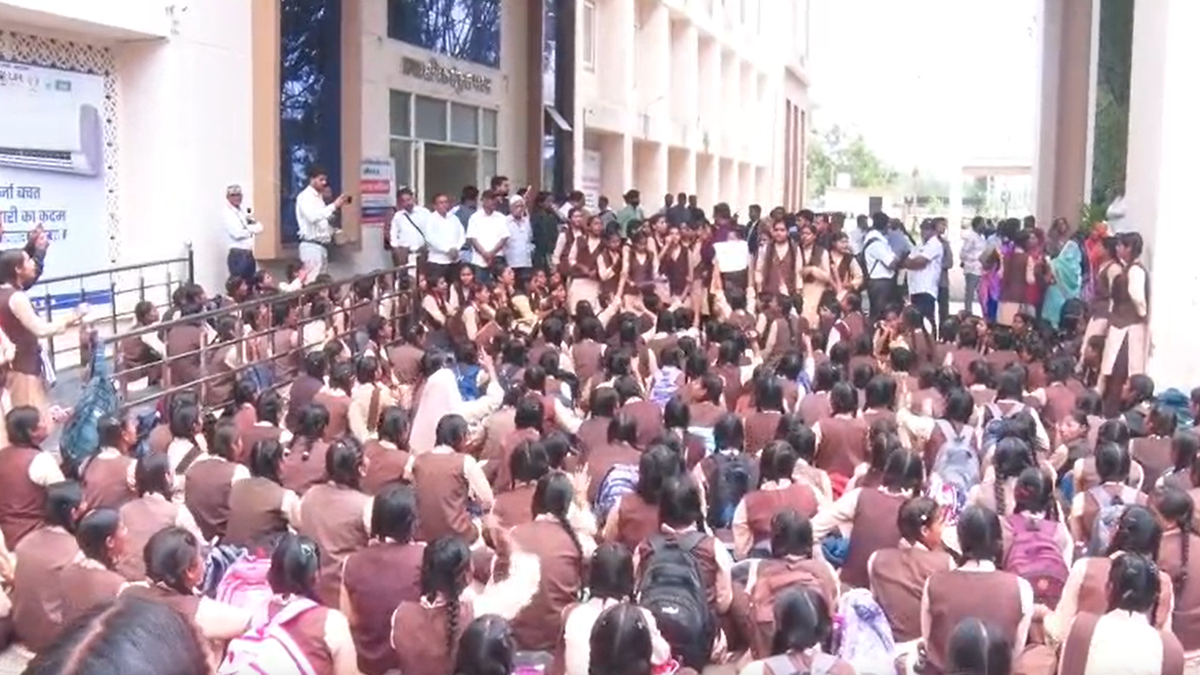
Hundreds of school girls in Madhya Pradesh’s Ujjain have come out in protest against plans to merge and shift various government schools in which they study to Daudkhedi, a location about six-10 kilometres from their respective schools, and out of the city limits.
On Friday (August 14, 2026), more than 300 girls of an all-girls school from the Sarafa area of Ujjain, accompanied by parents and activists, staged a demonstration at the Collector’s office against the government’s plans, while raising concerns for their safety and commute, as several students hail from nearby rural pockets. While students wearing their school uniforms staged a sit-in and raised slogans for nearly two hours, many were also seen breaking into tears and making emotional appeals to the authorities. Two girls also fainted during the protests, the protestors said.
Parliamentary panel flags nearly 73% students drop out before finishing higher secondary
At least six middle and secondary schools from areas including Sarafa, Mahakal Maidan, Maharajwada, and Jaisinghpura are likely to be impacted under the State government’s ongoing measures to merge smaller schools into larger schools, such as the Sandipani schools, earlier known as the flagship CM Rise schools.
Hyperpolitics: CJP protests and its aftermath
Activists involved with the protests claim the six schools are proposed to be merged with the Sandipani Vidyalaya, built in Daudkhedi, and that the move is likely to impact more than 2,500 students.
The students also appeared to be taking inspiration from the Gen Z protests that stormed the national capital of New Delhi in July, and ended with the resignation of the then Union Education Minister Dharmendra Pradhan.
Shikha (name changed to protect identity), a student, said that many girls already travel about 8-10 km and that their parents were concerned about travelling further away now.
“The way Gen Z protested in Delhi and the government had to bend before them, we will also carry out a movement here and will give up food and water if it comes to that. We just want education, which is our right. They started the scheme ‘Beti Bachao Beti Padhao’, but how will the daughter go so far when her parents are labourers?” Ms. Shikha said.
She also alleged that they had written to the Collector requesting him to meet the students but “only lower-level officials were coming”.
Nutan (name changed to protect identity), another student, spoke of distances and safety issues. “We don’t want to go to Daudkhedi. Our current school is on the main road and many of us come from very far-away villages. If we go there (Daudkhedi), which is very far, who will take responsibility for our safety? Two girls fainted here because we have not eaten anything since morning,” Ms. Nutan said.
“Some of us are not well. We have not eaten anything since morning but nobody is listening to us here. Have some shame,” a girl who broke down in tears during the protests said. A teacher also appeared emotional while trying to console the girl.
Following a meeting with parents and activists, Ujjain District Education Officer Mahendra Khatri said that the decision to shift the schools has not yet been taken, and that the final decision would be taken by the district-level monitoring committee, which is expected to meet next week.
“We have forwarded the note sheet from our side. The meeting should take place by Wednesday (August 19, 2026). During the meeting, the representatives of the students will be informed [about the proposal] and they can put forth their views,” Mr. Khatri said, adding that the Sarafa school would continue to function from its current location till a decision is taken.
Jitendra Sengar, an activist with the School Bachao Sangharsh Samiti that is backing the student protests, said students from various schools facing the impact have staged demonstrations against the move in July, and written applications had been given to authorities four times.
“We have no problem with new Sandipani schools. But if you shut down all schools within a 15-km radius, and only run one, it is a violation of the Right to Education Act. While the children of the rich, politicians, and senior officials will study in the city, it is the students from poor backgrounds who will be impacted by this move,” Mr. Sengar said.
“Parents of many of these students are labourers and the increased distance will hamper their earnings too, as several parents will have to drop their kids to school,” he said, claiming that all six schools were established before 1960.
As per a recent government order, 11 schools of the district, of which six are in urban areas, are proposed to be merged and shifted to Daudkhedi, Mr. Sengar said.
Mr. Khatri denied that the students had already submitted their written protest at least four times in the recent past. “The matter has come to my attention for the first time,” he said.