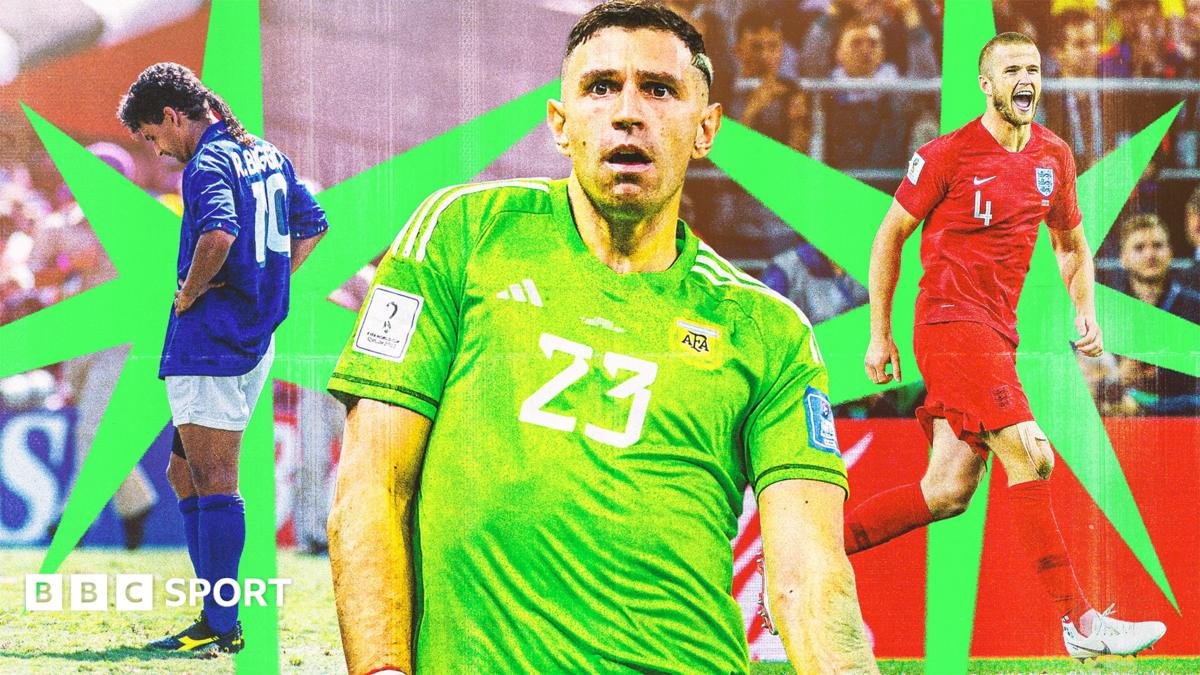
As the knockout stages begin, penalties are inevitable. What do the stats say about the best ways to take them?
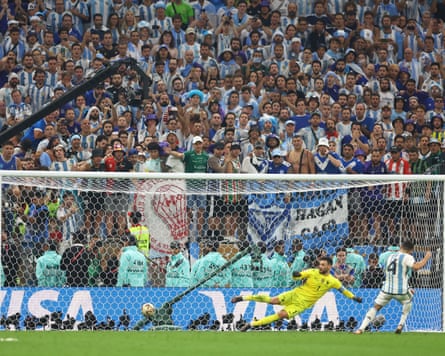
The 2022 World Cup final was a nail-biting affair, decided by a penalty shootout after Argentina and France were evenly matched with three goals apiece. Argentina subsequently won 4-2 on penalties, taking the title.
Even outside penalty shootouts, a single spot kick can easily decide the outcome of a game at a World Cup, making any advantage in taking a penalty crucial. So what can we learn about the best strategy for penalty kicks from statistics and research?
Go first, or at least win the toss
One of the best things a team can do is to win the shootout coin toss. Research based on shootouts at major competitions including the World Cup, European Championship and English domestic cups between 1970 and 2003, shows the team taking the first penalty wins 60.5% of the time. In later research which covered matches after the 2003 rule change that allowed the coin-toss winner to choose between going first or second, it was more beneficial to win the coin-toss, rather than kick first per se. About 60% of teams that won the toss were able to win the shootout, compared with a win rate of 51% for teams that shot first.
Importance of a good run-up
One of the studies with the largest sample — more than 1,700 penalties across four seasons from 2015-16 to 2018-19 — is a 2020 paper published in the International Journal of Performance Analysis in Sport.
The lead author, Mikael Jamil, and his colleagues compared the effectiveness of a wide range of techniques and other factors on penalty success across the top men’s divisions in England, Spain, Germany and Italy. One of the most interesting findings was that effective techniques actually varied depending on the country – for example, shots down the middle were statistically associated with successful penalties in the Premier League, but in La Liga, the bottom-left and bottom-right corners were the hotspots.
A long run-up (more than six steps) was associated with a successful penalty in all four leagues. In everywhere except Italy a medium run-up (two to five steps) was was also successful. Short run-ups were not a significant advantage anywhere.
Power v placement
A 2002 paper with a small sample of penalty kicks suggests, unsurprisingly, that shots with less power are more likely to be saved, shots with a lot of power are more likely to miss, and that the sweet spot is in between the two, with the authors suggesting shots at about 75% of maximum power have the highest success.
In Jamil’s 2020 paper, the authors categorised shots based on kicking action – those taken with the inside of the foot were considered to be placed, while those taken with the instep were considered to be powerful shots. Both types were associated with successful penalties in Spain, Italy and Germany, but in England only placement was significantly associated with success.
Again we see different approaches in different countries: placement preferred in the Premier League and Serie A, power in La Liga and the Bundesliga. Panenka-style chips were not favoured or significantly successful anywhere.
Shot position
Several papers have looked at the area of the goal targeted by the penalty taker to try to determine if there is an optimal strategy. Researchers divided the goals into a grid, and coded where penalty kicks were aimed as well as if the shot was saved, missed, or scored.
Here, you can see the results from a 2016 study by Carlos Almeida and co-authors, published in the International Journal of Performance Analysis in Sport:
The results from Almeida’s paper, and others, confirm what many footballers (and fans) know – there is a trade-off between risk and reward when it comes to shot placement.
Simply put, shots towards the upper section of the goal are much harder to save, but are more likely to miss. And, even though shots aimed high are harder to save, it is much more common for players to go low. Analysts suggest that this is because many players would prefer to have a shot be on target, with the risk of being it saved, rather than miss the goal entirely.
Looking back at shootouts at the 2022 World Cup bears this theory out, with very few shots aimed at the upper part of the goal.
While not the case in Almeida’s 2016 paper, other studies and statistics suggest shooting centrally can be a good strategy – but again, it may depend on the league.
A 2009 paper analysing 311 penalties from various men’s professional leagues around the world found shots down the middle were less likely to be saved than shots aimed for the corners. Premier League stats from Opta say shooting low left has a 77.2% success rate and low right 80%. But aiming high down the middle has a 97.8% success rate, and there’s a success rate of 80.2% for a low shot to the middle.
Jamil’s 2020 paper also looked at shot placement, and found shooting towards the middle of the goal was associated with successful penalties in the Premier League, but in other leagues aiming for the bottom corners was also associated with successf.
In part, the success (or not) of shot placement is down to …
Goalkeeper behaviour
Several papers also track the movement of the goalkeeper during penalties. Given the speed of penalties, it’s rarely possible for a goalkeeper to wait and react to the direction of the kick. Instead, the goalkeeper makes a guess at which way to go based on body language and their knowledge of the player’s past penalties.
However, one interesting stat shows up in several papers: goalkeepers almost always dive left or right, even though anywhere between 20% and 30% of shots go down the middle.
Various researchers suggest goalkeepers have a bias towards action – that is, they would rather be seen to be actively diving to save the ball, even if they get the direction wrong, than stay in the centre and see a ball go into the corner. There are some exceptions, such as Andrew “The Grey Wiggle” Redmayne correctly predicting a Panenka from Brendon Santalab in the 2019 A-League Men grand final, or Édouard Mendy doing the same to Brahim Díaz in January’s Africa Cup of Nations final.
Unpredictability
Even though some of these stats suggest the goalkeeper rarely stays in the middle, and shots down the middle can therefore have a decent success rate, there is an element of game theory to penalties. Goalkeepers are often briefed on, or have studied the penalty-taking habits of their opponents, and if everyone started shooting towards the centre more, goalkeepers would respond accordingly. Therefore, researchers argue one of the best strategies for a penalty taker is to be unpredictable, and for players to change their approach to spot kicks regularly.
This is an updated version of an article that was originally published in 2023