Updated on: Nov 16, 2026, 12:03:48 IST By Aryan Mudgal Prefer HTon Google Share via Copy link Three of the world’s most powerful leaders, US President Donald Trump, Chinese President Xi Jinping and Russian President Vladimir Putin, are expected to discuss major global issues as they meet in China’s Shenzhen city on Thursday, November 19, on the sidelines of the Asia-Pacific Economic Cooperation (APEC) summit, Beijing confirmed on Monday.
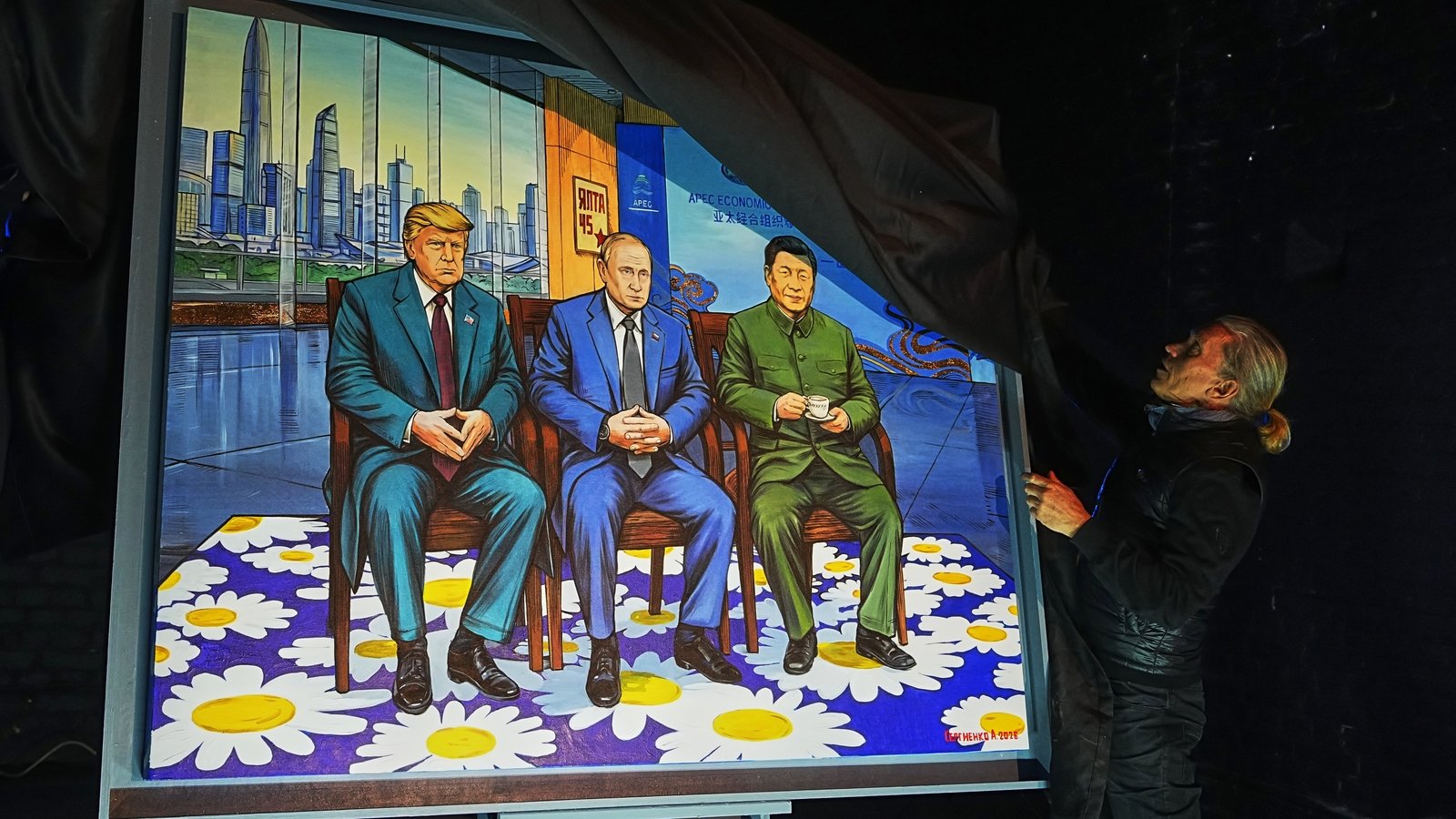
Russian artist Alexey Sergienko unveils his new painting named 'Shenzhen, 26' depicting US President Donald Trump, Russian President Vladimir Putin and China's President Xi Jinping in St.
Petersburg, Russia. (AP Photo) This would be the first trilateral meeting between Trump, Xi and Putin.
Trump will insist on a discussion on nuclear non-proliferation, White House spokesperson Olivia Wales told reporters.
The proposed meeting has drawn comparisons with the 1945 Yalta Conference, where the US, Britain and the Soviet Union agreed on spheres of influence.
The conference shaped the global order after World War Two and is often cited as an example of powerful nations making decisions that affect smaller countries without their involvement.
Yalta and the meeting of ‘great powers’ Deep Dive Powered ByAsk HT In 1945, towards the end of the Second World War, the three main Allied leaders, US President Franklin D Roosevelt, British Prime Minister Winston Churchill and Soviet leader Joseph Stalin, met in Crimea for the Yalta Conference.
They discussed plans for Europe after the war and the future of occupied Germany.
The conference laid the groundwork for Europe’s division after the war, with the continent remaining split between Soviet-controlled areas and the Western bloc for decades.
However, major changes followed within months.
Roosevelt died from a brain haemorrhage in April, and Harry Truman took over as US president.
Germany surrendered unconditionally in May.
On July 16, the US successfully tested its first nuclear bomb, developed in secret.
Less than two years later, the US announced the ‘Truman Doctrine’, which committed America to using its power to prevent the spread of Soviet influence across the world.
The Cold War began.
Trump-Xi-Putin meet is concerning nations wary of a new world order The Yalta Conference had drawn criticism since several countries were excluded from discussions that would directly impact their future.
Similar fears have emerged ahead of the proposed meeting in Shenzhen.
Ukrainian President Volodymyr Zelensky is among those who have warned against a repeat of the Yalta arrangement "We really don't want this to turn into 'Yalta 2, 3, 4,' with a redistribution of influence," he said last month.
Japan is also reportedly concerned over the prospect of the three leaders discussing global affairs without its participation.
“You’re going to have a meeting framed as three leaders settling global problems.
The Japan Times.
Japan, the report said, is worried that decisions concerning the Asia-Pacific could increasingly be shaped by China and Russia, despite Tokyo being a key ally of the US in the region.
Japanese Prime Minister Sanae Takaichi is believed to be seeking to meet Trump separately during this week's Association of Southeast Asian Nations (Asean) summit in Manila, ahead of the proposed three-way talks.
European countries are also likely to object to a China-hosted summit on the Ukraine war without representatives from Ukraine or the European Union participating.
Alicja Bachulska, Asia policy fellow at the European Council on Foreign Relations, told German broadcaster DW that discussing Ukraine in the absence of European representatives could “trigger further escalation in the already worsening relations between China and the EU”.
Taiwan, which China claims, is also among the smaller countries that feel uneasy about the idea of the big powers likely cutting a deal in private.
Taiwan will be watching the meeting closely, Wen-Ti Sung, a political scientist at Australian National University, told news agency AFP.
"If the Trump administration is open to abandoning one partner (Ukraine) out of convenience, then it can abandon another," he added.
Russia dismisses Yalta comparisons Moscow has played down suggestions that the Shenzhen meeting could resemble the Yalta Conference.
Kremlin spokesperson Dmitry Peskov said any decisions made by the three leaders could not be imposed on other countries.
“It’s clear that a meeting between the leaders of countries such as Russia, China and the United States is extremely significant,” he said.
“However, let’s not forget that the vision for a global order is that no one tries to impose any particular view of global order, and it should be based entirely on mutual benefit and mutual respect.” However, the possibility of a new arrangement involving the three powers has found support among Russian nationalists.
They see the talks as a chance for Moscow to negotiate an end to the four-year-old Ukraine war on terms that serve Russia's interests.
They also believe that the meeting itself would be significant for Russia, as it would place the country alongside China and the US in discussions on global affairs.
Russian nationalist ideologue Alexander Dugin told Radio Sputnik this week: “It shows who is important in the world: We are, China and the West,".
"It’s deeply symbolic - it’s a confirmation of a multi-polar world that the West denies.” What the meeting means for Trump, Putin and Xi For Putin, the talks could provide an opening to secure an end to the Ukraine war on terms favourable to Moscow.
Trump, whose Republican Party has suffered recent electoral losses, could use the gathering to make a mark on the global stage.
A possible step towards a three-way nuclear arms control agreement could also emerge from the discussions.
Xi, on the other hand, faces a meeting with an uncertain outcome.
Da Wei, a professor at Beijing’s Tsinghua University, told the Financial Times that China would seek to use the gathering to showcase its diplomatic influence and Xi's leadership.
According to him, Xi is unlikely to engage in detailed negotiations on Ukraine or nuclear arms control.
The meeting could also draw attention away from the APEC summit in Shenzhen, which is being attended by 21 economies across the Asia-Pacific.
With inputs from agencies ABOUT THE AUTHOR Aryan Mudgal Aryan Mudgal is a Content Producer at Hindustan Times with nearly three years of experience.
He is part of the digital news team at HT and enjoys covering day-to-day news and writing long, detailed explainers on key national and global affairs.
He takes particular interest in reading and writing about Indian politics, crime, civic issues, as well as global affairs.
He goes berserk when covering elections, especially Lok Sabha and assembly polls, and always looks out for fresh stories that could intrigue readers.
At Hindustan Times, Aryan has covered various major events, including the Bihar assembly elections, Maharashtra civic polls, the US' military action in Venezuela, Union Budget, and Bangladesh elections.
He has previously worked with the explainers team at Firstpost and the news desk at Times Network, covering a range of events including the 2024 Lok Sabha elections, Israel–Hamas war, Russia-Ukraine war, Bangladesh’s student protests and Sheikh Hasina’s ouster, Delhi assembly elections, and more.
He completed his bachelor’s degree in CEP (Communications & Media, English, and Psychology) from Christ University, Bengaluru, and later pursued a postgraduate diploma in English Journalism from the Indian Institute of Mass Communication (IIMC).
He hails from Siliguri in West Bengal and enjoys reading about politics and day-to-day issues concerning the state.