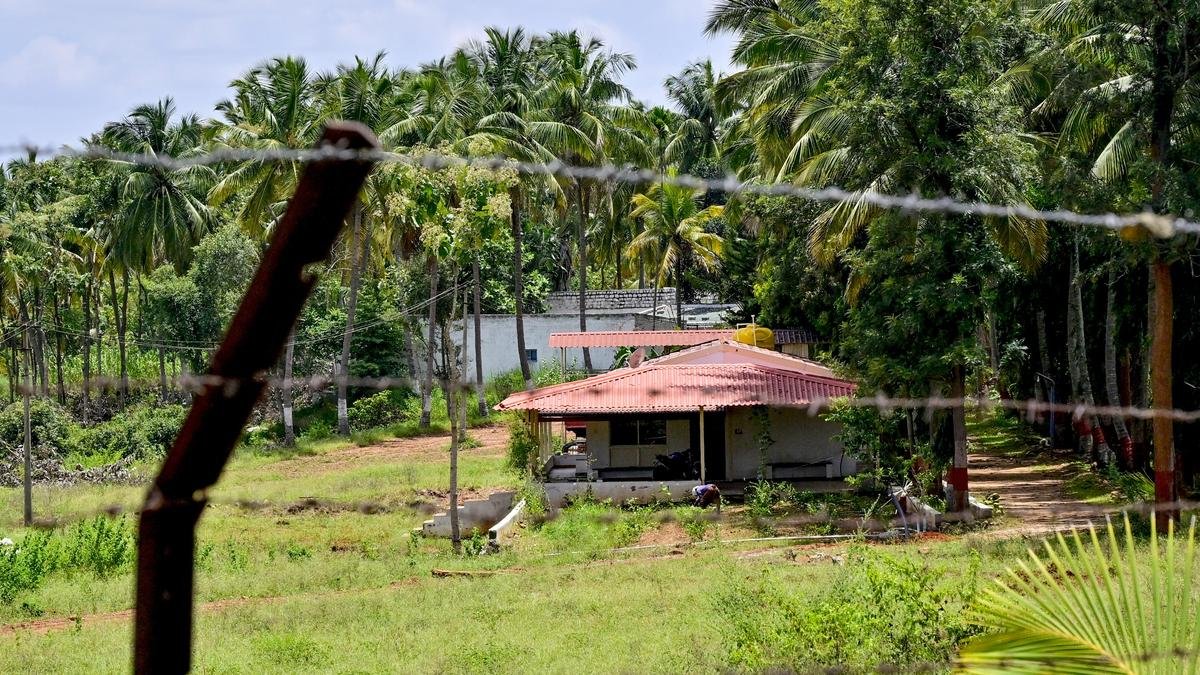
In mid-August, along the Bengaluru-Mysuru expressway, an agricultural labourer in C.K.
Tandya village in South Bengaluru district (formerly known as Ramanagara) noticed something unusual on a strip of farmland: a heap of medical waste.
This wasn’t the first time that the villagers in South Bengaluru had noticed suspicious objects or activity around the area which contained a farmhouse, say the police.
They had seen men frequently moving in and out of it on a scooter without a number plate.
They had also seen courier and e-commerce delivery vehicles making regular trips to the secluded location.
Spanning nearly eight acres and fenced by a compound wall, the farmland is situated on the outskirts of the village.
According to the police, the owners, who live in Bengaluru, seldom visited the place.
Spurious drug racket accused had shop near Minerva Circle in Bengaluru; SIT gets custody The villagers would whisper among themselves about what they suspected — until the day the labourer decided to report the dumped medical waste to the local beat police.
The officers at Taverekere police station put the farmhouse and the movements around it under surveillance, while also making inquiries about the property and its occupants.
The people they spoke to did not seem to know anything substantial.
According to an officer, the police learned that the farmhouse had been rented about a year earlier.
But what was happening inside the compound remained unclear.
Biomedical waste disposal: Govt. hospitals face challenges as companies quote high prices Days later, the police and Karnataka’s health department, in a joint operation, decided to enter the premises.
What they saw there — labels, medicine boxes, drugs, and other items associated with the preparation and packaging of medicines — changed the nature of the investigation.
They alerted senior officers, who joined hands with officers from the State Drugs Control Department and conducted a raid on August 18.
The police took four people into custody.
They discovered that the secluded farmhouse was being used as a counterfeit drug repackaging and re-labelling facility.
What began as a local’s suspicion had opened the door to a much larger pharmaceutical investigation.
According to investigators, the operation involved the procurement of low-cost, substandard, or expired pharmaceutical formulations from other States, which were then transferred into fresh vials and given counterfeit labels and packaging.
“The aim was to make the medicines appear as genuine products of established pharmaceutical companies and introduce them into the pharmaceutical supply chain,” says a police official familiar with the investigation.
During the seizure, the police recovered more than 5,600 vials of counterfeit antibiotic injections used in treating serious bacterial infections.
The total seizure was estimated at ₹4.91 crore.
They also seized ledgers, invoices, mobile phones, and other records, which provided them with details of the supply chain.
The raid at the farmhouse in C.K.
Thandya village. | Photo Credit: Special Arrangement From a farmhouse to the big city The police then moved their investigation beyond C.K.
Tandya.
A Special Investigation Team (SIT) was constituted.
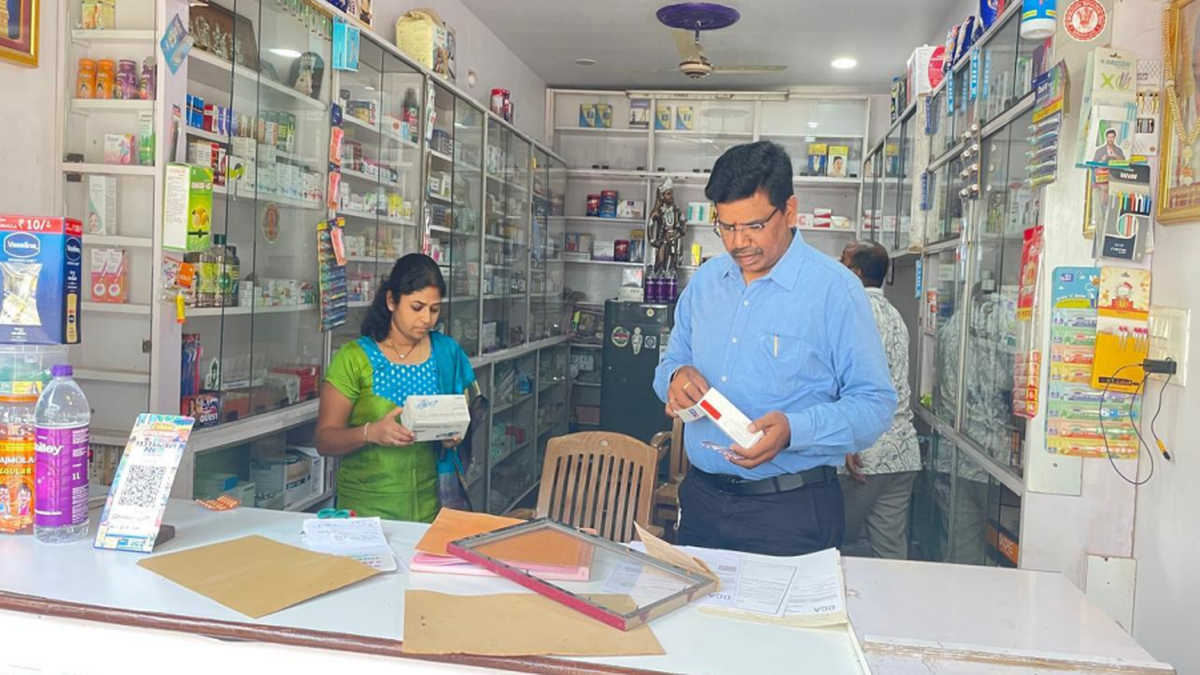
The trail led to Bengaluru and to Krupa Healthcare, a wholesale pharmaceutical distributor located on a busy commercial street in the city.
According to the police, the operators in the farmhouse supplied medicines to Krupa Healthcare, which distributed them.
The police found that the counterfeit medicines were not limited to antibiotics, but also included critical-care injections and cancer medicines.
They say some of the medicines were offered to hospitals at “discounts of up to 50%”.
Krupa Healthcare owner Veeresh Kumar Jain, who was arrested by the SIT, allegedly employed more than 15 medical representatives to promote the medicines and offered commissions to push the discounted stocks to private hospitals and medical centres.
The police then found that the alleged racket was not confined to Karnataka.
A joint force subsequently carried out simultaneous searches across Karnataka, Himachal Pradesh, Haryana, Tamil Nadu, Maharashtra, and Telangana.
The police are currently on the hunt for Bengaluru resident R.
Prashant, who they believe is a key figure in the network.
He is currently in Azerbaijan, and is Jain’s partner, say the police.
Cross-border bio-medical waste dumping: NGT asks Kerala Health Dept to furnish details on treatment capacity, waste generators Unanswered questions The families of patients are shocked and angry at these revelations.
On his WhatsApp profile picture, Maheshprasad Upadhya, 30, poses with his mother.
A cervical cancer patient, she passed away in 2024.
After hearing the news, Upadhya, a native of Odisha, cannot help second-guessing the events before his mother’s death.
She was diagnosed with cancer in 2022, he says.
For a year, she underwent chemotherapy and radiotherapy in Mumbai.
The doctors then suggested immunotherapy.
As treatment in Mumbai was expensive and there were also logistical difficulties in travelling to the city, the family decided to shift treatment to Bhubaneswar.
“The doctor we consulted referred a Bengaluru-based pharmaceutical distributor to us.
I bought a medicine from them.
It cost ₹1,65,990 per vial.
My mother needed two vials.
The distributor said if we purchase one, we would get another free,” recalls Upadhya.
He searched online and found that the manufacturer did offer such a programme.
He decided to go ahead with it.
Upadhya spent about ₹20 lakh on the overall treatment.
“But we saw no improvement in her condition,” he says.
“When she was diagnosed with cancer, the doctor had said she would live up to five years.
My mother passed away in one and a half years.” Upadhya sounds calm, but he admits within him a tumult of emotions — anger, suspicion, and helplessness.
“One person who had got his father treated at the Bhubaneswar hospital had advised us against buying this medicine from this particular distributor,” he says.
“But we didn’t listen since the doctor himself had advised it.
After my mother passed away, I started suspecting something, perhaps a nexus, but I was in no state of mind to think about it.
Now I’m questioning everything.” He confesses that there are times when he considers migrating abroad “after seeing how the corrupt try to profit from the desperation of the most vulnerable.” Parth Sharma, a resident of Gurugram, returned to India in 2017 to care for his ageing parents and mother-in-law, after spending 37 years abroad.
“The people I came here for are no more,” he says.
In October 2020, Sharma’s mother was diagnosed with myelodysplastic syndrome, a condition where the bone marrow doesn’t make enough healthy blood cells.
The doctors informed the family that the disease was not curable.
Given the patient’s age — she was in her 70s — a bone marrow transplant was also not an option, they said.
Nevertheless, treatment, including chemotherapy injections and blood transfusions, was started at a private hospital in December.
Sharma remembers that some of the expensive medicines were not available in India.
“The doctor gave us the phone number of a person and said he would help get it imported.
When you are desperate, you simply trust everyone.
So, we contacted him,” he says.
Sharma’s mother’s condition never improved.
With her body too weak to fight the disease, she passed away in May 2021.
“After the report on the counterfeit drug racket came out, I started wondering more deeply about something I had suspected all along: were the medicines even working?
We had spent a lot of money and given her the prescribed medicines.
At that point, we trusted the system and did not even suspect the possibility of fake medicines,” he says.
He still has some of the tablets, which cost him around ₹80,000.
Living in uncertainty The police say the suspect medicines have so far reached more than 90 hospitals and clinics in Karnataka and other States.
While the State government has published a list of antibiotics seized during the Bidadi raid, it has not yet disclosed the names of oncology drugs or the hospitals and clinics that may have received the medicines, or the names and batch numbers of counterfeit medicines reportedly linked to serious illnesses such as cancer.
There is pressure on the government to disclose this information.
According to the Karnataka Minister for Health and Family Welfare, U.T.
Khader, the full list of spurious and counterfeit drugs has been communicated to the Union government and all State governments.
“The SIT has taken charge of the investigation now.
Once the report is finalised, we will reveal everything.
We have got the list of hospitals.
But when the SIT is there, it is not right on my part to disclose anything,” he says.
As the SIT continues with its investigation, Upadhya wonders what patients must be going through with the information they have.
“Imagine their state of mind.
Would they want to continue or discontinue treatment when they have no way of knowing whether the medicine they are taking is genuine or counterfeit,” he asks.
Dr.
B.S Ajaikumar, radiation and medical oncologist and Founder and Chairman at HealthCare Global (HCG) Enterprises, says counterfeit drugs are a major problem in India today.
“I have been sounding the alarm on this for several years,” he says.
“Whenever somebody — say insurance companies — wants to bring drugs from outside, I don’t allow it at HCG because I’m concerned it could be spurious.
Any drug we purchase should come directly from the manufacturer.
The authorities should also lay down stringent guidelines and ensure they are enforced.
They should consult major users of oncology drugs like us, collaborate with us to develop a plan, and ensure spurious drugs don’t enter the system.” Expired medicine, products bearing forged MNC labels, injection vials worth ₹3.38 crore seized in Bengaluru Noting that cancer treatment often depends on the right drug, at the right dose, given at the right time, Dr.
Nitish Ranjan Acharya, Surgical Oncologist at Manipal Hospital, Bhubaneswar, points out that any compromise in the authenticity or quality of a medicine can directly affect a patient’s treatment.
“If a patient receives a counterfeit, substandard, or expired medicine, the drug may not work as intended.
This can delay disease control, allow the cancer to progress and, in some cases, affect the chances of achieving a good treatment response.
The impact may be particularly difficult to identify because a lack of response can sometimes be mistaken for the cancer becoming resistant to treatment,” he explains.
Acharya adds that there are more risks when the contents of the counterfeit drugs are unknown.
“A drug could contain an incorrect dose, inactive ingredients, contaminants, or substances that may cause unexpected side effects.
These risks can be especially serious for patients already receiving multiple cancer medicines,” he notes.
He also stresses the importance of appropriate storage and handling to maintain quality.
The question of accountability The alleged racket also raises questions about what hospitals should do when patients may have already been exposed to counterfeit medicines.
As S.V.
Joga Rao, a lawyer who specialises in healthcare law and ethics, says, “Given the circumstances in India, a detailed investigation may take time.
By that time, the spurious drugs may have found their way to patients.” According to him, hospitals need to work with investigating agencies to identify the medicines in question and their batch numbers.
“If there is some kind of leeway in terms of information, the hospital has an ethical duty to inform potentially affected patients,” he says.
Noting that regulatory authorities need to be mindful of Section 17B of the Drugs and Cosmetics Act, 1940, which defines a spurious drug, and Section 18, which prohibits their manufacture, sale, stocking, distribution and other related activities, Rao also points to the legal duty of hospitals to procure responsibly, verify authenticity, and detect sophisticated counterfeiting.
“If there are warning signs, they need to respond to that.
The duties of the hospitals and regulators operate concurrently, although they are different in nature.
It is a shared responsibility,” he says.
Gopal Dabade, president of Drug Action Forum, Karnataka, says, “Drug inspectors are the first line of foot soldiers, but they are not adequately equipped.
Punishment for wrongdoing is also not stringent enough.” He is a part of the All India Drug Action Network, a group of non-profits working to “increase access and improve the rational use of essential medicines”.
Another reality is the high cost of medicines, particularly cancer drugs, which can create a parallel market for cheaper counterfeit versions.
“Better access to good quality and affordable treatment is the crux of the issue,” Dabade says.
Sylvia Karpagam, a public health doctor and researcher, says people must demand an accountable public health system as part of the election mandate.
She also points to the responsibility of doctors, and questions the role they play in ensuring accountability within the healthcare system.
“Doctors who harp about ‘evidence-based practice’ in allopathy go mum when such incidents occur.
Other than for their own pay cheques and to oppose any form of regulation, one barely sees doctors protesting on behalf of patients,” she says.
She also stresses the importance of adequate budgets, trained and sufficient staff, and regular public scrutiny.
“Unless the government has an ongoing system to prevent drug rackets, and makes it known to the public through ongoing reports, these kinds of incidents will continue — some get picked up, and many don’t.” SIT head C.
Vamshikrishna says he cannot comment on the case while the investigation is on.
Repeated phone calls and messages to reach Srinivas K.
Commissioner of the Food Safety and Drug Administration, Karnataka, have not elicited any response.
This story was edited by Radhika Santhanam and Sunalini Mathew