On Wednesday, August 26, 2026, at approximately 8.44 a.m.
Nepal time, what initially appeared to be a 4.4-magnitude earthquake struck near the Nepal-China border.
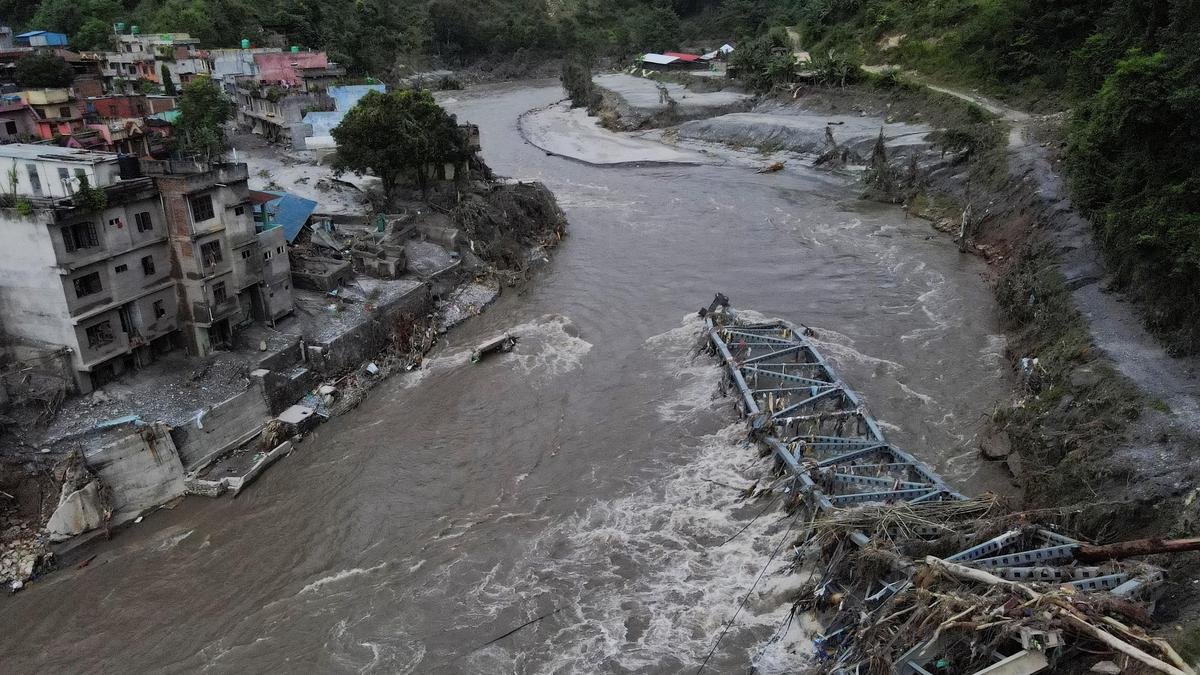
It triggered the collapse of an enormous glacial slab, which plunged a kilometre below to the valley floor, resulting in devastating flash floods.
The United States Geological Survey later confirmed that the seismic activity was, in fact, the glacial collapse itself and the landslide (later registered as equivalent to an earthquake measuring 5.2) rather than by tectonic shifts.
Preliminary estimates suggest that 579 people have perished in Nepal, with nearly 2,000 people missing, many of them believed to be foreigners.
Entire villages and towns that this writer has previously travelled through have been swept away.
Vital infrastructure, such as bridges and hydropower stations, has been completely decimated.
A staggering 475 megawatts of generating capacity has been wiped off Nepal’s electricity grid.
This may go down as the most devastating natural disaster Nepal has ever witnessed.
Nature’s fury knows no borders For Nepal and its two neighbours, India and China, which ordinarily see themselves caught up in geopolitical contestations in the country, the catastrophic force of Mother Nature is a reminder that the political dimensions of geography are relevant only insofar as nature does not intervene, unexpectedly and destructively.
The natural world does not recognise political boundaries in the same way that the custodians of nation-states do.
China and India both suffered substantial losses from Wednesday’s floods.
Human and property losses continue to mount in all three countries, including Nepal.
Related Stories Fresh glacial lakes form at source of Nepal’s ice-rock avalanche Glacier break or earthquake?
What triggered the Nepal floods? | Explained Nepal floods highlight growing glacier risks in warming Himalayas China’s Gyirong Port, the largest land trade port in the Tibet Autonomous Region and the primary gateway between Nepal and China, was designated an international-standard land port.
An upgrade in August 2017 led to its transformation, upgrading it from a bilateral crossing to a fully recognised international gateway.
Built at a cost of $175.8 million, the port and the services it provided are now effectively buried beneath heavy sediment and debris.
Access roads on the Chinese side leading to the Nepal border, as well as power supplies and local communication links, have been completely severed or severely damaged.
There are reports of fatalities on the Chinese side — a number that is almost certain to rise.
There are also reports of people missing in Tibet’s Gyirong County, including foreign nationals.
Editorial | Danger from above: On the Nepal flood The loss of human life for India is tragic, with the Ministry of External Affairs (MEA) confirming that Indian nationals are missing or untraced.
Most of them were tourists-cum-pilgrims headed to the abode of Lord Shiva at Kailash Mansarovar.
This is a route this writer has travelled on more than a few occasions.
The pilgrims would have driven from Kathmandu through the lush, rocky and distinctly narrow river valley to reach Gyirong Port, before proceeding further upwards to the majestic Tibetan Plateau.
Flood fallout for India For India, the downstream flood threats to its States have been severe, although the immediate threat from some of these events may have passed.
Floodwaters reached the Gandak, Kosi and Ganga rivers in Bihar, prompting authorities in Patna to go on maximum alert and deploy large teams, particularly to the Valmikinagar Barrage and along vulnerable embankments, to monitor alarmingly high water levels.
Riverside communities were evacuated to safer locations.
Authorities in Uttar Pradesh also went on alert, with the State’s Relief Commissioner tracking developments in real time, as overflowing rivers from Nepal naturally flow into Indian territory.
Nepal flash floods: Here are helpline numbers of Indian Embassy and state governments Border districts such as Maharajganj and Kushinagar stepped up emergency surveillance and deployed emergency personnel.
India’s National Disaster Response Force (NDRF) deployed teams across the Bihar-Uttar Pradesh border area.
New Delhi also activated an extensive Humanitarian Assistance and Disaster Relief programme.
The Indian Air Force dispatched more than 47.5 tonnes of emergency relief material to Nepal, including medical supplies, rations and tents.
A case for cooperation All of this underscores how severely this calamitous event has affected all three countries — Nepal, India and China.
The question that arises, therefore, is how to transcend some of the parochial features of geopolitics, while by no means ignoring the compulsions of realpolitik, and create a feasible framework for collaboration and coordination.
There is little doubt that Nepal, India and China will need to effectively address increasingly unpredictable cross-border natural phenomena such as the one we have just witnessed.
There is equally little doubt that such events are likely to recur in the future.
The past few days have underscored the need to find ways to compartmentalise the harder political dynamics of the China-India-Nepal relationship and create space for cooperation when confronted with events that remind us of the fickleness of nature, the fragility of human life, and the physical interconnections that inextricably link the three countries.
Bhaskar Koirala is a Nepali scholar based in New Delhi and the founder of the Nepal Institute of International and Strategic Studies, which launched the first Nepal-India-China Trilateral Track II Dialogue in 2014