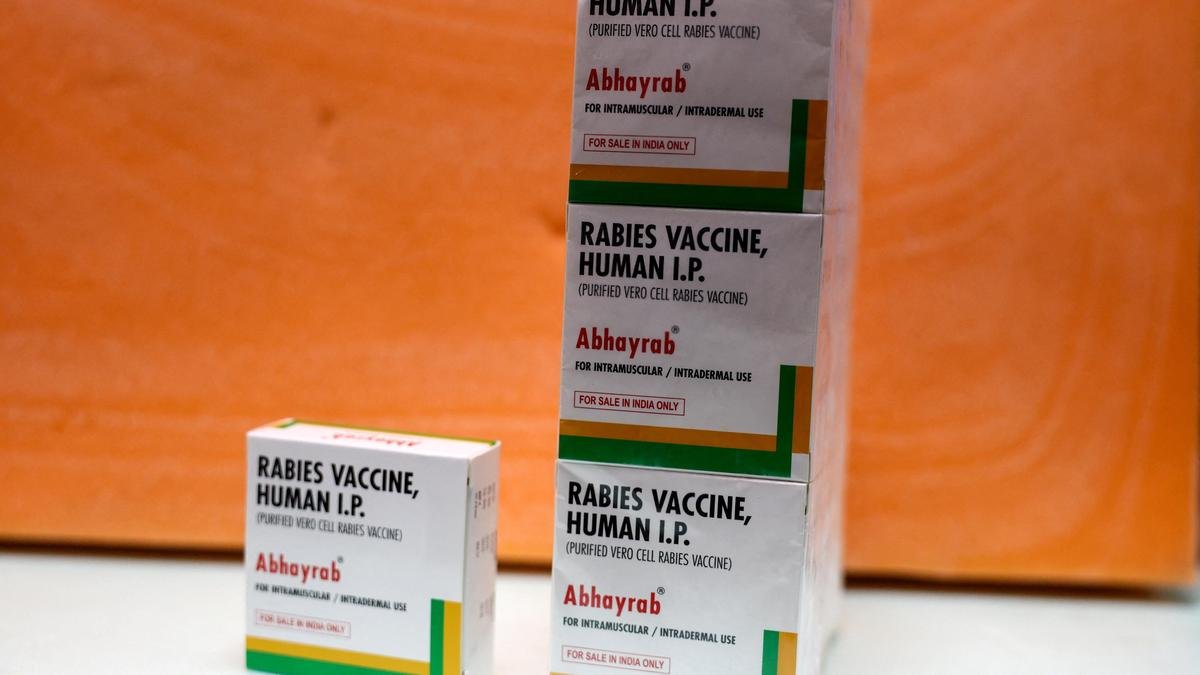
The story so far: A rabies vaccine, that could be critical in preventing a fatal infection, has failed a mandatory potency test, after vials bearing the batch number of a genuine Abhayrab consignment were seized from an unlicensed premises in Delhi.
The Central Drugs Laboratory (CDL), Kasauli, has declared the samples in question as “Not of Standard Quality” and “misbranded”, setting off an investigation into whether counterfeit vaccine was being manufactured or distributed.
Rabies is almost invariably fatal once clinical symptoms appear, while timely and quality-assured post-exposure vaccination can prevent complications and death.
The immediate concern for investigators, therefore, is not only how the questioned vials came to bear the details of a genuine vaccine batch, but whether any person bitten by a potentially rabid animal received a product that lacked the required potency.
Stray dogs at the centre of a growing social divide The samples, bearing batch number KE25012, were seized on April 22, 2026, during a joint enforcement operation by the Delhi Police Crime Branch and officials of the Delhi Drugs Control Department at an unlicensed residential premises in Mukherjee Nagar, Delhi.
Four persons have been arrested in connection with the case, according to the Central Drugs Standard Control Organisation (CDSCO).
The laboratory found that the questioned vials failed the prescribed potency test and differed from genuine reference samples in several respects.
These included packaging, labelling, artwork, QR-code verification, cap colour and licence details.
What went wrong with a rabies vaccine batch? | Explained Genuine batch or counterfeit?
Where is the investigation going?
Indian Immunologicals Ltd. (IIL), which manufactures Abhayrab through its Human Biologicals Institute (HBI), has denied manufacturing the seized vials.
In a statement issued on September 4, the company said the genuine KE25012 batch comprised 83,370 vials, underwent the required testing and was released on November 7, 2025, through its authorised distribution network.
More significantly, IIL said the CDL identified 17 differences between the questioned vials and the genuine retention samples of the same batch submitted by HBI for batch release.
Why are deaths occurring despite rabies vaccine?
Doctors stress strict adherence to prevention and treatment steps The company has submitted its manufacturing, quality-control, reconciliation and distribution records to CDSCO and has asked authorities to trace the source of the questioned vials and take action against those responsible.
The CDL finding establishes that the seized samples were NSQ and misbranded.
It does not establish that the genuine KE25012 batch manufactured by IIL was defective.
IIL’s position is that its legitimate batch passed the prescribed testing and that the batch number may have been reproduced on unauthorised material.
What are authorities investigating?
Investigators now have to establish who manufactured the questioned vials, where they were stored, how they entered circulation and whether they reached patients through any part of the legitimate or informal medicine supply chain.
A particularly important question is whether anyone was administered the suspect vaccine.
If so, authorities may have to determine the nature of the exposure, the treatment received and whether additional medical intervention is required.
The Drugs Controller General of India has asked State and Union Territory drug controllers to maintain strict vigilance over the movement, distribution and availability of Abhayrab bearing batch number KE25012 and to take appropriate regulatory action.
CDSCO has also stated that no part of the concerned genuine batch was exported to another country.
International counterfeit rabies products The case follows a suspected counterfeit Abhayrab episode involving batch KA24014 in 2025.
IIL had reported suspected counterfeit vials to authorities, following which health warnings were issued in some countries over the possibility that travellers to India could have received counterfeit rabies vaccine.
That episode highlighted the international dimension of counterfeit rabies products.
Travellers exposed to rabies may begin treatment in one country and complete their vaccination schedule elsewhere.
A falsified vaccine can therefore create a public-health concern beyond the country in which it was obtained.
In the present case, however, CDSCO has said no part of the genuine KE25012 batch was exported.
The investigation will have to establish whether the questioned vials were entirely domestic and, crucially, whether they entered patient use.
Why rabies vaccine matters?
Rabies is a viral disease that affects the central nervous system and is transmitted mainly through the saliva of infected animals, usually through bites or scratches.
Dogs account for up to 99% of human rabies transmission globally.
Once clinical symptoms appear, the disease is virtually 100% fatal.
Yet rabies is preventable.
Prompt post-exposure prophylaxis involves thorough wound washing, vaccination and, for appropriate severe exposures, rabies immunoglobulin or other recommended biologicals.
Quality-assured PEP can prevent the virus from progressing to the nervous system.
This makes the quality of a rabies vaccine particularly consequential.
For a person exposed to a potentially rabid animal, the vaccine is not routine preventive medicine; it is a time-sensitive intervention intended to prevent a disease that, once symptomatic, offers virtually no chance of survival.
India’s rabies burden India continues to bear a substantial share of the global rabies burden.
A recent ICMR-National Institute of Epidemiology estimate cited by WHO puts annual human rabies deaths in India at 5,726, alongside an estimated 9.1 million animal bites each year.
Globally, WHO estimates about 59,000 people die of rabies each year, with more than 95% of deaths occurring in Asia and Africa.
The suspected circulation of a misbranded rabies vaccine therefore raises a question that goes beyond counterfeit packaging or regulatory compliance: whether a person who believes they have received life-saving protection has actually received a vaccine capable of providing it.
What happens next?
The Union Health Ministry maintained that the immediate task is to establish the origin and distribution of the questioned KE25012 vials and determine whether any patient received them.
Authorities will also have to establish the scale of any unauthorised manufacturing or distribution network.
For IIL, the laboratory comparison, together with its manufacturing and distribution records, will help determine whether the episode concerns a manufacturing-quality failure or the unauthorised use of its product identity and batch details.
For patients and healthcare providers, the case reinforces the importance of obtaining rabies vaccines through licensed hospitals, clinics and pharmacies and reporting suspicious products to drug-control authorities.
With rabies, the margin for error is exceptionally small.
A genuine, potent vaccine administered promptly can prevent a fatal disease; a counterfeit product can create the dangerous illusion that protection has been provided.