Company behind Claude chatbot expected to attend separate Australian government hearing on AI next week
Get our new political email, free app or daily news podcast
The chief executive of Anthropic will turn down an invitation to appear at a Senate committee hearing on AI this week, in the wake of the revelation that OpenAI agents had breached Australian government websites.
However, the company will make an appearance before another committee early next week.
The chair of the Senate inquiry into AI and datacentres, Greens senator Sarah Hanson-Young, wrote to OpenAI and Anthropic last week asking for their US-based chief executives to appear before the committee on Thursday this week.
The invite came after the prime minister’s revelation that OpenAI’s agents had infiltrated systems run by the Australian Institute of Health and Welfare, Victoria’s Department of Health, the New South Wales Bureau of Crime Statistics and Research, and the Medicare statistics reporting service portal of Services Australia.
Sign up for Guardian Australia’s Politics, really newsletter here
Neither company’s executives could be compelled to appear before the Senate committee, given they are based outside Australia, and it is understood that Anthropic – the company behind Claude – will not attend the hearing this week.
It is understood the company’s local team is not in Australia, and the invite was considered last-minute. An alternative date for the hearing has been sought.
Anthropic is, however, expected to attend a separate joint standing committee hearing on AI next week. Anthropic’s chief executive, Dario Amodei, will not attend, but it is understood representatives of its Australian and US operations will appear.
The company has made a submission to that committee in which Anthropic warned that governments had a critical role in reinforcing a responsible approach to AI by industry, while also arguing that frontier AI was not just an economic capability but also a “national security capability”.
“It matters which countries build the most capable models, and on whose terms they are deployed,” Anthropic said in the submission.
“The most capable AI models are built in the United States. Broadening that development out to trusted allies like Australia is critical and will support efforts to ensure that the capability of democracies outpace those of authoritarian states.”
OpenAI was approached for comment. The prime minister, Anthony Albanese, who was in the United States last week when announcing the hack, said he had spoken with OpenAI’s chief executive, Sam Altman, “to express Australia’s extreme concern about this incident”.
The finance and government services minister, Katy Gallagher, flagged new mandatory reporting rules could be introduced for AI data breaches. After criticism of the government’s slow response to the incident, Services Australia has put in place new procedures to ensure real-time monitoring of information sent to the public-facing email address used by OpenAI to report the hacking.
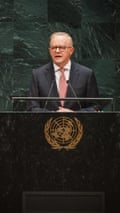
But Gallagher rejected Coalition claims the government had politicised the Medicare breach, rejecting suggestions Labor had delayed a public announcement or overstated the significance of the rogue agent’s actions.
“It is the first time that we’re aware that an agent acting on its own, not with the authority of OpenAI, was able to get into one of our data systems, and I think we did the right thing,” she said.
Cabinet was briefed on the ongoing investigation on Monday, as the company continued to cooperate with Services Australia and the intelligence agency, the Australian Signals Directorate.
Gallagher said the investigation would take a matter of weeks to be completed but confirmed the statistical website accessed in the incident had been decommissioned and the data transferred to a new portal.
The taskforce would also review how OpenAI’s agent had interacted with the Australian Institute of Health and Welfare’s website.
An obscure German wiki site that was reportedly hijacked and used as a message board for the agents to communicate with each other included messages showing the agents tried and failed to access the AIHW website data over multiple days in June this year, as first reported by the ABC.
Part of $160m in new funding for cybersecurity improvements at Services Australia, announced in the May budget, will be used for the response to the OpenAI incident.
“The kind of cyber protections of a public-facing website, versus our systems of government significance are quite different, and they are under constant, constant attention from people who would like to get in,” Gallagher said.
“Those systems are the ones that the upgrade will be focused on.”
The opposition leader, Angus Taylor, said every cyber-attack was serious, but criticised Albanese for waiting to reveal the incident publicly.