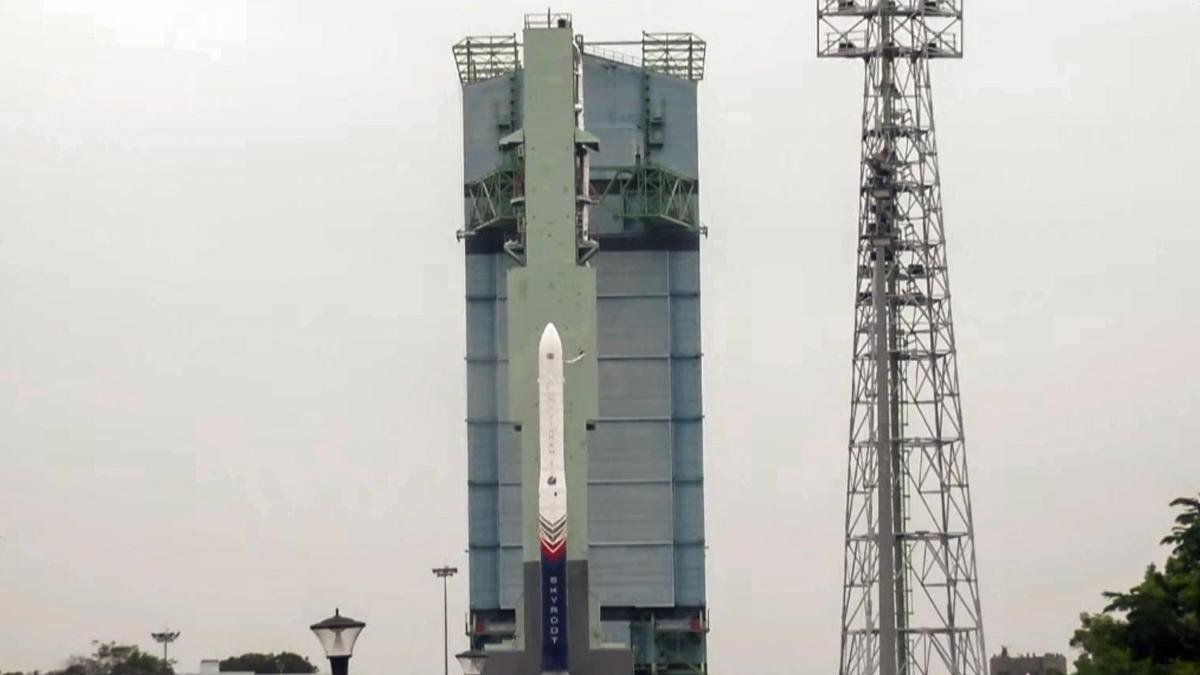
India had its first private orbital rocket launch at 12.05 p.m. on July 18.
So far, all orbital rockets India had launched as part of its space programme had been state-funded and led by the Indian Space Research Organisation (ISRO).
Hyderabad-based Skyroot Aerospace changed that by launching its small-satellite launch vehicle Vikram-1 to a low-earth orbit.
The mission has been dubbed ‘Aagaman’, Hindi for ‘arrival’.
Since 2020, the Indian government has opened the domestic space sector to private companies by creating institutions such as IN-SPACe and allowing private firms to build launch vehicles and use ISRO infrastructure.
.
A similarly short list of others, including ABL Space Systems and Isar Aerospace, are still searching for success.
What makes Skyroot’s Vikram-1 launch unique? | Explained Significant feat A successful first flight is a significant feat.
Many rockets, including the storied Falcon 9, have failed their maiden flights.
But the same feat also shows the full context in which Skyroot is now operating.
As a commercial entity, a single launch — crucial though it is — will not catapult the company to success.
The global small-satellite launch market is evolving and there are still considerable challenges, including domestic demand and market uncertainties.
Former ISRO engineers Pawan Kumar Chandana and Naga Bharath Daka founded Skyroot Aerospace in 2018.
It had its first milestone in 2022 when it successfully launched Vikram-S, the first privately developed Indian rocket on a suborbital flight.
Vikram-1 is a four-stage rocket.
The first three stages use solid fuel and the fourth uses liquid fuel.
Skyroot has said that once its manufacturing has been streamlined, it will be able to produce one Vikram-1 rocket per month.
Mission Aagaman was a developmental flight of Vikram-1.
This means the company tested the rocket by putting it through its paces, especially to check parameters that cannot be fully understood unless the rocket is flying.
According to the company, Mission Aagaman was to validate stage separation, propulsion, guidance and navigation, structural performance, avionics, fairing deployment, upper-stage separation, and orbital insertion.
Emotional moment for Warangal artist as micro sculptures journey into space Inserting itself into the intended orbit would have been the mission’s hardest part, as the launch vehicle would have had to accelerate to high speed while maintaining its guidance and propulsion.
It also carried some payloads, although the primary mission focused on the rocket itself.
Vikram-1 has a payload capacity of 290 kg to a 500-km sun-synchronous orbit and 480 kg to a low-inclination orbit at similar altitude.
Skyroot has said it will have two more developmental flights after this before the rocket will be deemed market-ready.
“The company’s roadmap includes Vikram-2, capable of carrying up to 1,000 kg to low-earth orbit, with its maiden flight targeted for 2027, and a fully reusable launch vehicle, with both booster and upper stage engineered for recovery and reuse,” the company said in a post-launch statement.
Building rockets is one thing.
Building a business is another — and arguably significantly more valuable.
Broadly, the small-satellite launch market in which Skyroot is hoping to excel has become challenging.
A successful business today requires growth as well as industrial maturity and access to demand.
In the half-decade until 2021, many forecasts anticipated a boom in the demand for launching satellites weighing 100-500 kg.
While the demand has grown since, not every entrant has been equally profitable.
Launch vehicle revenues have been growing more slowly than those of satellite manufacturing, creating consolidation pressure.
The forecast had assumed demand would be diffused across enterprises but following a series of geopolitical realignments, demand is today increasingly concentrated in satellite constellations.
On the cost front, many small-satellite makers are flying their payloads as rideshares on larger rockets, especially the SpaceX Falcon 9.
The launch fee has thus dropped dramatically.
For added measure, while a launch vehicle dedicated to small satellites will offer flexibility and the option to pick specific orbits to deploy into, satellite-makers still have to pay something of a premium over the lower costs offered by rideshare launches.
The PSLV itself is such a launcher, although public confidence in its abilities has come under a cloud thanks to two successive failures, the reasons for which the government has refused to disclose.
That said, Vikram-1 may have an advantage in the form of India’s lower manufacturing and labour costs, access to ISRO’s infrastructure, and the country’s increasing focus on manufacturing, including of satellites.
Next, startups across Europe, the U.S., China, Japan, and Australia are also developing small-satellite launchers — and many have folded or pivoted away after struggling to secure launch contracts from what is already a small pool of customers.
Vikram-1 will also compete with ISRO’s own new Small Satellite Launch Vehicle.
Third, launch services are low-margin and capital intensive, especially when compared to satellite manufacturing, downstream applications, data services, and communications.
Then come the costs of compliance for debris mitigation and other regulatory obligations.
Of course, Skyroot itself may diversify in future after it has established itself in the sector.
India’s own commercial space ecosystem is only just beginning to expand and includes potential future collaborators like Pixxel, Bellatrix Aerospace, and Dhruva Space.
Even so, the domestic market remains relatively limited.
ALSO WATCH Watch: Vikram-1, India’s first private orbital-class rocket, successfully launches into orbit Big picture The big picture is that the Skyroot factory capable of producing 12 Vikram-1 rockets every year will be an asset if there is demand for 12 Vikram-1 launches every year.
But even ISRO does not launch 12 small satellites a year today.
In other words, Skyroot will have to find and secure international customers.
When it does, it will still have to contend with a simple fact: even when small satellites account for a third of all satellites launched, as some projections have said will be the case in the decade until 2035, they will only account for less than one-tenth of the total launch mass.
None of this diminishes what Skyroot achieved on Saturday.
Designing, building, testing, and flying an orbital launch vehicle on the very first attempt is a rare accomplishment anywhere in the world.
It is certainly a milestone for India’s private space sector.
But it remains that the companies that endure have repeatedly reached orbit through a trustworthy process, at prices customers are willing to pay.
With the success of Mission Aagaman, Skyroot now has an opportunity to build that kind of business.