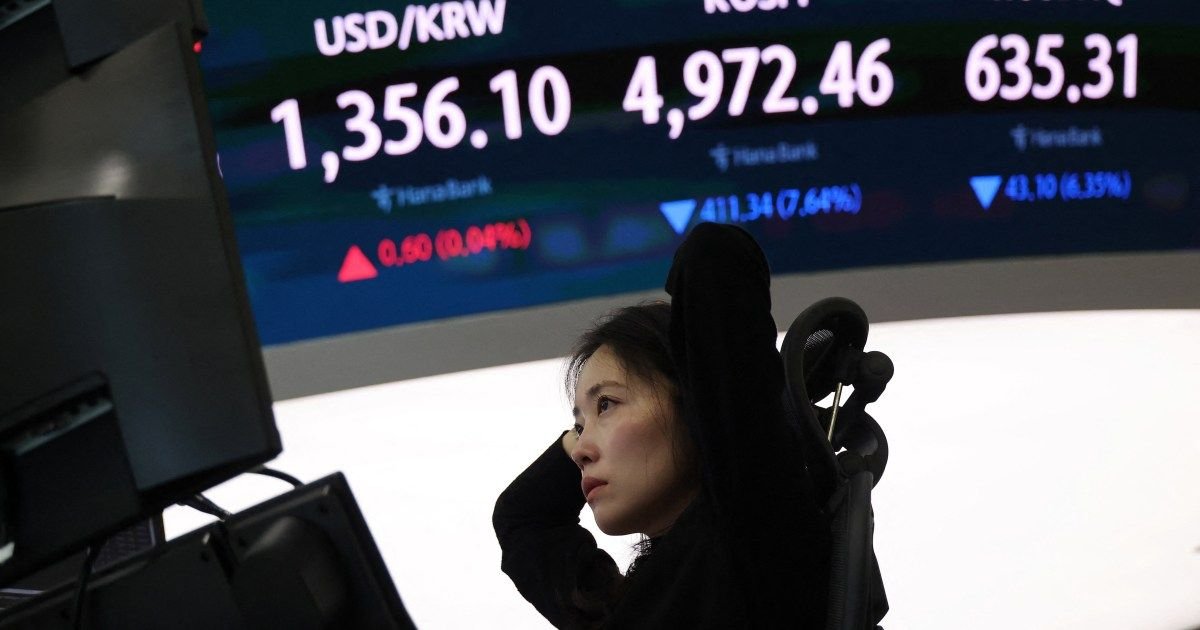
A currency dealer works in front of an electronic board displaying the Korea Composite Stock Price Index (Kospi), the Korea Securities Dealers Automated Quotations (KOSDAQ) and the exchange rate between the US dollar and South Korean won in the dealing room of a bank in Seoul, South Korea, on November 6, 2026 [File: Kim Hong-Ji/Reuters] By John Power Published On 23 Nov 202623 Nov 2026 Asian stock markets have opened to sharp losses amid mounting concerns over the sustainability of the AI boom.
Key indexes in South Korea, Taiwan and Hong Kong fell on Monday, continuing Friday’s tech-led sell-off on both sides of the Pacific.
The Korea Composite Stock Price Index (Kospi) fell as much as 4.3 percent in early trading, while the Taiwan Stock Exchange Capitalization Weighted Stock Index (Taiex) and the Hang Seng Index both dipped more than 1 percent.
Japan’s stock markets were closed for Labor Thanksgiving Day.
On Friday, Wall Street’s benchmark S&P500 closed 3.7 percent lower for its seventh straight loss, while the tech-focused Nasdaq Composite dropped 5.3 percent to erase all of its gains for 2026, following a rout in Asia.
The Kospi, Nikkei 225, and the Taiex entered the weekend between 5.1 percent and 6.2 percent lower, while the Hang Seng Index finished down 1.9 percent.
Investors have long been concerned that tech firms may not be able to sustain the multi-trillion-dollar investments they have poured into the infrastructure needed to train and run AI.
Global AI-related investment, much of it fuelled by debt, is expected to reach $2.7 trillion in 2026 and $3.6 trillion in 2027, according to technology insights company Gartner.
Concerns that the AI boom may be running out of stream have been exacerbated by growing calls for greater oversight of the sector.
The Democratic Party’s sweeping victory in the US midterm elections is expected to slow data centre construction in US states, while the alleged espionage scandal embroiling chip giant Nvidia and its former CEO Jensen Huang has led to a push for tighter restrictions on China’s access to advanced chips.