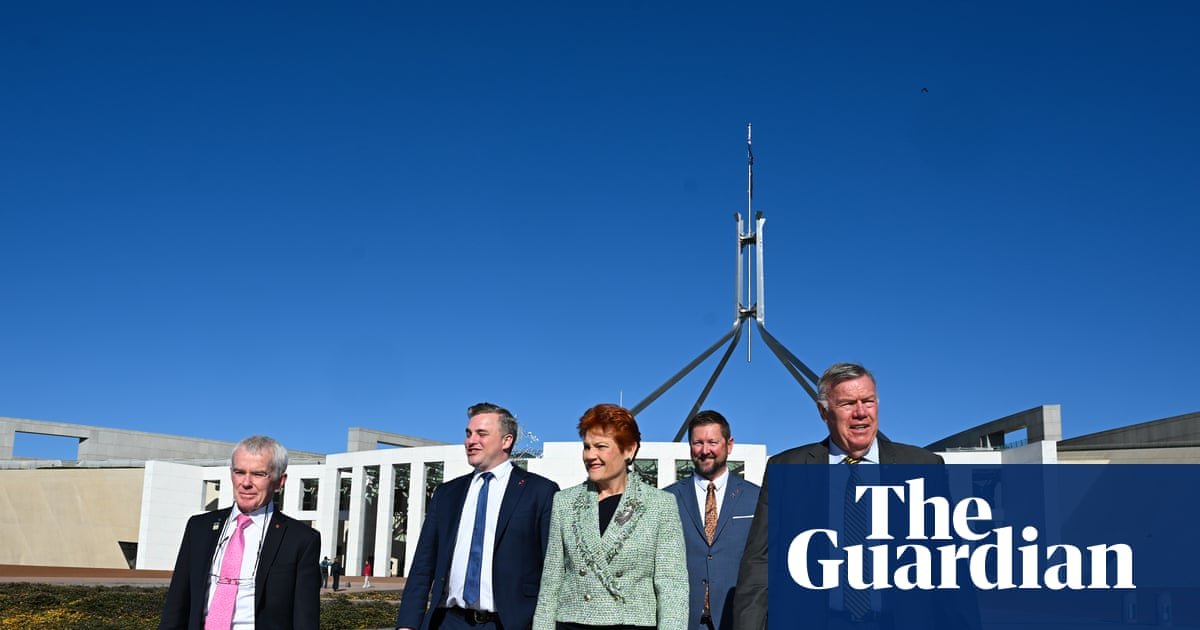
Meanwhile Sarah Hanson-Young confirms Greens and Coalition in talks to pressure Labor on gambling. Follow today’s news live
Get our breaking news email, free app or daily news podcast
3h agoAnna Funder says her work hoovered up and ‘broken down for parts’ by big tech
4h agoSydney council drops proposal to introduce parking meters to popular beaches
4h agoAlbanese backs Treasury modelling despite falling house prices
5h ago‘A chance for the Coalition to actually stand for something’: Greens consider teaming up to push Labor on gambling reforms
5h agoCoalition to push to ‘get the balance right’ on gambling legislation
5h agoWilson says time and trust needed to win the public back
6h ago‘We’re very confident in Treasury’s forecasts’: Labor defends tax reforms against cooling housing market
6h agoLabor moves to clean up consulting industry
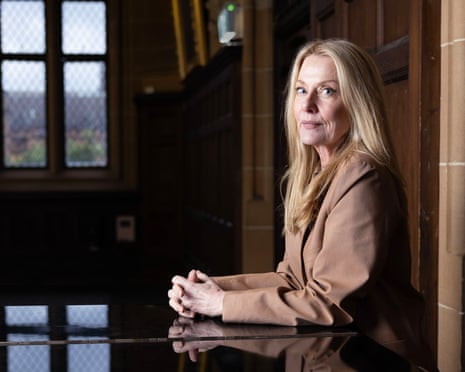
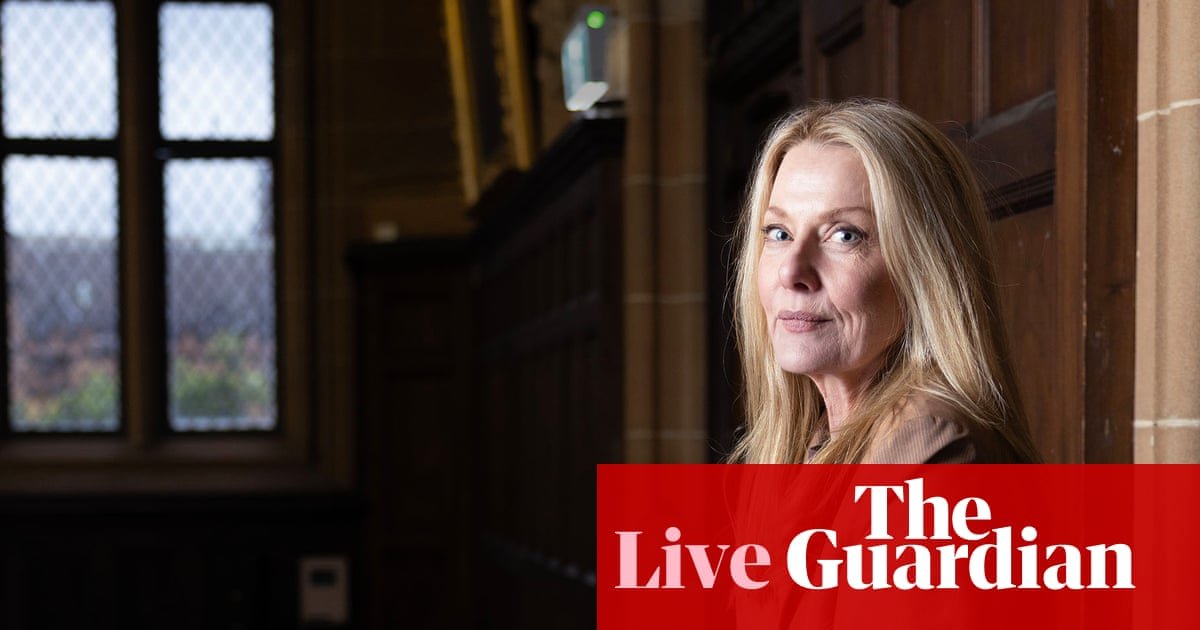
Anna Funder, an Australian author, tells a press conference that today, she’s “standing here before you today really as a victim of crime”:
My books that I’ve lived off for 30 years, have all been hoovered up in many editions, in many countries, in many languages by big tech, broken down for parts and used for them to make money. If I look back on my career, which I’m old enough to do now, I feel like I’ve been building slowly and painstakingly with a massive mortgage, a block of flats. Each book is a flat and I rent it out and the money that I get is royalties. These big tech bros have moved into my flats, kicked me out and are charging rent for my work.
My books that I’ve lived off for 30 years, have all been hoovered up in many editions, in many countries, in many languages by big tech, broken down for parts and used for them to make money.
If I look back on my career, which I’m old enough to do now, I feel like I’ve been building slowly and painstakingly with a massive mortgage, a block of flats. Each book is a flat and I rent it out and the money that I get is royalties. These big tech bros have moved into my flats, kicked me out and are charging rent for my work.
Vic state executive to determine Moira Deeming’s future
The Victorian Liberal party’s state executive will meet on Friday evening to decide the future of embattled MP Moira Deeming.
On Monday, Deeming said she misunderstood the “technical meaning of the term ‘headlock’”, but would not apologise to her colleague Matthew Guy after she alleged he assaulted her. Victoria police concluded no offence occurred.
In a statement released today, the opposition leader, Jess Wilson, said the party’s state executive would meet to consider Deeming’s candidacy ahead of the state election in November. A party spokesperson confirmed the meeting would take place on Friday at 6.30pm.
Deeming is the top candidate on the Liberal party ballot for the state’s western metropolitan region.
Victorians are relying on my team to change the direction of this state. I am determined to not let them down. I will not be making further comment until the matter is resolved.
Victorians are relying on my team to change the direction of this state. I am determined to not let them down.
I will not be making further comment until the matter is resolved.
Industry warns up to 10,000 homes a year could be lost over self-managed super fund property investment ban
Andrew Bragg, the shadow housing minister, says he has held a meeting with finance, housing and superannuation bodies, who warned up to 10,000 homes a year could be lost over the government’s banning of self-managed super funds (SMSFs) investing in property.
That ban was part of an agreement with the Greens, to get the capital gains tax and negative gearing changes over the line – and followed previous reports to the government to take that action.
Bragg spoke to the media a little earlier and said the SMSF industry as well as builders and developers came up with the estimate.
As many as 10,000 houses a year are going to be lost as a result of the government’s ban on self-managed super funds investing in property. There are a range of industry estimates. We’ve heard from builders, developers. We’ve heard from SMSF industry people. The government say they think it’s about 4,000, but it seems that it would be at least 10,000 based on the evidence that’s been anecdotally collected from the industry today at the roundtable.
As many as 10,000 houses a year are going to be lost as a result of the government’s ban on self-managed super funds investing in property.
There are a range of industry estimates. We’ve heard from builders, developers. We’ve heard from SMSF industry people. The government say they think it’s about 4,000, but it seems that it would be at least 10,000 based on the evidence that’s been anecdotally collected from the industry today at the roundtable.
Asked about falling house prices, and whether this was a welcome change, Bragg said:
I think these are blips and bumps. Ultimately, the fundamentals are very bad. The government has brought in 2 million people since they won the election in 2022, and they’ve only built 600,000 houses. Now, we are still building not enough houses, and our population is still growing very quickly. So the fundamentals haven’t changed. So I suspect that affordability, which is the key in housing, is only going to get worse under this government’s policy suite.
Democracy ‘under assault’ from significant third parties at 2025 federal election, parliamentary inquiry finds
New laws are needed to police behaviour at polling booths after Australia’s democracy came “under assault” at last year’s federal election – including from third parties such as Plymouth Brethren Christian Church members and rightwing lobby group Advance – the chair of a parliamentary inquiry has said.
The proposed new code of conduct for campaigners was among several recommendations in the interim report from the Labor-led committee reviewing the 2025 ballot, which was tabled on Tuesday afternoon.
The Coalition has dismissed the findings, accusing Labor of turning the election inquiry into a “hyper-partisan witch-hunt” against members of the church.
“The way that they have been treated by Labor for exercising their right to participate in our political process is a stain on our democracy,” the Liberal senator Jess Collins said.
Read the full story by Dan Jervis-Bardy here:
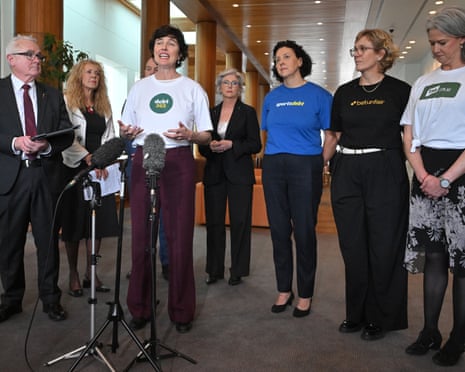
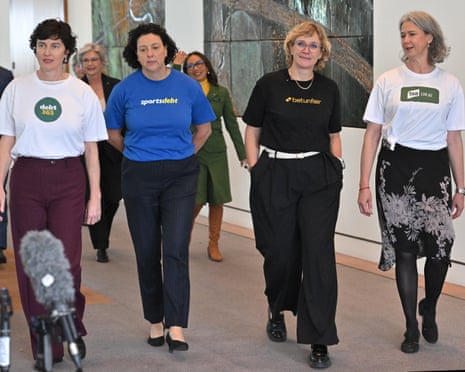
‘Sportsdebt’ and ‘Debt365’: teals get creative in push for gambling action
The crossbenchers want far stronger action against online gambling advertising than what the government is proposing – with David Pocock putting forward six of his own amendments to the laws.
Pocock is pushing for all gambling ads on all platforms to be banned over three years; ban gambling inducements; ensure opt-out mechanisms for ads are easy to find; capture smart TVs in reforms; ban gambling ads during one hour before, and one hour after live sport; and set up an independent review of the reforms three years after they commence.
The teals spoke to the media earlier on the issue, and have even had some T-shirts made. They’re pretty good, if I do say so myself.
Datacentre boom drives building approval values to record high
Building approval values hit a record high in May thanks to the datacentre boom, new data shows.
The value of all building approved hit $21.07bn in May, of which non-residential building made up $10.83bn, also a record high, according to Australian Bureau of Statistics seasonally adjusted data.
The rise was driven by a boom in large datacentre approvals located in New South Wales and Victoria, the ABS said.
In the unadjusted data, datacentres look to have accounted for more than two-fifths of all non-residential work approved. May’s non-residential building approvals were valued at $12.56bn, of which $5.65bn was for commercial buildings not elsewhere classified. The category includes datacentres and smaller projects like petrol stations and funeral homes.
Housing approvals fell in the month of May. About 17,000 new homes were approved, with a steady increase in houses but a drop in units and other approvals. More than 10,000 new houses have been approved each month since February. The total value of residential approvals was $10.24bn, seasonally adjusted.
That meant May was one of just five months in the last 15 years where the value of non-residential approvals was greater than the value of residential approvals.
Fuel prices rise 16 cents a litre in Perth as excise cuts scale back
Petrol prices are a little higher around the country today – and a lot higher in Perth – after the fuel excise relief has begun to taper off.
The federal and state governments’ 32-cent-a-litre cut to the fuel tax has today been replaced with a 16-cent discount, to expire on 2 August. The excise was initially cut to combat price surges in the wake of the US war on Iran.
Unleaded petrol prices have risen about 4 cents a litre today in most cities, MotorMouth data shows. Stations have passed on the costs of higher excise on fuel bought from terminals, where wholesale prices rose about 10 cent a litre yesterday.
Unleaded petrol has picked up in Sydney from 152.2 cents a litre on Tuesday to 156.9 today on average across the city’s petrol stations. In Melbourne, it’s gone from 153.8 cents to 156.7; in Brisbane, 154.8 to 158.0; in Adelaide, 148.9 to 155.3, and Hobart’s 160.4 to 164.9.
In Perth, where prices spike each week on Wednesdays, unleaded soared by 16 cents immediately from 148.3 cents a litre yesterday to 164.5 today.
Diesel prices are about 5 cents a litre higher on average. Sydney’s prices are up from 173.3 cents a litre yesterday to 178.9 today; Melbourne’s are up from 173.9 to 178.4; Brisbane 176.6 to 180.5; Adelaide 173.9 to 178.2; and Hobart’s from 189.9 to 193.2. Perth’s are up from 168.8 yesterday to 177.9 today.

Creatives lobby government to protect industry from AI models
Today’s open letter follows a dataset search tool recently created by the Atlantic which revealed a vast catalogue of work by Australian musicians - including Nick Cave, Jimmy Barnes, Kylie Minogue and Powderfinger - had already been scraped to train AI models.
We call on the Australian Government to commit to the future of creativity in this country and not to trade it away. Our stories and our creativity is how Australia knows itself, how we speak to the world, and how the world comes to know us. The next National Cultural Policy is an opportunity to build a global creative powerhouse. That future can only be built on the foundation that gives creators the economic security to keep making work. Asking Australian creators to quietly absorb the legal liability of tech companies before they float on the stock market, it would be the permanent transfer of Australian stories to the wealthiest corporations in human history.
We call on the Australian Government to commit to the future of creativity in this country and not to trade it away. Our stories and our creativity is how Australia knows itself, how we speak to the world, and how the world comes to know us.
The next National Cultural Policy is an opportunity to build a global creative powerhouse. That future can only be built on the foundation that gives creators the economic security to keep making work. Asking Australian creators to quietly absorb the legal liability of tech companies before they float on the stock market, it would be the permanent transfer of Australian stories to the wealthiest corporations in human history.
Independents push for amendments to NDIS bill
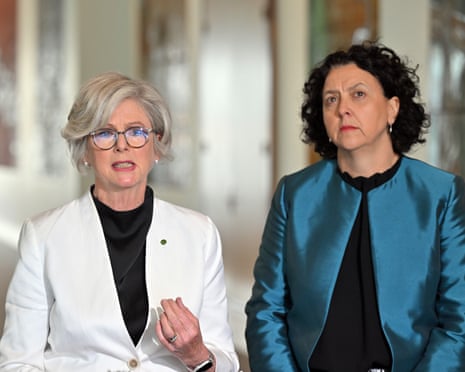
Helen Haines and Monique Ryan have put forward a raft of amendments to the government’s NDIS bill, arguing that while the scheme does need reform, the current design will “risk undermining the scheme’s core purpose of providing necessary supports to people with disability”.
They have concerns around access to “activities of daily living” being cut, transparency over the allocation of funding and ensuring that people in regional areas aren’t pushed out.
Haines said her amendments will “protect funding that is already approved for “activities of daily living” from blanket funding reductions; strengthen transparency of decision making for participants by requiring written reasons when requested supports are not approved; and clarify the definition of “appropriate treatment” so that real-world barriers like regional access and affordability of treatments are accounted for.”
Australians with a disability are not asking for special treatment. They’re asking that we honour the central principle of the NDIS, ‘Nothing about us, without us’. That principle has been completely disregarded in the opaque drafting and rushed presentation of this legislation.
Senate gets a little messier, Labor loses another critical vote
There was a further bit of mess a moment ago in the Senate, because the government again lost a vote on its pharmaceutical prescription bill.
The government had already lost two votes (see below), with the Greens and Coalition teaming up to make amendments for the second reading of the bill.
Then on the bill itself, the two parties supported an amendment by Jacqui Lambie to allow eligible podiatrist prescribers to prescribe certain medications on the PBS.
It means the amended bill will go back to the house for a vote.
But Guardian Australia understands the government won’t be supporting that amended bill, which means it’ll be punted right back to the Senate, which creates a little extra drama.
Australians to regain access to Anthropic’s latest AI models
Australian businesses and the government are set to regain access to the latest Anthropic AI models after the Donald Trump administration lifted export controls on Claude Fable 5 and Mythos 5, the company has said.
In early June, the company received an export control directive from the Trump administration ordering Anthropic to suspend foreign national access to its frontier models, citing national security concerns.
Anthropic said at the time that its understanding of the government’s concerns was that there was a method of bypassing the safeguards in the AI model. Safeguards are in place to reduce the chance of the AI being misused for things like cybersecurity.
As a result, Anthropic suspended all user access to the models, not just those outside the US.
In a post on X, Anthropic said it would begin restoring access from tomorrow US-time, after the export controls were lifted.
Government loses votes in the Senate over pharmaceutical prescription bill
The Greens and Coalition have teamed up to pass amendments over the second reading of the government’s bill which would enable nurse prescribers to prescribe certain pharmaceutical benefits under the Pharmaceutical Benefits Scheme.
What exactly does this mean? Great question.
When the government introduces a bill, there’s then a vote to bring on a second reading of it, which is essentially the time where debate on that legislation takes place. The third reading is the passing of the bill through which ever House it’s in.
In the Senate right now, the government is losing votes because the Greens and Coalition are teaming up to add amendments to the vote for the second reading.
This doesn’t mean that the bill won’t pass, but it delays the bill, notes the displeasure of the two other parties over certain aspects of the bill and all round puts pressure on the government.
The Greens moved an amendment that calls on the government to “as soon as practicable, allow endorsed podiatrists and podiatric surgeons to access PBS benefits when prescribing medicines”, because they are currently “the only professions in Australia who can gain endorsement to prescribe medicines but are not able to access PBS benefits for those prescriptions”.
And the Coalition amendment calls on the government to provide a comprehensive response to the 18 recommendations in the “Unleashing the Potential of our Health Workforce Scope of Practice review” as a matter of priority, which was handed to the government 18 months ago. That review was about removing barriers stopping health professionals in primary healthcare working to their full scope of practice.