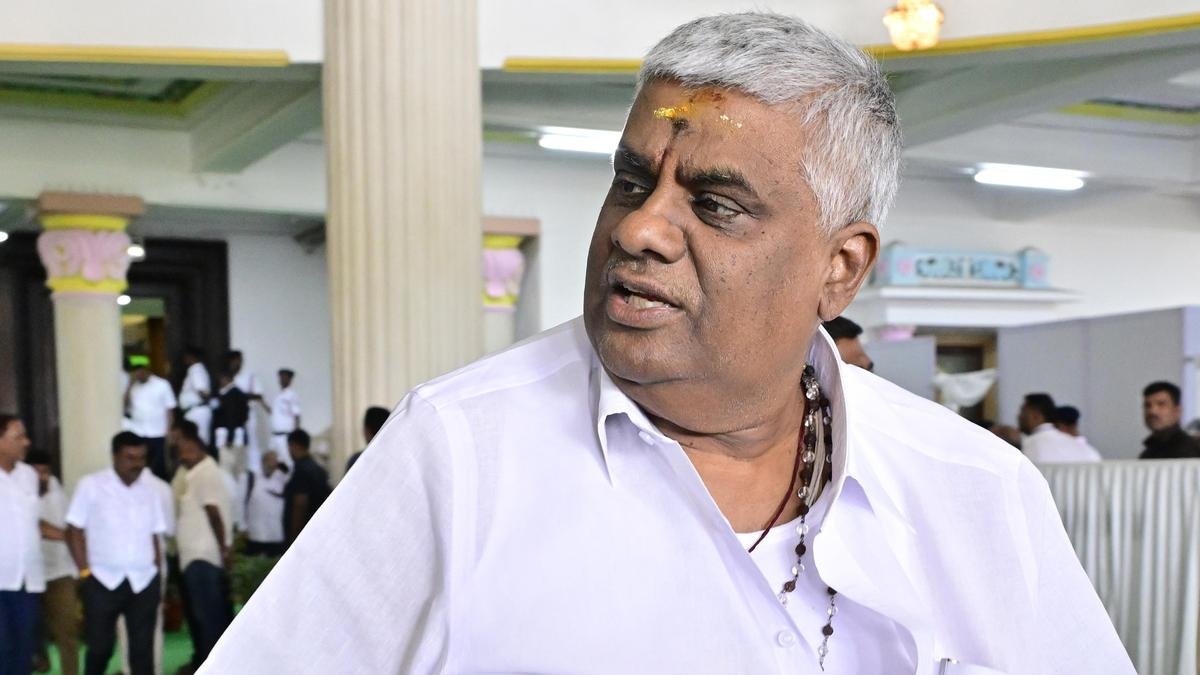
In a major relief for JD(S) leader and former minister H.D. Revanna, a special court in Bengaluru has discharged him from the allegation of sexually harassing a 47-year-old former maid when she was working at his house in Hassan during 2020.
The Special Court of Magistrate for criminal cases against former and present MPs and MLAs said that both the complainant and the prosecution had failed to provide reasonable explanation for the court to take cognisance of the alleged offence under Section 354A (sexual harassment) of the Indian Penal Code (IPC) by condoning the delay, under Section 473 of Code of Criminal Procedure (CrPC), of over four-year in lodging the complaint.
SC seeks H.D. Revanna’s response on Karnataka’s plea against High Court order quashing the charge of outraging modesty
K.N. Shivakumar, judge of the special court, in his December 29 verdict, declined to accept the claim of the prosecution that the complainant woman took over four years to lodge the complaint due to fear of political power of Mr. Revanna.
“No fear...”
The Court pointed out that she had stated in her complaint that after she had left her job at Mr. Revanna’s residence, a house granted to her under a housing scheme of the State Government was demolished, and that had she had lodged a complaint with the Hassan Deputy Commissioner and the district police against Mr. Revanna on demolition of her house.
“When she had no fear of Mr. Revanna in approaching the Deputy Commissioner and the district police against him when her house was allegedly demolished at the instance of him, how come she had such a fear to lodge complaint or to take legal action or to disclose about incident of alleged sexual harassment,” the Court questioned.
The Court pointed out that the woman failed to provide specific dates or year for when the incidents happened. It also noted that even if she couldn’t report because she was employed at his house between 2020-22, she waited for two years, for reasons best known to her, after leaving the job to file the complaint in April 2024. Even the Special Investigation Team (SIT) neither recorded or explained reason for the delay in launching prosecution, the Court said.
Indicating that the complaint might have forgotten the alleged incidents involving Mr. Revanna as memories fade from the minds of victims due to the lapse of time if the offences are not severe in nature, the Court said that the subsequent incident of alleged rape by his son, Prajwal Revanna, might have prompted her to add older incidents involving Mr. Revanna while lodging the complaint against the son.
The Court said that “it may not be necessary to condone the delay of more than three years” in lodging the complaint as “such an action may lead to unwanted delay and multiplicity of proceedings in respect of other/severe offences [of rape] alleged in this case against Mr. Prajwal,” which is pending trial before the sessions court.”
“Balance of interest”
The Court further said that, to come to a conclusion as to what would be “the interest of justice” in this case, it has to consider how much harm or injustice the victim would suffer if the delay is not condoned, and how much harm or prejudice the accused would face if the cognisance is taken by condoning the delay.
On considering the nature of overt-acts alleged against Mr. Revanna, the Court inferred that “it appears that from such acts there might not be any such severe effects or harm or injury caused to the complainant”.
“If any such graver effect or injury was caused, definitely she would have taken legal action against the accused without any delay, as she did when her residential house was demolished at the instance of this accused [Mr. Revanna] as alleged in the complaint... Further she had been working in the house of Mr. Revanna for about two years even after alleged incident. This also fortifies such an inference,” the Court.
“On the other hand initiating prosecution for such acts allegedly done by the accused who is presently a member of legislative assembly in the state would definitely affect his political life career to some extent”, the Court noted.
HC order
The High Court of Karnataka, in its November 19 order, had quashed the allegation of “outraging the modesty of woman” made against him under Section 354 of the IPC, stating that no such allegations existed in her complaint but had asked the special court to re-examine whether “it is a fit case to take cognisance under Section 354A by condoning the delay of more than three years, from the dates of alleged offences, in lodging the complaint”.