Identities of all sex workers, former sex workers, and their families have been changed to maintain privacy Sitting in her older daughter’s room, where one corner is covered with maps and math formula sheets, Savitri, a 40-year-old former sex worker, recalls when she began hating her profession.
“It was when my girls turned five and seven,” she says.
“I had decided that my daughters would never live the life I had.
They would live with dignity.” Although she continued in the profession for a few more years due to family responsibilities — her husband, who was one of her clients, abandoned the family years ago — Savitri eventually quit.
Now, about 10 years later, her elder daughter works with an NGO and is preparing to write the police exam, while her younger daughter is preparing for medical entrance tests in Indore.
The family belongs to the Banchhada community, a de-notified tribe with an estimated population of 25,000 spread across 78 villages in the districts of Mandsaur, Neemuch, and Ratlam in western Madhya Pradesh.
Unlike Savitri’s daughters, most girls in the community are born into a system in which their families expect them to enter sex work — a practice passed down over generations.
According to several members of the community and NGOs in the region, while many Indians celebrate the birth of a boy over a girl, the Banchhadas welcome a girl with sweets and firecrackers.
As girls grow up, they receive better nutrition than boys.
They are given expensive clothes and, unlike in much of India, are not told that they will have to marry one day and leave the nest.
The reason, however, is disturbing: for generations, the Banchhada girls have been pushed into sex work upon hitting puberty and given the responsibility of earning.
Their family members function as pimps and live off their money.
Akash Chouhan, founder of the Jan Shaurya Social Welfare and Development Society, an NGO based in Neemuch, estimates that at least 10,000 women of the community, including about 3,000 girls, remain trapped in this form of exploitation.
“Girls are forced to drop out of school after Class 8 or 9 and are pushed into sex work by their families,” says Akash, who is from the community.
“Community elders protect the practice in the name of tradition.” Radhika, a sex worker, says girls are conditioned from childhood to believe in the tradition.
They are told it is their responsibility to ease the family’s financial woes.
“I quit school on my own after Class 9 and began working,” she says.
“But if a girl refuses to quit, her family forces her into sex work through physical or emotional abuse.” Supreme Court recognises sex work as a ‘profession’ Abuse along the highway A drive along State Highway 156, which connects the three districts, passes through several villages of the community.
Girls wearing bright lipstick stand along the way, while older women sit on cots outside their houses and shanties, watching children playing nearby.
As evening approaches, they gesture to men to come in.
In Neemuch’s Jaitpura village, an elderly woman approaches a car parked on the roadside and asks if anyone would like to come in.
She points to three girls sitting outside her house; two of them are her granddaughters.
“You can pick either of them and go into the house,” she tells them.
“It will cost you ₹300 for 10 minutes, but I will take ₹100 as my tip.
The room has a fan; you will be comfortable.” Most girls along the highway, including those who look underage, say that they are around 20; some say they recently turned 18.
Conversations with them reveal that they have been involved in sex work for about four years.
Multiple dhabas along the highway are also involved in brokering deals between prospective clients and sex workers.
The owner of a highway dhaba in Ratlam’s Dhodar village claims he can “arrange girls” and lists different price brackets based on location, duration, and the girl’s age.
Standing near a toll booth, he lists the facilities available, including an air-conditioned room, car parking, and assurances of safety from the police.
The rates range from ₹300 for 10 minutes to ₹1,000 for an hour, and ₹6,000 for a night.
They go up to ₹10,000 for a younger girl.
“If girls are taken to a hotel, clients face the risk of police raids.
But here, clients have no problem,” the dhaba owner explains.
“The girls avoid going to hotels as they face incidents of violence by drunken men.
That is why many of them have built rooms in their houses with AC.” Several sex workers from the region also travel to cities such as Indore in Madhya Pradesh and Chittorgarh and Udaipur in neighbouring Rajasthan, on client requests.
Shivangi, a former sex worker in Neemuch’s Nilkanthpura, who now works with the government’s Women and Child Development (WCD) Department, recalls some of the horrific incidents she faced.
“In 2003, my friend and I had gone to a hotel in Chittorgarh for two clients.
After a few minutes, two or three others entered the room.
For hours, we suffered sexual and physical violence that still haunts me.
All I could think of was jumping out a window,” says Shivangi, who is now married with two daughters.
Shivangi says girls rarely share grim experiences with their families as they have to “get to work as soon as the next client approaches”.
In 2005, Shivangi came in contact with an international NGO working in the region and began volunteering with it while continuing sex work.
“Over the next few years, my mindset began to change as I got exposed to a life outside my community,” she says.
“In 2008, I chose to leave that life behind for good.
I married a man I met during my NGO work and moved in with him.” From a criminal tribe to social outcasts Historically a nomadic community in the Malwa and Mewar regions of present-day Madhya Pradesh and Rajasthan, the Banchhada community was notified as a ‘criminal tribe’ by the British government under the Criminal Tribes Act, 1871.
Narendra Chouhan, founder of Naya Jeevan Foundation, an NGO working for the youth of the community, says the origin of sex work in the community can be traced back to that period.
“Our elders have told us that it began during the British Raj, when the police would catch men from the community and demand women in exchange for their release.
Some families who could not pay money started sending them unmarried girls from their homes,” he says.
The community was de-notified by the Government of India in 1952 and classified as a Scheduled Caste.
The practice that ensured monetary benefits for families continued, says Narendra.
“Slowly, families who were engaged in sex work started moving out of Rajasthan and settled in this region.” Apart from offering services in their homes, they also began offering services in trucks.
A girl would board a truck at one location, offer services, and get off at another.
“This method went on till the 2010s when people started buying land along the highway and building houses,” he says.
Barriers to a better life Today, the Banchhadas remain cut off from mainstream society, with their members facing stigma in all walks of life: from education to employment to renting properties in cities.
In many villages with a mixed population, the houses of the Banchhadas remain secluded.
In Hadi Pipliya, for instance, the two sections are divided by a drain.
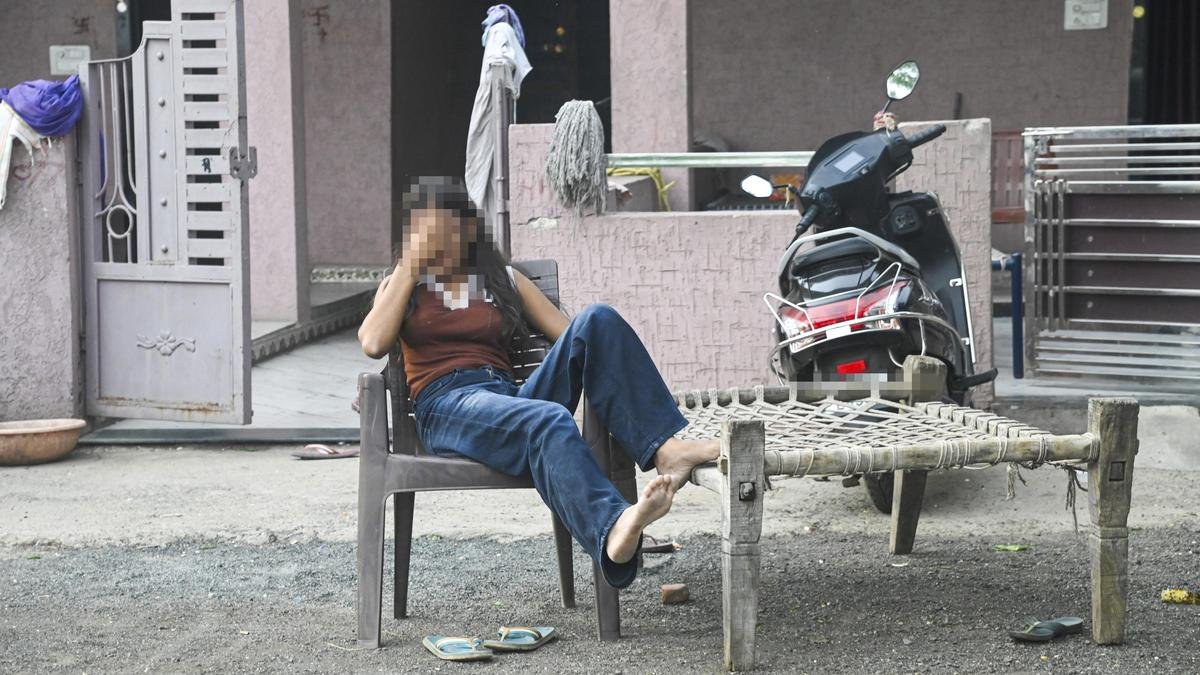
A girl with a family member in a district in Madhya Pradesh. | Photo Credit: A.M.
Faruqui Kanupriya, a counsellor with Jan Shaurya, says members of the community, including women who are not involved in sex work, face job rejections in the private sector as soon as they reveal their social identity.
“I have been rejected from various jobs myself,” she says.
“Schools often deny admissions to Banchhada children.
They say taking them in could disturb the atmosphere of their institution.” A shot at life, Mandsaur’s model for HPV vaccination Aditi Garg, who was Mandsaur Collector until recently, says the administration is trying its best to bridge the gap.
Once, when the administration had recommended some women from the community, living in a government hostel, for teaching and teaching assistant jobs at private schools, there was pushback, she recalls.
“The managements were concerned about their reputation, but we dealt with them firmly and ensured jobs for 24 women from the community.
We have also hired some women on help desks in government offices where the public has to communicate with them,” she says.
The youth of the community find it hard to obtain government documents, especially a caste certificate, since many of them are born out of wedlock and have no records of their fathers.
The absence of a caste certificate means that they are deprived of various government benefits such as reservation and scholarships.
Neemuch Collector Himanshu Chandra says the district administration has written to the government seeking a provision to help the community.
“This is a policy problem.
Since a person’s caste is decided based on the father’s caste, we can’t do much at our end,” he says.
Narendra says it is because of these reasons that many girls who want to leave sex work stay trapped.
“They see no scope outside this profession.
Some of those who did manage to escape or were rescued returned to sex work,” he says.
A government official adds that some girls who were rescued and rehabilitated at government hostels and centres returned to sex work as they had to vacate these places on turning 18.
“While the government is running initiatives and programmes to provide them livelihood options such as sewing or skill-based jobs, it is difficult to match the income and lifestyle the girls earn through sex work.
This leaves a gap in our efforts to rehabilitate the community,” the official adds.
In Mandsaur, however, Ms.
Garg says the district administration has been able to find a way to issue caste certificates through ancestral records or any fraternal records that can establish a person’s connection to their family.
A cycle of exploitation A recent short film, Khilawadi, which has received awards at various national and international film festivals, depicts the story of a Banchhada girl who dreams of becoming a doctor.
Made by a debutant filmmaker, Shobhita Thakur, the film’s title comes from a local term often used for the oldest daughter of a family, who is not allowed to have a life of her own, whether it is a career or marriage.
A new short film spotlights the caste-based sex work tradition still trapping girls in Madhya Pradesh In the Banchhada community, dowry is paid by the groom’s family to the bride’s.
The reason is simple: her in-laws compensate her family for lost income.
Activists and community members say the amount has increased over the years, with some girls’ families even taking ₹25 lakh.
As per the community’s customs, a girl cannot marry within the caste once she enters sex work.
A married woman is not allowed into sex work.
Sangita, a social worker with Udan Women Employment Welfare Society, explains that the girls are fed ideas against marriage from childhood and encouraged to get into sex work, which promises materialistic benefits such as smartphones, scooters, and clothes.
“They tell the girl that if she is unmarried, she can buy whatever she wants, but if she gets married, she will be stuck doing household chores,” says Sangita.
After the age of 25, many women are forced to become brokers or offer their houses on commission as client demand begins to decline.
Others, suffering from infections, sexually transmitted diseases, or HIV/AIDS, become dependent on relatives or NGOs.
While researching for her film, Shobhita found that a girl suffering from AIDS was in the hospital.
“The girl’s father came to the hospital in a drunken state and asked her to give him money even though she was in a critical condition.
He created a scene and left.
The girl died a few days later.” She says she came across many incidents that were so revolting that she could not include them in the film.
Sex workers say it is because demand goes down with age that they take on as many clients as they can.
Radhika says she has about 10-15 clients a day and earns about ₹5,000.
“I don’t have a large family; I only have my grandmother.
So, I have to save enough to buy a house and live comfortably after a few years,” she reasons.
Sangita says the girls are unable to escape as caste panchayats punish or penalise those who try to break free from the practice.
She adds that the community has an unofficial nexus of pimps and agents that keeps a close watch on the girls, including those who have been rescued.
Ms.
Garg adds that caste panchayats and community members oppose programmes they believe could affect the profession.
“We recently faced resistance during our HPV [human papillomavirus vaccination] drive for cervical cancer as they feared it could impact their girls’ work,” she says.
A generation of hope Social activists allege that multiple government campaigns and programmes have failed to impact the community.
For instance, the Jabali Scheme launched by the State government remains “completely missing from the ground,” Akash says.
Launched in the early 1990s, it was aimed at building hostels for the women from the Banchhada and Bedia communities that are involved in caste-based sex work.
Officials say there has been no allocation for the scheme for about four years.
“Even when it was active, the allocation was just about ₹5 lakh-7 lakh a year for a district,” says a WCD official.
Narendra says most government programmes focus on creating awareness instead of providing women with alternative livelihood options and erasing the stigma.
“And even their awareness drives often turn into photo opportunities for government officials,” he points out.
Meanwhile, NGOs have been running learning centres for children of the community so that they can resist their families’ push when the time comes.
The youth in various villages also have initiatives to do away with the practice.
In Sagargram, a group of mostly college-going youth formed a committee about four years ago.
Within a year, they were able to stop sex work and liquor inside their village.
“We faced objections, but we stood our ground,” says Vikas Chouhan, a Master of Social Work student.
Saniya, who is part of the committee, says she encouraged a friend, who was being pressured by her family to get into sex work, to fight back.
“Her parents came to my house to complain to my parents, but my parents took my side.
My friend fought with her parents, and they eventually relented.
She is now continuing her studies,” she says.
Her approach was simple, Saniya explains.
“Start with one house, one person, then move up.
Now, our village feels much safer,” she says. mehul.malpani@thehindu.co.in