Ladakh, one of the country’s two youngest Union Territories, is set to lead the way in demonstrating how caste will be enumerated for the first time in independent India.
The second phase of the Census—the Population Enumeration (PE)—which starts on August 17 in Ladakh and other snow-bound areas, is likely to ask questions on 40 parameters and provide an open-ended column for caste enumeration.
Open-column methodology As reported by The Hindu on July 6, the rehearsal, or the “pre-test” for the PE phase, was conducted from July 1 to 20 in 16 States and Union Territories, where respondents, other than Scheduled Caste and Scheduled Tribes, recorded their castes in an “open column”, or the enumerator noted a resident’s caste as declared by them.
The methodology is likely to be retained in the final form.
Census 2027: Frequently asked questions on the self-enumeration process While the ongoing Census is India’s first digital Census, officials are making an exception for Ladakh by printing a sufficient number of paper schedules.
The move takes into account the presence of large defence establishments in the region bordering China and Pakistan, whose locations cannot be geo-tagged because of security concerns.
The digital Census mandatorily requires enumerators to geo-locate the structures on a mobile App.
Respondents who self-enumerate on Census portal are also required to do the same.
Ladakh: a data profile of its people, identity, economy, and employment Though the questionnaire or the schedule is yet to be notified by the Registrar General and Census Commissioner of India (RG&CCI), preparations have begun in Ladakh and snow-bound areas of Jammu and Kashmir, Himachal Pradesh and Uttarakhand to conduct Population Enumeration—the second phase of Census—from August 17-September 30, ahead of the rest of the country, where the exercise will be conducted in February 2027.
The Directorate of Census Operations, Jammu & Kashmir and Ladakh, has concluded a three-day Master Trainers’ Training Programme for Census 2027 population enumeration, marking the next phase of field preparedness ahead of operations scheduled to begin on August 17 with the self-enumeration phase.
Why Census 2027 matters for development, democracy and representation According to Chief Principal Census Officer Amit Sharma, the three-day programme provided comprehensive training on all aspects of Census 2027 population enumeration, covering census concepts, caste and demographic data collection, digital tools, self-enumeration, interviewing techniques and hands-on use of the mobile application.
Ladakh’s case is peculiar as it was not among the 16 States and UTs where a “pre-test” or rehearsal of the questions to be asked during the second phase, was held in July.
A senior government official said that, in the absence of the pre-test, the master-trainers are being trained based on tentative questions, around 40, which are likely to be notified this week.
Census 2027: The pressures of counting India “The broad contours have been conveyed to us.
This time the questions are descriptive and will also include caste.
The caste column will be open-ended, and enumerators will record the name of the caste as provided by the respondent,” said the official.
The official added that since the Census envisages counting all structures and buildings, enumerators are being told to exercise caution and record defence structures along the Line of Actual Control (LAC) as “special charges” on paper schedules.
The open-column methodology had resulted in the 2011 Socio-Economic Caste Census (SECC) returning over 46 lakh different “caste names”, largely owing to the differences in what people understand by caste.
Significantly, the Prime Minister Narendra Modi-led government has consistently maintained over the last decade that the 2011 SECC’s caste data was unreliable because of “errors” in data collection.
The total number of castes recorded during the 1931 Census was 4,147.
The SECC was conducted as a survey and was outside the purview of the Census Act, 1948, and had no statutory backing.
The data was never released by the government.
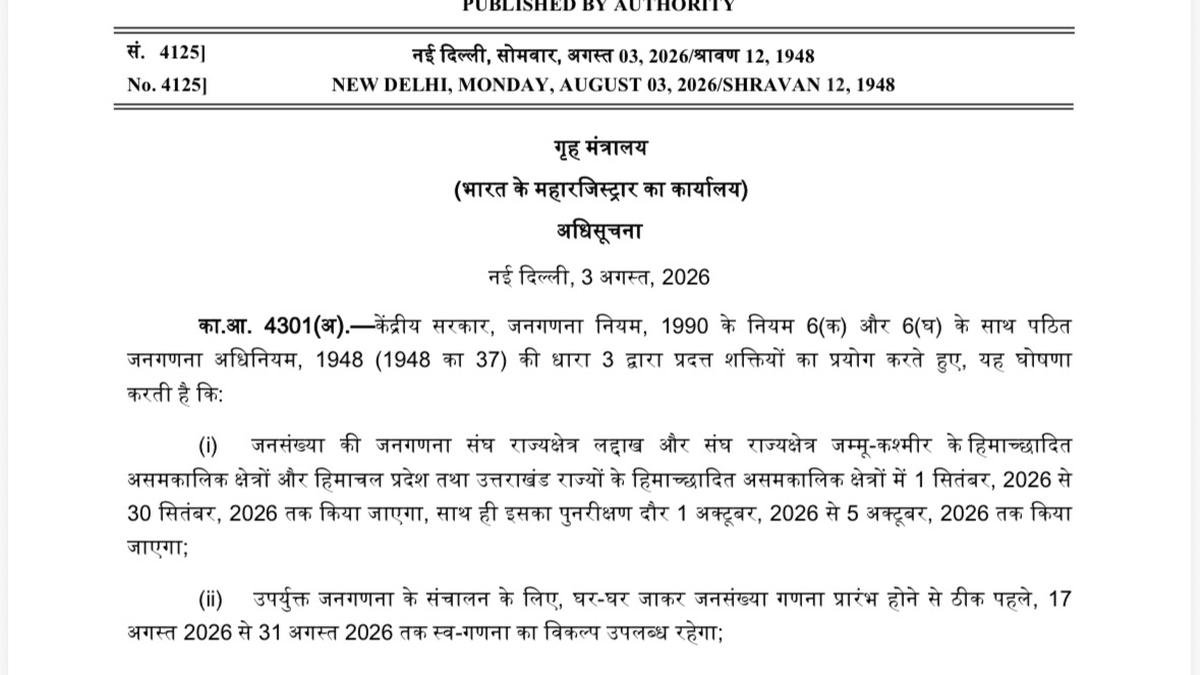
On August 3, the Registrar General and Census Commissioner of India notified in the gazette of India that “the conduct of Census of the population shall be undertaken in the Union territory of Ladakh and the snow-bound non-synchronous areas of the Union territory of Jammu and Kashmir and the snow-bound non-synchronous areas of the States of Himachal Pradesh and Uttarakhand, from 1st September, 2026 to 30th September, 2026 with a revisional round from 1 October, 2026 to 5th October, 2026”.
An option for self-enumeration will be available from August 17 to 31, before the start of house-to-house population enumeration, the notification said.