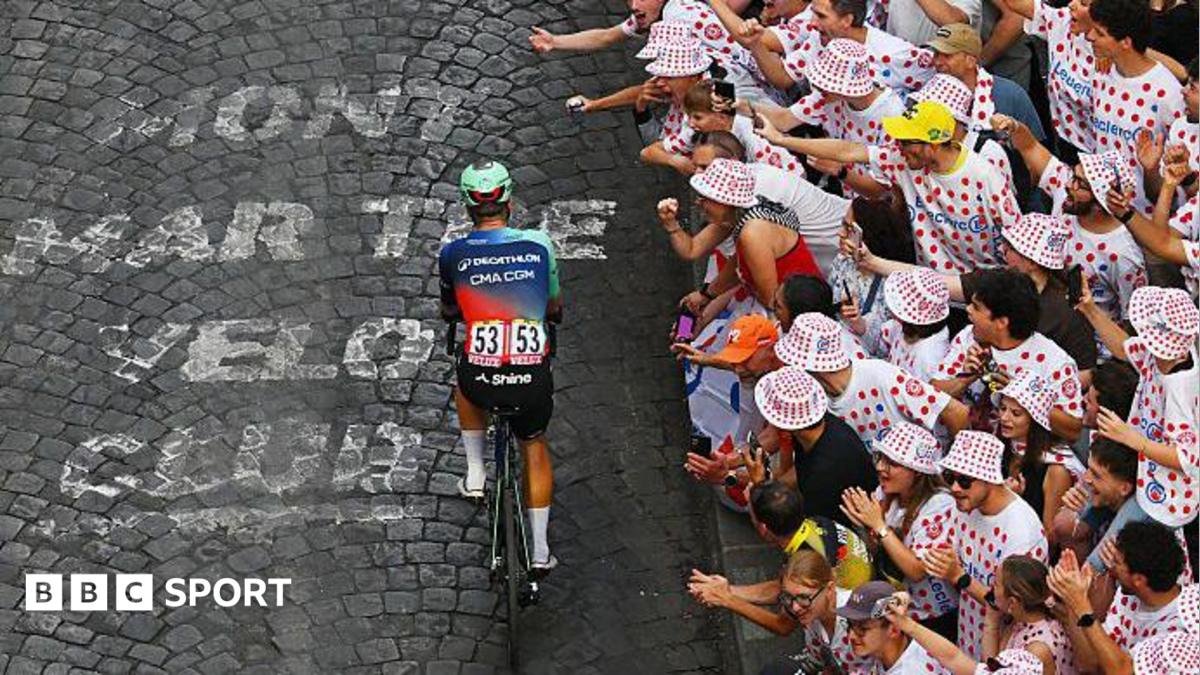
Image caption, A crowd of 180,000 spectators stood on Montmartre for Sunday's finale ByMatt WarwickBBC Sport Senior Journalist Published 38 minutes ago Tour de France fans were spoilt for choice in Paris when it came to drinking in the drama of cycling's greatest race.
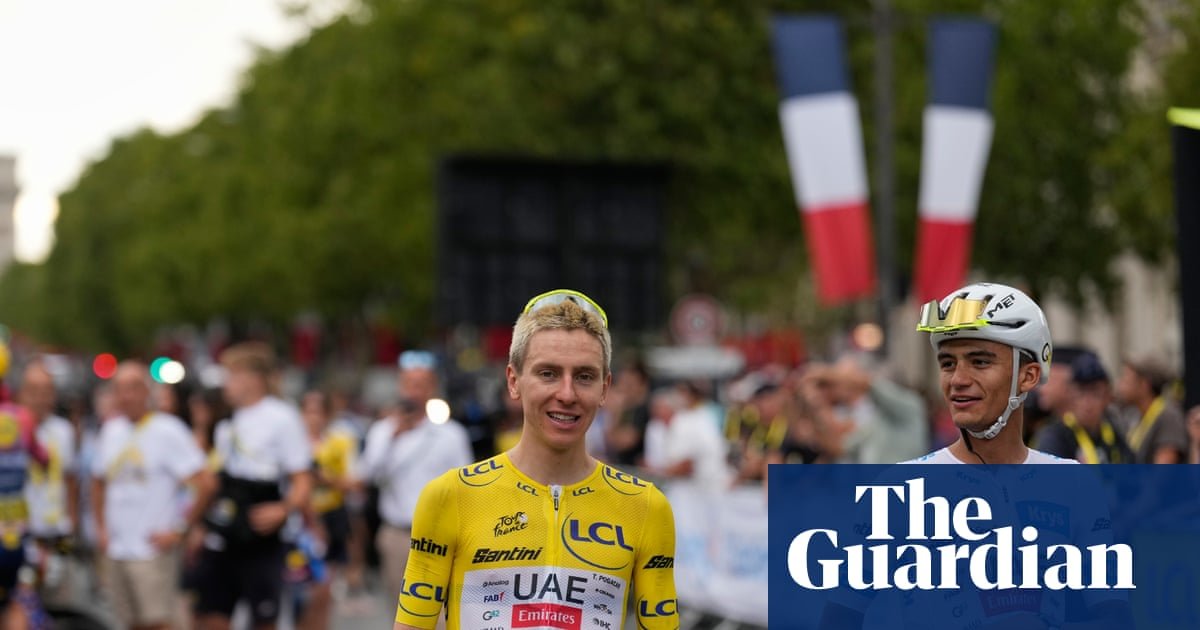
Should their attention be all on Tadej's Pogacar's crowning as the joint most successful rider of all time, with five Tour titles?
But then what about Mathieu van der Poel's superhero-style victory on the final stage, climaxing magnificently on the Champs-Elysees?
Or would the focus be on the sheer passion of a huge, fervent crowd which lined the streets on Montmartre and around Sacre-Coeur?
That last element illustrated a sport in rude health and again raised the question of why organisers had not run the traditional closing stage over the scenic cobbled hill before its debut visit last year.
Pogacar, the rarely beaten 27-year-old Slovenian, is widely regarded now as cycling's greatest of all time.
The fifth Tour win helps in that respect, matching fellow greats Jacques Anquetil, Eddy Merckx, Bernard Hinault and Miguel Indurain – but Pogacar can also point to his many successes elsewhere in cycling's other huge events, such as one-day monuments.
Brutal Belgian Merckx stood alone as the sport's greatest before now, thanks to a similar versatility on the bike – capable, like Pogacar, of winning in all formats: time trials, cobbles, high mountains and even some sprints.
But perhaps what elevates Pogacar to the top now is his respectful demeanour, paying tribute as he did in Paris to every one of his domestiques by name, before thanking his family.
He also shepherded his young UAE-Team Emirates-XRG team-mate Isaac del Toro across the line on more than one occasion during this year's race when his own job was done.
The fact Pogacar achieved what he did while most of his team-mates - and possibly even himself - suffered sickness across the second half of the Tour is even more remarkable.
The Tour de France still is, after all, one of the hardest events in elite sport.
The Tour de France has a chequered history that cannot be forgotten.
"He knows what the record is," Lance Armstrong said on social media following Sunday's result, referring to Pogacar.
The American's record of seven Tour de France victories between 1999 and 2005 has long since been wiped from the record books following the revelation of his systematic doping.
And those in the sport have fairly diligently avoided mentioning his name since.
But the night-time anti-doping tests during this year's Tour, which the International Testing Agency (ITA) told BBC Sport were undertaken as an "exceptional operation" and because time was of the essence, once again raised questions in a sport which doesn't need them, thanks to that dark past.
Testing at such anti-social hours is rare and requires additional permission, and some suspect it may have been a factor in Jonas Vingegaard's Tour-ending crash after he was woken at 2am the previous night, and Pogacar himself at 5am.
Others were tested at night, too, and all riders were tested during the race.
But what were the ITA looking for?
They wouldn't say, specifically, but one possible explanation for night-time testing of professional cyclists appears to be to gather as much information as possible to try to understand micro-dosing.
That is where an athlete could take performance-enhancing drugs, such as red blood cell stimulant EPO or anabolic steroids, in very small quantities to evade detection on the Athlete Biological Passport, which is endorsed by the World Anti-Doping Agency (Wada) and used across cycling.
There is no suggestion of wrongdoing in the case of Pogacar, Vingegaard or any of those tested at night this year.
Past findings produced by Wada suggest micro-dosing could evade detection methods, and so the scope to cheat in professional sport remains, meaning all efforts must be taken to ensure nobody beats the system.
The ITA cannot confirm when the results of the Tour tests will be made public, but EF Education-Easypost boss Jonathan Vaughters told BBC Sport: "Doubts?
Actually [those tests] solve my doubts." Vaughters, who doped during his riding career, is now reformed.
He said during this year's race: "If we had 24-hour testing in 2001 when EPO tests were first introduced we would have had a huge number of riders excluded from the sport, including me.
And it would have saved 25 years of drama.
"So I mean we wouldn't have had to go through Lance Armstrong...
The problem would have been solved immediately in 2000.
"If you introduce a low enough dose of a peptide hormone, the clearance time can be four hours - if you take it at 11 it'll be out of the system at 3am, so it makes a difference.
The testing technology is evolving quickly.
"If you want to watch a clean sport, watch cycling, most other sports' testing is a complete joke.
"Why is cycling so hyper-focused?
History.
This is human F1 car racing; this is edge of human performance; boundaries are always going to be pushed." Many riders and team bosses won't go near the 'D' word, and the consensus is 'believe what you are seeing' when Pogacar accelerates away and wins by, at times, a matter of minutes, and when others perform their own remarkable feats in the saddle.
Image caption, Half a million spectators watched on Alpe d'Huez UK prepares as thousands pack French mountains and cities Huge numbers of people do believe what they see.
About 500,000 spectators turned out in Paris on Sunday, with 180,000 around Montmartre alone.
And it doesn't stop at the Tour de France, as many of the bigger races on the calendar are seeing notably bigger numbers.
"You can't get to certain parts to watch it any more, everyone has been there all day.
Especially this year," said one journalist at Paris-Roubaix in April.
"There's so much traffic and so many people." And many fans have noticed the increase in numbers.
Another 500,000 people were estimated to have lined the roads up to Alpe d'Huez last Friday, as videos emerged on social media of crowds setting up camp days before, drinking and partying prior to the race arriving.
At the end of Friday's stage, Movistar's Colombian climber Einer Rubio was even involved in a harrowing incident when he crashed, face-first, into the back of one of the service cars belonging to Pogacar's team, breaking the glass.
The car had been forced to stop abruptly when a spectator fell immediately into its path.
Rubio was forced to abandon the race after being given 20 stitches in hospital.
The presence of Britain's women's Tour winner Lizzie Deignan and record Tour stage win holder Mark Cavendish on the Champs-Elysees on Sunday was a timely reminder that Britain will hosts six stages of the men's and women's Tour de France races next summer.
It will be summer when British fans hope Netcompany Ineos Cycling's new injection of investment will pay dividends – after they failed to win a stage in this year's race – and riders such as Tom Pidcock can light up the race on home soil.
Some 30.2m people cycled at least once in Britain in the past year, according to British Cycling, which is the highest number it has been since 2019-20.
By next summer it will be nearly a decade since a British rider has won the Tour.
While Pogacar will probably prevent it happening in 2027, many thousands of Britons are still expected to flock to witness the race in motion.