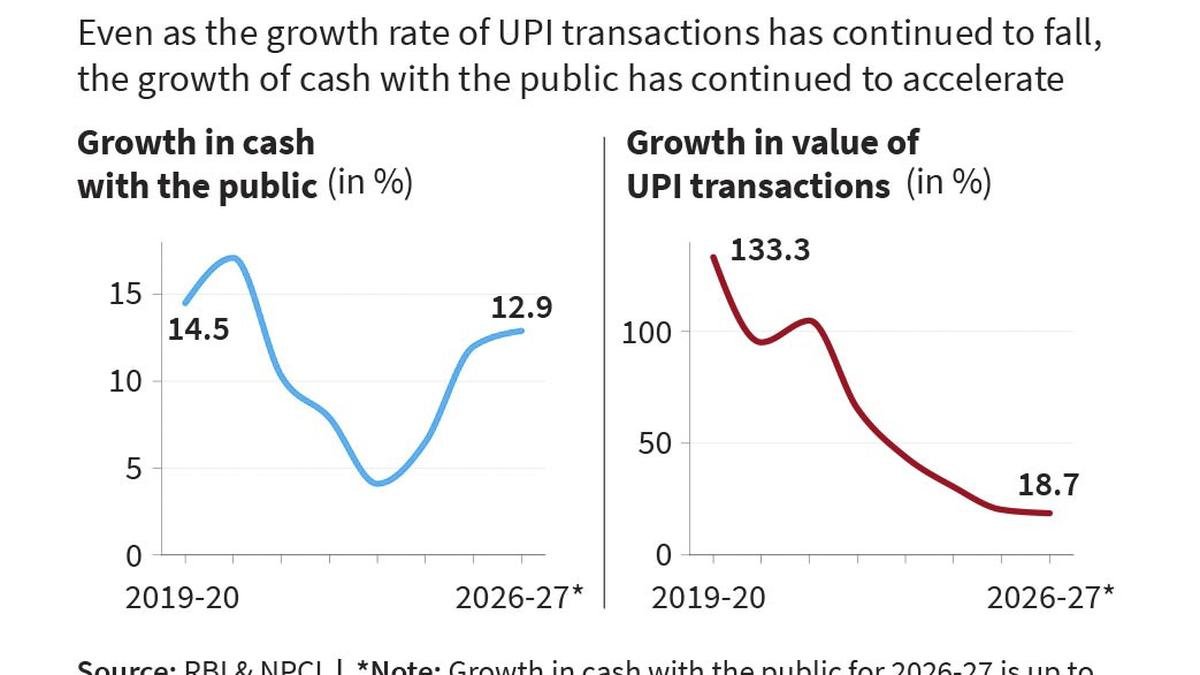
At a time when the government is proposing to allow the levy of a charge on UPI transactions, an analysis shows that the growth in the value of UPI transactions has been slowing for the last five years, while the growth of cash with the public has been quickening over this period.
Paywall: On a charge on UPI transactions While slowing, the growth of UPI transactions remains faster than the growth of cash among the public, but this margin is shrinking.
Experts say this is both a sign of higher economic activity and higher price levels than are being reflected in the official inflation data.
Will UPI remain free to use? | Explained UPI and RuPay debit card transactions are currently free, like cash transactions.
However, the government passed the Taxation and Other Laws (Amendment) Bill, 2026 in the recently-concluded Monsoon session of Parliament, which enables it to allow a Merchant Discount Rate (MDR) charge to be levied on these electronic transactions.
Cash is back An analysis by The Hindu of data from the Reserve Bank of India shows that the growth rate of cash with the public reached a recent high of about 17% in the COVID-19 pandemic year of 2020-21.
Thereafter, the growth of cash with the public fell consistently until 2023-24, where it hit about 4%.
Cash with the public is the total cash in circulation minus what is sitting in banks.
RBI has funds to pay for UPI platform without having to charge merchants, customers Since then, the growth of cash with the public has been quickening.
That is, this growth rate rose to 6.5% in 2024-25 and further to 12% in 2025-26.
In 2026-27, cash with the public, at ₹41.8 lakh crore as of July 31, 2026, was nearly 13% higher than in the same period of the previous year.
Finance Minister Nirmala Sitharaman and the Payments Corporation of India have made assurances that the general public would not have to pay the MDR charge on UPI transactions and that it would only be levied on certain high value merchants and transactions.
However, the Opposition has said that the merchants who do have to pay this charge would pass that higher cost onto their customers in the form of higher prices and that this could push people back to using cash.
UPI slowing but high UPI transactions, on the other hand, have seen their growth slowing over the last few years, as per data with the National Payments Corporation of India (NPCI).
The value of UPI transactions conducted in the country grew 133% in 2019-20, which then slowed to a relatively robust 95% in 2020-21 as the economy locked down.
It then quickened again to 105% in 2021-22 as the economy opened up and pent-up demand combined with health fears over handling cash to push up UPI usage.
Govt mulls MDR charge or ‘tiered incentives’ to make UPI financially self-sustaining Since then, however, the growth in the value of transactions done on the UPI platform has consistently been slowing, with growth hitting 20.3% in 2025-26.
In 2026-27, this has further slowed to 18.7% as of August 2026, as compared to the April-August period of last year.
However, this 18.7% growth in UPI transactions is still higher than the 13% growth in cash with the public in the same period.
Inflation likely understated According to Pronab Sen, former Chief Statistician of India and former Chairman of the Standing Committee on Statistics, the fact that both cash and UPI are growing should be showing itself in the form of higher inflation rates than what the official numbers are currently showing.
“This would imply that we are undercounting inflation, because that’s where this should show up,” Mr.
Sen told The Hindu.
“If there is more money being transacted, both digitally and in cash, then that should show up in inflation.
The first effect would be there.” “A lot of this could be explained if the official data showed prices were rising faster than they are,” he added.
The latest official retail inflation data for July 2026 stood at 4.45%, slightly higher than in June, while the wholesale data showed inflation had slowed marginally to 9.8% in July from 9.9% in June.
Signs of robust economy D.K.
Srivastava, chief policy advisor at EY India, says that simultaneous cash and UPI growth is a sign of a vibrant economy.
“The first reason is increasing economic activity in general,” Mr.
Srivastava said.
“That is to say, high growth rates.
We have been maintaining a real growth rate in excess of 7% in the post-COVID years.
That is the main reason why both cash transactions and digital transactions have increased.” Mr.
Sen, however, warned that an increase in cash transactions could also point towards distress in the economy brought on by high unemployment, especially among the youth.