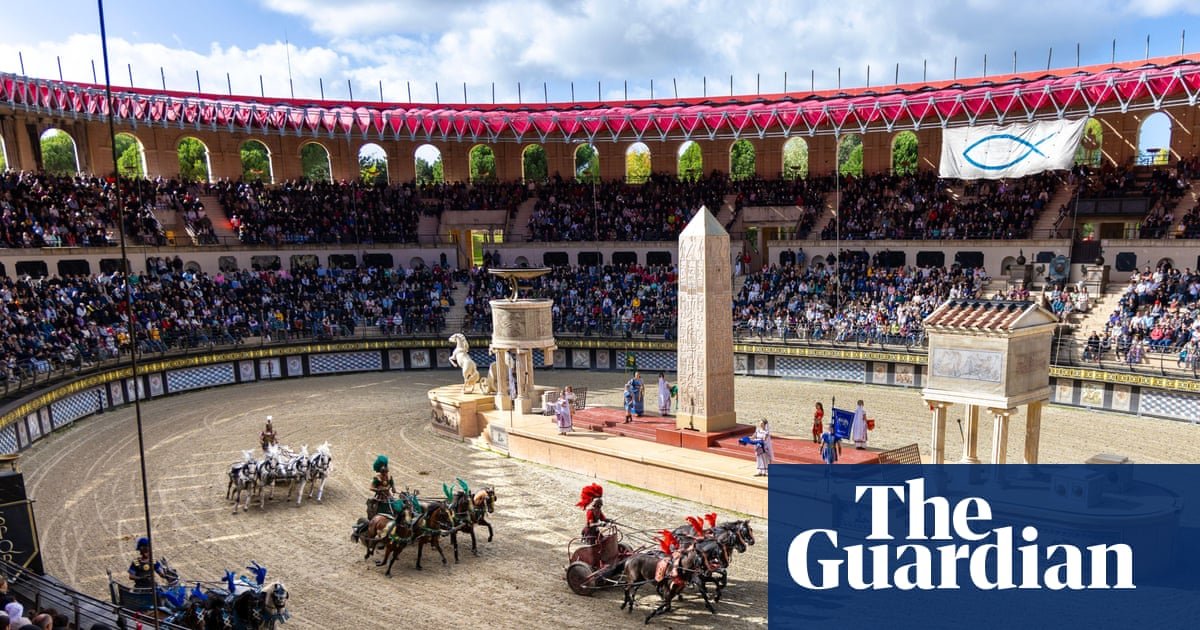
The Roman Colosseum at the Puy du Fou theme park in France.
The French company hopes to win planning approval for a £600m site in rural Oxfordshire.
Exclusive: Puy du Fou worked with under-sanctions oligarch on plans for Crimea resort longer than disclosed, and later courted Iran and China By Rob Davies In February 2014, thousands of “little green men” – Russian soldiers in unmarked uniforms – flooded into Crimea, seizing control of military bases and infrastructure.
Their arrival marked the opening salvo of Vladimir Putin’s annexation of the peninsula, an operation that ultimately escalated into the full-scale invasion of Ukraine.
In the months that followed the Crimean incursion, Washington and Brussels imposed sanctions on a host of Putin allies for allegedly providing backing for the assault.
Among them was Konstantin Malofeyev, a bushy-bearded media mogul, whose far-right ultranationalist ideology has seen him called the “Orthodox oligarch”.
Amid a western backlash, one powerful French family took a contrarian approach, extending the hand of friendship to Moscow and to Malofeyev.
Konstantin Malofeyev is the founder of pro-Kremlin television channel Tsargrad.
In the splendour of the Livadia Palace, where Joseph Stalin, Franklin D Roosevelt and Winston Churchill had once thrashed out the post-second world war order, De Villiers Sr and Putin discussed the French company’s plans for two new parks.
The venues, one of them in newly occupied Ukrainian territory, were to be a partnership with Malofeyev, and would “highlight Russia’s history and the significance of Russia’s soul”.
In the end, those grand plans never bore fruit.
Puy du Fou now has its sights set on different horizons.
Within days, it is expected to win planning approval for a £600m park in rural Oxfordshire, complete with re-enactments, mock medieval castles, themed villages, hotels and restaurants.
Map showing the planned Puy du Fou UK theme parkBut even as the company prepares to dramatise more than 1,000 years of British history, new evidence raises questions about the firm’s depiction of its own past.
Puy du Fou has previously played down its past flirtation with Russia and Malofeyev, claiming it began winding down the partnership once EU sanctions were imposed in July 2014.
But new documents seen by the Guardian indicate that the relations continued for many months and may, according to experts, have tested the very limits of EU sanctions.
They also raise questions about the family’s willingness to work with other autocratic regimes.
The documents reveal: Puy du Fou worked with Malofeyev’s company until August 2015.
The French company made payments to a key Malofeyev aide.
Executives discussed the risk of breaching sanctions.
When the plan collapsed, Puy du Fou turned to new horizons, including Iran.
The Chinese Communist party had script approval for a Shanghai park.
To Russia with Love “When I see the spiral of sanctions and counter-sanctions, I think European leaders are irresponsible,” Philippe de Villiers, then 65, told the French radio station RTL in August 2014.
“I would gladly swap [French leaders François] Hollande and [Nicolas] Sarkozy for Putin,” he added.
A 34-year-old Nicolas put it more romantically.
“He [Putin] is different from how we expected.
He has sweet words and sweet eyes.” Emmanuel Macron with Nicolas and Philippe de Villiers at Puy du Fou in 2016.
New evidence seen by the Guardian offers some insight into the partnership they had been building.
At least one of the parks was to be named Tsargrad (translation: Imperial City), the same name that that Malofeyev uses for his own media company.
A ‘term sheet’ document governing a 50:50 venture called Puy du Fou Tsargrad.
Nicolas de Villiers and Malofeyev had already signed a “term sheet” document governing a 50:50 venture called Puy du Fou Tsargrad, according to a document seen by the Guardian.
The timing of the agreement, signed on 12 July 2014, could not have been worse.
On 30 July 2014, the Orthodox oligarch was placed under sanctions by the EU, over his alleged financial backing for the annexation of Crimea.
The sanctions were designed to leverage western economic power to punish alleged participants in the Crimean incursion and deter further aggression.
The sanctions, Puy du Fou told the Guardian, spelled the end of the partnership.
“As the sanctions regime began to be implemented, in waves, we stopped working with a … now sanctioned individual we had been introduced to as a local partner.
“When the wider international effort was clearly stalled and not improving, we quite appropriately took the decision we did not want to be involved in Russia, and thus withdrew from all our potential projects and partners there, which took a little over a year to unwind in an orderly fashion.” Material seen by the Guardian appears to indicate an ongoing relationship with associates of Malofeyev, geared towards keeping the project alive.
In bed with an oligarch In September 2014, two months after Malofeyev was placed under sanctions, Puy du Fou staff circulated a document internally, outlining how the Tsargrad project might be restructured to reflect the geopolitical situation.
Organisational charts envisaged Malofeyev providing startup funding and short-term loans to a Russian entity, Tsargrad Puy du Fou LLC, which would pay the proceeds of operations to a bank account held by Puy du Fou International.
Notes attached to the document refer to the account using Russian roubles to “avoid probable effect of sanctions”.
Chart showing plans for an offshore company jointly owned by Konstantin Malofeyev and Puy du Fou.
Phase two of the scheme, according to the document, would involve the Russian entity being housed within an offshore company, jointly owned by Malofeyev and Puy du Fou.
The offshore company would hold the intellectual property to the park’s carefully scripted shows and collect dividends flowing from Tsargrad’s takings, distributing them to Puy du Fou and Malofeyev.
Another chart in the same document indicated that Malofeyev could remain a “minority shareholder” in a fund owning 50% of the offshore entity.
Internal correspondence seems to suggest that Puy du Fou was aware of the risks of the reorganisation, telling its Russian partners in September 2022 that it approved of the scheme but was wary of “the international context and the issue of sanctions”, which could expose the company to penalties.
There is no evidence that this structure was ever put into place.
But documents suggest that financial transactions with Malofeyev associates continued into 2015, funding activity that appeared to envisage the project going ahead as planned.
A budget for an early phase of the Tsargrad project A January 2015 budget document, seen by the Guardian, indicates that Puy du Fou continued casting actors for the project, even hiring a sports hall in Russia to stage the auditions.
The 23.5m roubles (almost £500,000) budget included itemised sums for office rental, payment of staff and 75 wristwatches engraved with the Tsargrad Puy du Fou logo, described as “gifts”.
Most of the payments were marked 31 January 2015, while at least one appears to cover a period up until April 2015.
Puy du Fou said: “There have inevitably been some low-level supplier/consultancy fees on either side as one cannot explore an international project for free; these has never been with any sanctioned entity, in compliance with French and EU law.” Internal records raise questions about how Puy du Fou complied with sanctions law.
They suggest that some of the transactions took place in partnership not with Malofeyev directly but with a business called Marshall Capital (MarCap).
The Viking show in the Puy du Fou theme park in Les Epesses, France.
Records indicate that payments to MarCap employees during 2015 were funded, at least in part, by Puy du Fou.
The French company’s main point of contact for ongoing discussions about the project and its budget, documents suggest, was Yury Leonov, an employee of MarCap and a key subordinate of Malofeyev.
Correspondence with Leonov continued during July 2015, when he wrote directly to Nicolas de Villiers to discuss “payment of January’s invoice”.
An email header showing correspondence in July 2015, with Oleg Ochinsky copied in.
Email exchanges between Puy du Fou staff in July and August were also copied to Oleg Ochinsky, a known business associate of Malofeyev, who was described in one internal document as Malofeyev’s “DG”, understood to mean “general director”.
One such email sent in July 2015, a year after Puy du Fou claims to have begun winding down its project, bore the subject line “meteorological studies”.
Puy du Fou does not appear to have taken a final decision to end its association with Leonov, Ochinsky and the Tsargrad project until at least August 2015.
Michael Ruck, a partner and sanctions expert at the law firm K&L Gates, said: “The circumstances in this matter appear to raise questions in relation to sanctions compliance and whether the relevant restrictions would prohibit any of the ongoing activities.
“When sanctions are imposed and a person or organisation is designated, the relevant restrictions apply immediately.
There is no automatic wind-down period and any transactions undertaken which breach the sanctions restrictions are prohibited unless a specific licence or derogation is issued providing for such a wind-down period.” Puy du Fou declined to answer whether it obtained such a licence.
It did not address the apparent transactions with MarCap employees or why it discussed “meteorological studies” with Leonov on a project that was winding down.
The company said it had been “caught off guard by the rapid deterioration of the geopolitical situation in Russia and Crimea”.
“Quite properly we cancelled this initiative once attempts to de-escalate the conflict had clearly failed and the international sanctions regime was being properly established,” it added.
Philippe de Villiers at an anti-abortion rally in Paris in January 2025.
There was a natural kinship between the French politician and the Orthodox oligarch, underpinned by faith and a brand of far-right politics deeply suspicious of groups such as Muslims and LGBT people.
Philippe de Villiers is a career politician, a former minister in the government of Jacques Chirac who once harboured presidential ambitions and is feted as a hero by many in the Vendée region of western France, where Puy du Fou is based.
He founded his own party, Mouvement pour la France, in 1994.
MPF’s manifesto included a ban on the construction of new mosques and a prohibition on gay marriage and same-sex adoption.
As a leading figure in the far right in France, he has declared Islam incompatible with the French Republic and railed against LGBTQ+ rights.
He is no longer involved in running the Puy du Fou business but remains a director.
Critics, including left-leaning historians in France, have claimed that the family’s deeply traditionalist Catholic worldview has skewed the version of history depicted at Puy du Fou.
Disneyland for dictators In promotional material on its website, Puy du Fou sets out its ambition to “conquer the world”, a mission that has seen the company explore projects in countries ranging from Singapore to Spain and from India to Italy.
In 2024, it opened the temporary City of Light show in Shanghai, bringing its brand of immersive drama to China.
Guests donned red cloaks and entered an interactive choose-your-own-adventure show set in the 1930s, getting up close and personal with actors as they engaged in carefully choreographed fights or stage musical numbers.
Puy du Fou’s success has always been underpinned its scripts, the first of which were written by De Villiers Sr.
Capable of transforming mere re-enactment into gripping theatre, the scripts are perhaps the company’s most valuable asset.
Gladiators fight at the Puy du Fou theme park in Les Epesses.
Internal messages, seen by the Guardian, show how senior executives bemoaned the “control of scripts by the government” yet appeared to accept this as an inevitability.
Puy du Fou said: “As with any project in any country, there is a statutory approval process which in China also includes any scripts being shown to the relevant authorities for prior approval.
“For absolute clarity, at no time did any individual nor any authority in China ever write or have control of any Puy du Fou scripts.” China was just one of Puy du Fou’s international ventures.
Another proposed partnership might be particularly surprising, given the views of Philippe de Villiers about Islam.
A letter seen by the Guardian – first published by the French satirical magazine Le Canard enchaîné – shows how the company courted the Iranian theocracy.
Sent in 2016 by Philippe de Villiers to Iran’s ambassador to France, the letter espouses expresses interest in a project that would showcase the “cultural refinement and historical depth of this great civilisation”.
A mockup of Puy du Fou’s plan for its theme park in Oxfordshire Puy du Fou said: “In 2016, at a time when sanctions were being lifted from Iran and many international companies were thus looking to invest again in the country, its French ambassador approached Puy du Fou to see if we were interested in pursuing a project there.
After what Puy du Fou described as a “very preliminary initial engagement”, the Iran plan went the way of Tsargrad.
Today, irrespective of the De Villiers’ sometimes controversial past, Puy du Fou’s international ambitions are flourishing.
A Spanish park, which opened in 2021, is thriving and Puy du Fou now looks primed for its greatest international adventure yet, the conquest of Britain.
Visit Britain, the UK’s tourist authority has swung behind the project, as has the UK government itself.
Planning approval is expected within weeks, with opening slated for 2029.
But as the first visitors flock through its doors to soak up British history, as told by Puy du Fou, questions remain about the story this French institution tells about itself.
Explore more on these topicsCrimea France Theme parks features Share Reuse this content