
The horror movie sensation of 2026 has its roots in gaming’s discovery of ‘noclip’ – and the hidden virtual realms that could be opened up inside games. Developers explain how everyone got lost in these liminal spaces
It starts on 4chan, in a May 2019 thread entitled “unsettling images”. The first post was a photo showing an empty room with the now iconic yellow wallpaper, no natural lighting and a kind of inexplicable jutting half-wall. Shortly afterwards, another user (there are no usernames on 4chan, just identifying numbers) responded with 78 words of text that would essentially lay out the blueprint for a future $262m A24 movie sensation.
“If you’re not careful and you noclip out of reality in the wrong areas, you’ll end up in the Backrooms,” the post begins. For the uninitiated, “noclip” refers to a game mode in which collision with solid objects is disabled, allowing players to move freely through walls and floors. Think of Chiwetel Ejiofor’s character in the film, finding a permeable wall in the basement of his furniture store and passing through to the world on the other side.
In games, noclip is intended for use by developers testing out their creations – but for decades now, players have been finding ways to access it themselves and reach hidden places they were never intended to see. It’s a phenomenon that Studio Chyr creative director William Chyr is intimately familiar with, both as a maker of games and as a player.
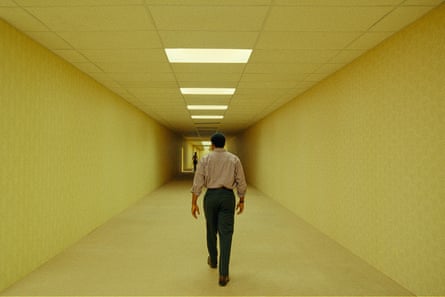
“Going behind the scenes, noclipping, and seeing the logic of the space, it’s like this Wizard of Oz moment of pulling open the curtain,” Chyr says. He remembers an early encounter with this in Batman: Arkham City: “There was this glitch that allowed you, if you kept spamming one of the grenades, to keep going higher and higher.” From there, the caped crusader could soar outside the level, into sections of Gotham that were only ever intended as a backdrop. “The streets had these cars that moved, but it was just a flat texture.”
Watching Backrooms, Chyr was also reminded of a similar bug in the notoriously janky Skyrim, where holding a wooden plate provided a quick way of noclipping out of the world. Looking at it from the outside in, players discovered that many of the game’s “tables” were in fact just bookcases embedded deep in the ground – just like the memorable Backrooms shot of a room in which the furniture is clipping through the floor. All these things that, in video games, the player is never meant to see.
The feel of Kane Parsons’ film is actually closer to these experiences than any of the many “official” Backrooms games that have popped up. The open-source nature of this mythos (as well as 4chan and Reddit, there are sprawling fan wikis cataloguing and expanding the lore) means that it’s possible to release your own game set in the Backrooms, using the name and iconography, in a way you couldn’t with another horror movie.
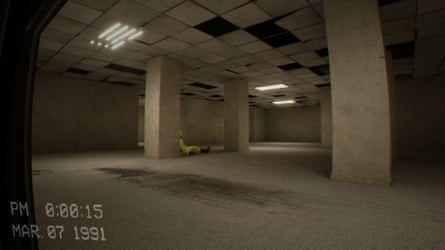
The most high-profile of these games, Escape the Backrooms, was first available in early-access form in August 2022, just months after Parsons’ first video. It offers a perfectly faithful recreation of the Backrooms aesthetic, from the yellow hallways to the yellow hazmat suits worn by agents of Async, the mysterious organisation only introduced towards the end of the film but a mainstay of the online incarnations. But all this is just wallpaper applied over the blueprint of a multiplayer survival horror game.
At its best, Backrooms taps into a sense of a place being “off”, in a way that’s unsettling but hard to pin down. It’s a delicate sensation, easily shattered (as it is in the film, I’d argue) by the presence of killer monsters. Even more so by the sight of another player in their gas mask and reindeer onesie, bunny-hopping through the hallways ahead.
Thankfully, there’s another stripe of Backrooms-inspired games offering nothing more than a self-guided tour through environments with a growing sense of weirdness and the constant suggestion of a threat lurking out of view.
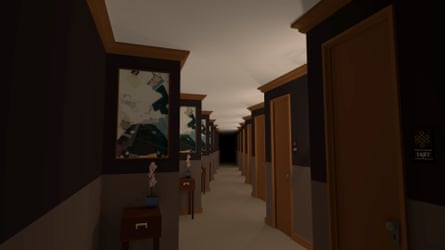
Pools and Dreamcore both shine a spotlight on Poolrooms, an infinite swimming-baths dimension first glimpsed in one of Parsons’s videos and codified by the fandom as Level 37 of the Backrooms, with a similarly alien approach to architecture. In Dreamcore, it’s just one of a selection pack of realms to explore. You’ll also explore a “dead mall” and the looping corridors of a hotel: both abandoned and seemingly endless, like the spaces explored in the film, but with less of an obvious supernatural edge.
These malls and hotels are prime examples of a larger online taste for liminal spaces from which Backrooms is just one offshoot.
“These spaces always feel like they’re past their prime,” says Chyr. “It’s clear there was human activity here, at one point, but no longer.” His 2025 game Hotel Infinity is steeped in all these ideas, to the extent that at one point Hotel Liminal was considered as a title, Chyr says. “But I thought that was just too on the nose!”
Set in the lifeless corridors of a hotel seemingly designed by MC Escher, it’s a VR game that uses some clever spatial trickery to fold its endless halls into a 2x2m square of your living-room floor. One particular sequence late in Backrooms made me think of Chyr’s game – he confirms that he thought the same thing. “I was like, damn, I wish we’d done that!” he laughs.
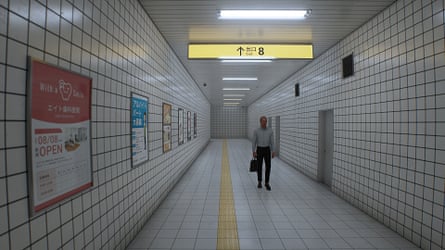
Hotel Infinity is primarily focused on the impossible architecture of these places, something it shares with Exit 8 (also adapted into a film this year), a Japanese-made game that traps you in an infinitely looping section of a Tokyo metro station. The other side of the liminal coin is the sensation summoned by that original 4chan image: the eeriness of an empty place that no longer has any obvious function, or perhaps never did.
One game exploring this aspect is Interior Worlds, a “liminal photography” game in which you explore such spaces armed only with an SLR camera. The game’s developer, who goes by the moniker Sodaraptor, remembers first encountering the concept of liminal spaces “back in 2020, when the original Backrooms post on 4chan started going viral.”
It was an emotion they’d felt in such places but never previously had a name for. “A strange liminal discomfort”, Sodaraptor says, mixed with pangs of “anemoia”: nostalgia for an era that predates your own experience.
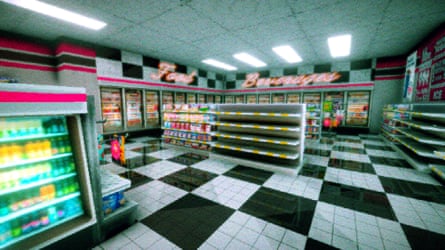
So it’s only fitting that the phenomenon’s virtual inspirations are now, in video game terms, as ancient as all those dead malls.
The aforementioned Arkham City and Skyrim both came out in 2011. The same year, Valve released Portal 2, the mind-bending first-person puzzler which Parsons has repeatedly cited as his biggest influence. The director even made a couple of Portal fan-videos; the last one was uploaded to his YouTube channel in 2021, just months before the first Backrooms clip.
It is probably inevitable that the aesthetics of these 15-year-old games would just now be beginning to seep through into the cinematic mainstream. Parsons was a young child when Portal 2 came out, and it’s only natural that he – and the generation of film-makers just now coming of age – would make things informed by the dark rooms they got lost in as kids.
A Minecraft Movie may already exist (unfortunately) but what will be much more interesting are the films and other artworks shaped by the experience of playing Minecraft at a formative age. Those dark caverns, the endless mines, the sounds of the zombies, the threat of the creepers – once those strange experiences have sunk into internet lore, who knows what will emerge and where it will take us.