Cooperation between One Nation and the Liberals ‘up to Angus Taylor’, Pauline Hanson says at conservative conference. How would that work?
Get our new political email, free app or daily news podcast
The annual Conservative Political Action Conference billed itself as a chance for the leaders of the three main conservative parties – Liberals, Nationals and One Nation – to make their pitch and compete for rightwing voters.
The reception they received in Brisbane on Saturday suggests Pauline Hanson is effectively the preferred opposition leader, with Angus Taylor relegated to leading a minor party.
But how would they work together, if the opportunity arose? While Hanson repeatedly criticised the Coalition, to laughter from the audience, the One Nation leader is keeping the door open to some kind of arrangement to defeat Labor.
Discussion of how to “unite the right” echoed around the Brisbane convention centre.
It was always a risk for Taylor, still leader of the second-largest bloc in parliament, to agree to equal billing on the conference lineup with Hanson, who leads a party room of five others. The Liberal leader was the first guest speaker, with his office calling his opening address a “keynote”, but CPAC had effectively advertised all three leaders – Taylor, Hanson and Matt Canavan – as co-headliners.
This framing would be remarkable in itself, if Hanson hadn’t already been operating as de facto opposition leader through 2026, while filling a void left by Taylor who has struggled for mainstream cut-through and political oxygen. Hanson followed Taylor on the schedule, but it’s the first time in a while – Taylor has been following her lead all year.
That Hanson literally took a seat Taylor had just vacated as they conducted back-to-back interviews with Karl Stefanovic, the One Nation leader nestling herself into a spot Taylor had just warmed up for her, was a moment that felt symbolic.
Sign up for Guardian Australia’s Politics, really newsletter here
Taylor was always up against it, in front of a CPAC crowd which leans more conservative than the centre-right. Beginning with a mea culpa for Liberal governments past – apologising for his role in immigration increases, pandemic spending and net zero – Taylor admitted his side “made mistakes” but were now “unashamedly on the right”. His speech favoured conservative talking points, including “big government”, “climate bureaucracy”, “NDIS fraud”, and no less than six mocking references to “socialism”.
While CPAC usually finds speaking slots for half the Coalition frontbench each year, Taylor is the first sitting Liberal leader to feature. It’s interesting that he felt the need to, or wanted to, front a convention where the demographic is somewhat outside the voters the Coalition must win back – those in the centre.
This audience represents a very activated, politically engaged conservative base. But with the Coalition vote still cratering eight months from Sussan Ley’s dumping, and One Nation’s rise carving off voters on the right, trying to win back some of that base makes sense for the Liberal leader.
It was a valiant effort to reclaim the Coalition’s mantle as “the most credible alternative government”, but not even Taylor’s newly announced immigration crackdown – confirmed, coincidentally or otherwise, just days before CPAC – could save him from heckles from those more partial to Hanson. A handful booed as he said net overseas migration would rise from 100,000 to 160,000 under the Coalition plan; more booed when he dodged questions from Stefanovic about why he wasn’t trying harder to work with Hanson.
This is where the problem lies for Taylor, presenting a vexed conundrum with no easy solution. While the Liberal leader’s speech ran through a list of relatively well explained Coalition policies – cutting taxes, indexing tax brackets, instant asset write-offs – and philosophical markers for how the Coalition would intellectually approach government, it was clear that much of the crowd wasn’t really buying what he was selling. The biggest claps Taylor got were when he railed against socialism and big government, not for talking up fiscal discipline.
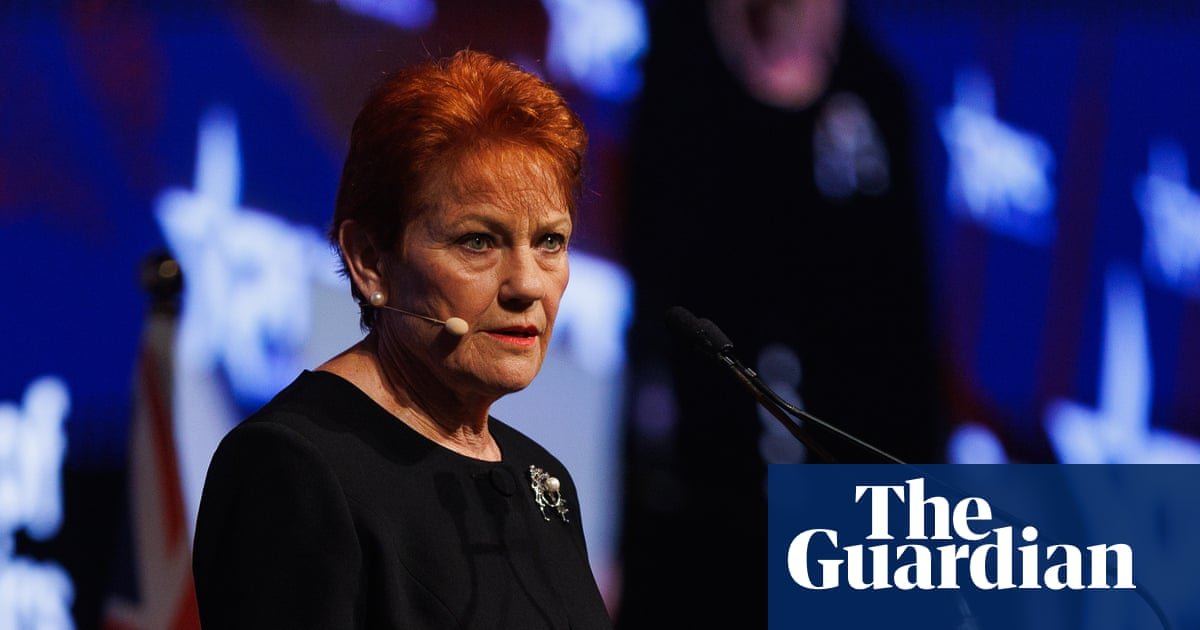
Hanson, by contrast, got a standing ovation from most of the room before even walking on stage, with a hype video – set to Vanessa Amorosi’s Amazing – playing her on. More scripted than usual, Hanson’s speech went to economic pain, anger at climate policies and “mass migration”, and criticism of “elitists”. Nearly every line received enthusiastic applause.
Despite claiming Australians don’t want a “smarmy management consultant” replacing Anthony Albanese, and questioning how conservatives could “trust” the Coalition, Hanson repeatedly signalled her keenness for rightwing parties to cooperate in some way.
In a press conference, she wouldn’t say exactly how that would work. Hanson said she didn’t want ministry positions for One Nation in a Coalition government, nor would she accept Coalition ministers in a One Nation government, appearing to rule out a formal agreement.
But asked if One Nation would continue playing hardball and beating up the Liberals, or if cooperation might emerge, she said it was “up to Angus Taylor”.
After seeing how his message went across to the Brisbane convention room, compared to Hanson’s, Taylor may have a lot to think about.
Josh Butler is a Guardian Australia political reporter and chief of staff in Canberra