By Ahmed Najar Palestinian political analyst and playwright.
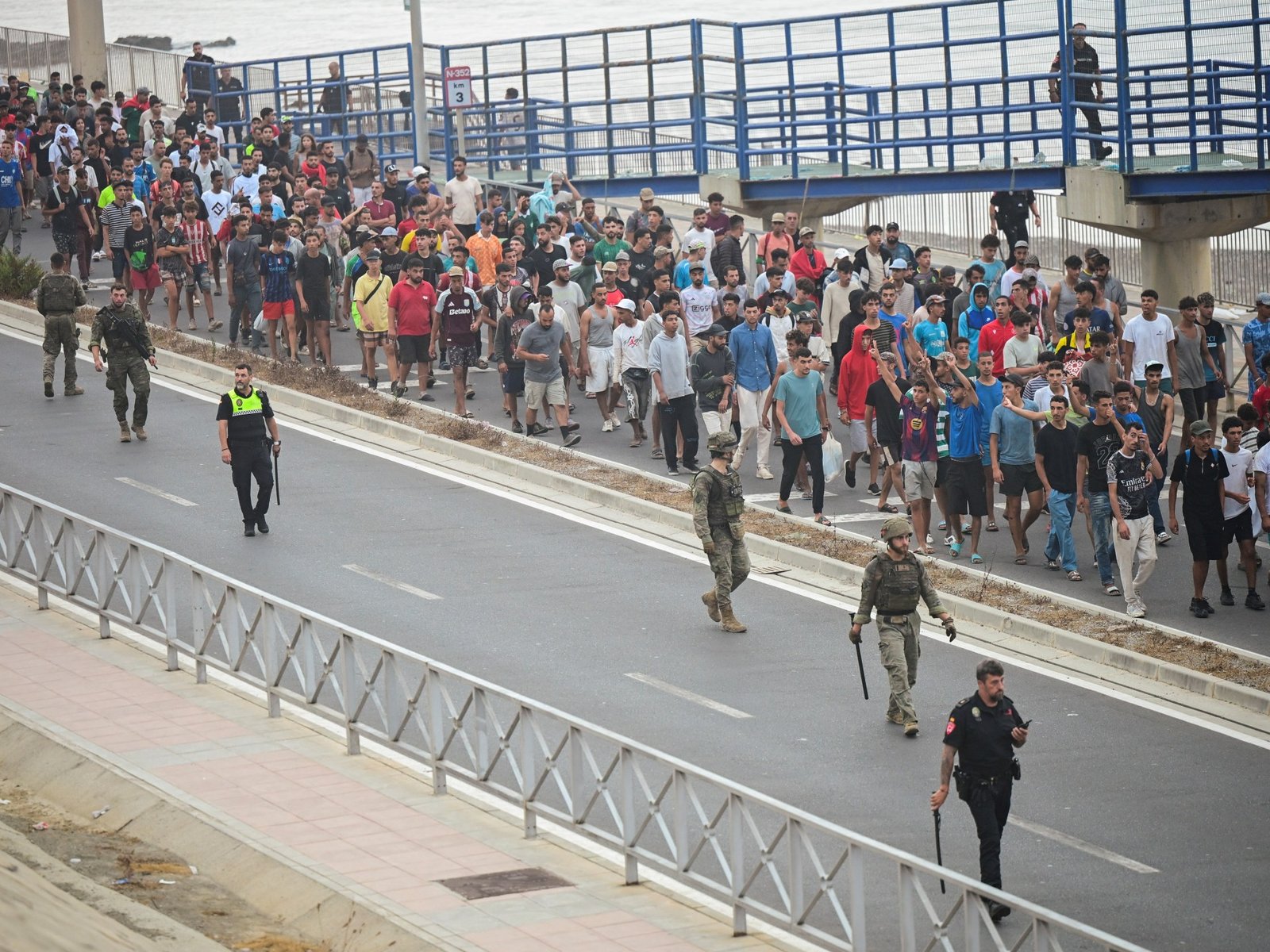
Spanish police officers and soldiers escort a big group of migrants to the border to take them out of Spain, after mass crossings from Morocco, in Ceuta on August 1, 2026 [Fabian Bimmer/Reuters] The scenes from Ceuta were tragic.
Thousands of desperate people attempted to cross from Morocco into the Spanish enclave, which left dozens dead and reignited one of Europe’s most contentious political debates.
Yet almost as quickly as the humanitarian dimensions of the crisis emerged, they were eclipsed by something else.
Within hours, social media was filled with warnings of an “Islamic invasion”.
The hashtag #StopIslam spread rapidly among far-right networks.
Politicians who had long campaigned against immigration seized on the events as proof that Europe faced not simply a border challenge, but a civilisational one.
Calls for tougher border controls quickly followed, while Italy announced it was reintroducing border checks with Spain.
The speed of that transformation is perhaps the most revealing aspect of the crisis.
Before investigators had established the full circumstances of the crossings, before many of those who died had even been identified, prominent politicians, commentators and online campaigners already appeared certain of what Ceuta meant.
That certainty deserves as much scrutiny as the tragedy itself.
The question to pose right now, therefore, is who benefited from the way the events in Ceuta were immediately interpreted.
The beneficiaries were quickly apparent.
Europe’s nationalist right found fresh material to reinforce long-standing warnings about migration and Islam.
Anti-Muslim campaigners gained another opportunity to portray Muslims as an internal security threat.
At the same time, the events fed into a broader narrative advanced by the Israeli government and echoed by its political allies in Europe: that Muslim immigration, rising criticism of Israel and concerns about anti-Semitism are increasingly intertwined.
Advertisement That narrative has become more pronounced since the war in Gaza.
As public outrage over Israel’s genocide has grown across Europe, Israeli officials have repeatedly argued that changing European attitudes are driven less by the scale of destruction in Gaza than by demographic change and the growing political influence of Muslim communities.
Israeli Prime Minister Benjamin Netanyahu has been one of them.
In speeches and public remarks, he has portrayed Israel and Europe as partners in a shared struggle against radical Islam, mass migration and what he describes as a broader challenge to Western civilisation.
In this telling, Israel is no longer simply defending itself; it is defending Europe itself.
This framing has profound political consequences.
It shifts the debate away from Israel’s genocidal conduct in Gaza and towards the identity of those criticising it.
Opposition to Israeli policy is no longer presented primarily as a response to humanitarian catastrophe, occupation or violations of international law.
Instead, it is increasingly framed as a consequence of demographic change and the political influence of Muslim communities.
Never mind that across European nations, majorities of up to 78 percent hold unfavourable views of Israel – nations where Muslims make up less than 10 percent.
Still, political leaders including Viktor Orban, Geert Wilders and Marine Le Pen stick to this narrative, expressing strong support for Israel while pursuing hard-line anti-immigration agendas.
In Britain, figures such as Tommy Robinson have similarly presented Israel as the front line in a broader civilisational struggle with Islam.
Increasingly, support for Israel has become intertwined with a wider political project defined by opposition to immigration, multiculturalism and Islam.
The convergence is striking.
For parts of Europe’s nationalist right, support for Israel provides an opportunity to present themselves as defenders of Jewish communities while pursuing policies directed against Muslim minorities and migrants.
For Israel’s current government, these movements offer reliable diplomatic support while reinforcing a narrative that links criticism of Israel to broader anxieties about migration and security.
The political interests are distinct, but they increasingly reinforce one another.
The consequences extend well beyond electoral politics.
Across Europe, debates about Palestine are increasingly discussed through the language of security.
Demonstrations against the war in Gaza are sometimes portrayed less as expressions of political dissent than as potential public order concerns.
Muslim organisations are viewed through the lens of counter-extremism.
Campaigns for Palestinian rights are, in some quarters, presented not as movements grounded in human rights or international law, but as vehicles for imported anti-Semitism.
Advertisement None of this diminishes the reality of anti-Semitism.
It remains a serious and persistent form of racism that must be confronted wherever it appears.
But there is an important distinction between combating anti-Semitism and broadening its meaning to encompass criticism of Israeli government policy.
When that distinction becomes blurred, legitimate debate is narrowed, and a vital tool for confronting genuine anti-Semitism risks being weakened through overuse and politicisation.
Seen in this context, Ceuta becomes more than a migration story.
The remarkable speed with which politicians, commentators and activists converged around familiar themes suggests that the political infrastructure for interpreting such events already existed.
Whether coordinated or entirely independent, the political effect is the same.
One narrative reinforces the next.
Fear of migration fuels hostility towards Muslims.
Hostility towards Muslims makes solidarity with Palestinians appear increasingly suspect.
Once support for Palestinian rights is reframed as a security concern rather than a political or humanitarian one, scrutiny of Israel’s actions becomes easier to dismiss.
This matters because the debate is no longer only about borders.
It is about legitimacy.
It is about whose voices are considered credible, whose suffering deserves recognition and which political causes are regarded as legitimate.
If solidarity with Palestinians can be portrayed as the product of demographic change rather than a moral response to the devastation of Gaza, then attention shifts away from the conduct of states and towards the identities of those raising concerns.
Ceuta should have been remembered first and foremost as a humanitarian tragedy.
Instead, it became another chapter in Europe’s culture wars.
When humanitarian disasters are understood less through the lives they destroy than through the political narratives they can sustain, truth risks becoming secondary to political utility.
Fear ceases to be merely a reaction to events and instead becomes a governing ideology.
And once fear becomes ideology, impunity is never far behind.
The views expressed in this article are the author’s own and do not necessarily reflect Al Jazeera’s editorial stance.