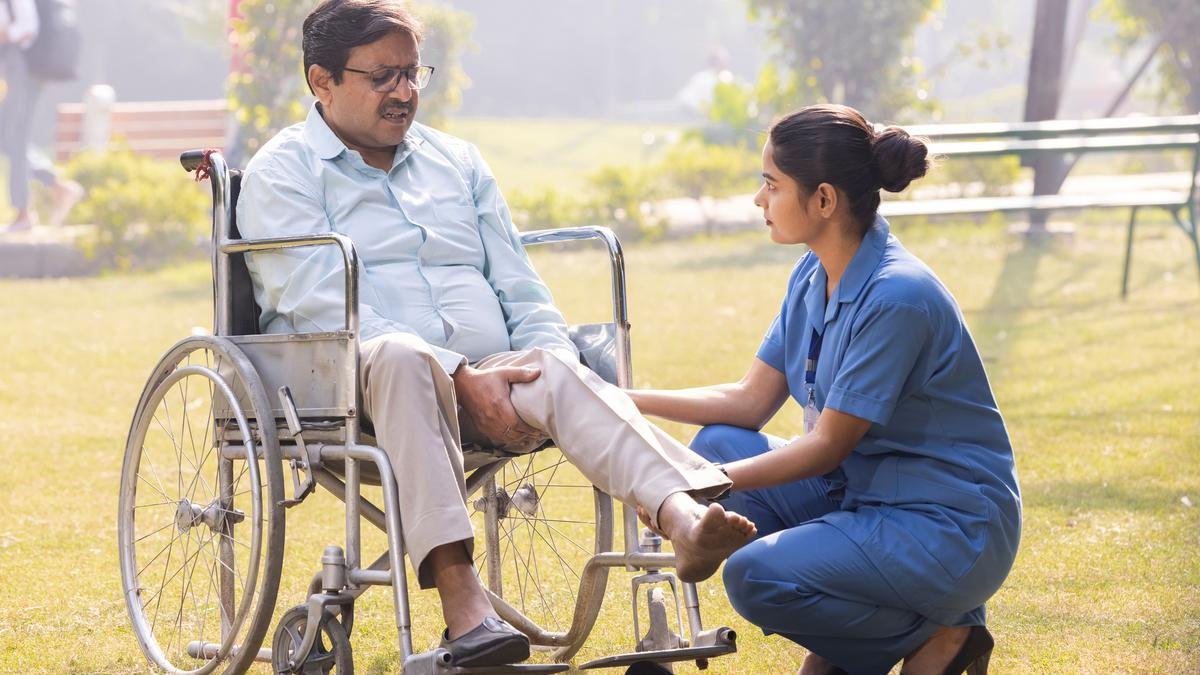
To establish a comprehensive framework for registration of allied and healthcare professionals (AHP) in both the State Registers and the Central Register, the National Commission for Allied and Healthcare Professions (NCAHP) under the Ministry of Health and Family Welfare notified the Registration of Allied and Healthcare Professionals Regulations, 2026 on August 31, 2026, and published it in the Gazette of India on September 15, 2026. (Sign up for THEdge, The Hindu’s weekly education newsletter.) Under the new regulations, all allied and healthcare professionals spanning 57 vocations across 10 broad disciplines, including physiotherapists, dietitians, lab technologists, forensic psychologists, among others, will soon have to register in the State and Central registers to practise in their chosen fields.
Registration certificates, including digital certificates featuring the Unique Identification (UID) number and a secure QR code, will be issued to the professionals by the Commission or the respective State Council.
This will facilitate identification and verification of registered professionals and support greater transparency in the delivery of allied and healthcare services.
The registration and payment of the fee will be processed on a dedicated online portal developed by the Commission.
Academic reform for allied health: strengthening the foundations of healthcare “These regulations mark a leap towards streamlining the allied and healthcare workforce.
Unless and until the professional gets the UID, he/she will not be able to practise/work.
There is a penalty of up to 6 months to two years’ jail term under the NCAHP Act-21 if the professional practices without registration,” Dr.
Yagna Unmesh Shukla, chairperson of NCAHP said.
“The regulations also aim to bring uniformity in the registration of allied and healthcare professionals and ensure renewal.
With this registration, the actual number of qualified professionals will be available, as well as the difference between qualified and non-qualified professionals, which is also one of the key objectives of the NCAHP Act-21,” she added.
Public access Highlighting that the registration process is the first of its kind in the history of allied and healthcare professions, Dr.
Shukla says that the regulations provide a real-time synchronisation between the State Registers and the Central Register through an integrated online system.
Further, the Central and State Registers will be accessible to the public through the websites of the Commission and the respective State Councils, which will display the prescribed particulars of registered professionals.
Since only persons meeting the prescribed eligibility requirements, including recognised qualifications and the applicable exit examination requirements, will be eligible for regular registration, this will provide an important safeguard for patients and service users by promoting the practice of appropriately qualified professionals.
The public will be able to verify the registration status and relevant details of allied and healthcare professionals through the websites of the Commission and the respective State Councils.
Professionals residing in a State or Union Territory where a functional State Council has not yet been established may register directly with the Central Register.
A key feature of the Regulations is the flexibility they give to allied and healthcare professionals to register in one State and practise in another State.
“This will mitigate the hassles professionals face when applying for registration in another state.
All they now need to do is fill out the form and inform the state in which they reside of the state where they intend to practise, so that this information remains on record.
Since each registered professional is provided with a UID number, all their records are documented, facilitating the smooth transfer of registration details from one state to another,” Dr.
Shukla said.
Apart from registration certificates, including digital certificates featuring the UID and a secure QR code, registered allied and healthcare professionals will also have access to a Good Standing Certificate.
It will help professionals pursue any foreign education or profession or participate in student exchange programmes outside India.
“There is a big difference between registration and a Good Standing Certificate.
Registration is the licence to practise in India, whereas a Certificate of Good Standing is issued by the State Council when required by various countries for professionals who wish to work or study in those countries,” Dr.
Shukla says.
Registration of foreign-qualified professionals The Regulations establish a pathway for Indian citizens holding foreign qualifications in allied and healthcare.
A foreign-qualified allied and healthcare professional will be considered eligible to apply for registration provided his qualification is recognised by the Commission, or he has completed the prescribed credential equivalency evaluation, and has also passed the relevant exit examination, where applicable.
“It is important to have an equivalence process of foreign qualified professionals in place for the safety of the patients,” Dr.
Shukla adds.
Union Health Ministry brings in new competency-based curricula for 10 allied and healthcare professions There is also provision for temporary registration for eligible foreign-qualified Indian professionals for specific, time-bound purposes, including postgraduate or specialty education, fellowships, clinical research, observerships, advanced workshops, expert visits, and voluntary community service.
Such registration remains subject to the conditions laid down in the Regulations and applicable regulatory guidelines.
Validity period Under the regulations, the registration will remain valid for five years, renewable upon the fulfilment of Continuing Professional Development (CPD) requirements through approved online and offline modes.
This means that professionals must upgrade themselves professionally (15 hours per year) by attending seminars, conferences, workshops, training programmes and faculty development programmes.
“It is important for professionals to update and upgrade themselves in their respective professions.
Since the regulations are being implemented for the first time, flexibility in the CPD programme is being permitted.
This explains why 50% of these participations in online mode are being considered,” Dr.
Additionally, the Commission is making efforts to introduce provisional registration for professionals currently practising in the allied and healthcare sector who lack the prescribed primary qualifications.
Such professionals will be provided with an option to undergo a bridge course to attain eligibility for regular registration.
The Commission is making concerted efforts to introduce provisional registration for professionals currently practising in the allied and healthcare sector who lack the prescribed primary qualifications.
“Those who are practising for many years and are not qualified as per the provisions of the Act will be registered under the Provisional Registration Act and will have to undergo a prescribed Bridge course within the given time period to attain eligibility for regular registration,” Dr.
Interim registrations The Regulations have also introduced provisions for interim registration for students enrolled in recognised institutions who are undertaking internships, clinical training, observerships, or practical coursework required to complete an allied and healthcare qualification.
Interim registration must be initiated by the recognised institution and obtained from the concerned State Council.
No fee will be charged for interim registration applications, the NCAHP regulations stated. (Rajlakshmi Ghosh is a journalist with over three decades of experience in media houses and educational institutions)