Michigan senator-elect also secured a meeting with JD Vance, who called him a ‘terrible evil’ in lead-up to election The incoming US senator Abdul El-Sayed of Michigan said that he and Donald Trump were in agreement about ending foreign military aid to Israel – and he hopes to find more common ground with the US president when he takes office.
“I agree with the president – I can’t believe I’m saying that – that we need to end foreign military aid that is unconditional to Israel, as well as Egypt and Saudi Arabia and Pakistan,” the senator-elect said.
In a surprise election day announcement, Trump told Fox News that the US would end military aid to Israel at the end of this year under an agreement reached with that country’s prime minister, Benjamin Netanyahu.
“I think we need to be applying very basic international law to what Israel is and has been doing,” El-Sayed added.
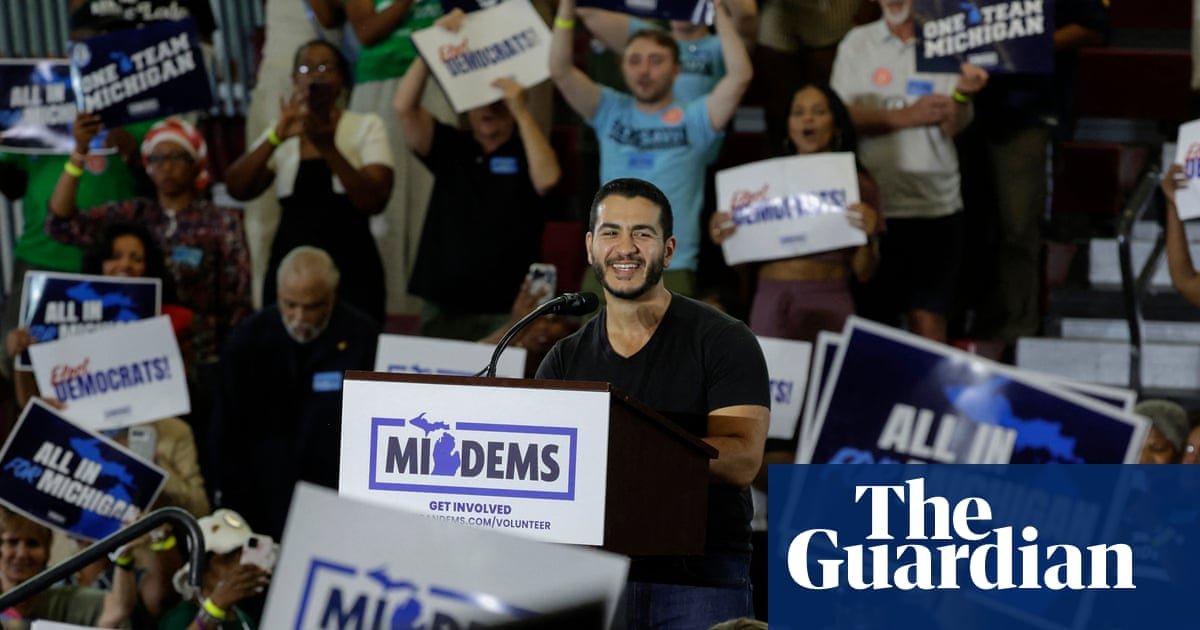
“We should not continue to be running cover for them at the UN, at the ICC, at the ICJ.” Abdul El-Sayed at a campaign event in Muskegon, Michigan, on 11 October 2026.
The comments come after El-Sayed said he has secured a meeting with JD Vance.
The senator would not share the agenda of the meeting, but confirmed that the vice-president’s chief of staff reached out to him after his election victory.
El-Sayed has goaded the Trump administration into working with him.
In recent days, he created a shiny gold “TrumpCare” card and said that Trump can call Medicare for All “TrumpCare” if it will help expand healthcare to more Americans.
Vance regularly attacked El-Sayed on the campaign trail, calling the incoming senator a “terrible evil” and “corrupted”.
After El-Sayed won his race, he called Vance “habibi”, a term of endearment in Arabic, and joked about how the vice-president will have to preside over his swearing-in ceremony in January.
Abdul El-Sayed greets supporters who were not able to attend his campaign event after it reached maximum capacity in Traverse City on 10 October 2026.
El-Sayed, who will become the first Muslim US senator in January, overcame tens of millions of dollars spent against him, first in a closely watched primary and then a swing-state general election.
He has three immediate goals once he’s sworn in, he told the Guardian: stopping the “nuclear bomb” of Medicaid cuts, ending the war in Iran and addressing the “stupid approach” to tariffs.
He also plans to propose Medicare for All legislation, get to work on voting rights legislation after the US supreme court gutted the Voting Rights Act, advance the Pro Act to expand union rights and overturn Citizens United, the supreme court decision that unleashed unfettered outside spending on campaigns.
El-Sayed is supporting the Maryland senator Chris Van Hollen’s bid for the Senate leadership role.
El-Sayed said Van Hollen, an advocate for Palestinian rights, would be an “amazing leader, and he’s a departure from a lot of the instincts of the past”.
Van Hollen was an early supporter of El-Sayed in his primary election against the US representative Haley Stevens and campaigned for El-Sayed.
As part of his campaign promise to change the Washington establishment, El-Sayed said he would not be moving his family to the US capital, and would be spending a lot of time back in Michigan doing town halls and talking to voters.
Abdul El-Sayed arrives at a press conference in Detroit on 22 September 2026.
He’s one of a large group of incoming senators and representatives who skewed younger this cycle and also have young children.
The “somewhat erratic” schedule of the job makes it harder on people with kids, he said, so making the US Capitol building a “free and open place” for children would help.
The Capitol should help “good senators and congresspeople also be good parents”, he said.
“I think one of the challenges with service is that we forget that every public servant is a private servant too, and that’s to their families, in particular to their children,” El-Sayed said.
“And those two things shouldn’t be mutually exclusive.” Throughout his campaign, El-Sayed faced Islamophobic rhetoric, including from Trump and Republican officials.
Though his campaign wasn’t about defending himself, Michiganders rejected those attacks when they voted him in, and that was important, he said.
“There are a lot of kids who are watching,” he said.
“And when the president of the United States is attacking somebody for their name or how they pray, it’s important that the people of the state of Michigan stood up and said, ‘No, this is not how we want to be.’ And I think they sent a message that was loud and clear, and I’m really grateful for that.” Explore more on these topicsUS Senate Michigan Donald Trump JD Vance Israel US midterm elections 2026 US Congress news Share Reuse this content