machinery that helps cells divide, and have used it to restore cell division in cells from which a crucial structure had been removed.The finding could help scientists understand how cells divide and, eventually, identify new targets for drugs against diseases such as cancer.
The study has been published in EMBO Reports.
And their new technique may also help further cancer researchCell division is a tightly controlled process.
Before a cell splits into two, its genetic material has to be copied and then pulled apart accurately.
This is done by the mitotic spindle, a network of thread-like structures that attaches to the genetic material and separates it.The centrosome, a small structure inside the cell, helps organise this spindle.
It’s made up of more than 200 components, but which are essential has remained unclear..The IISc team has developed a technique called Light-Induced Spindle Activation (LISA), which allows them to switch on Aurora A, an enzyme involved in building the spindle, by shining blue light on it.Aurora A normally becomes active at the centrosome, where it gathers into clusters.
Scientists had believed that a protein called Cep192 was needed to help activate it.
LISA showed that Aurora A can instead be artificially clustered and activated using light, without Cep192.Researchers adapted an existing technique called LARIAT, which uses light to make proteins cluster together.
They attached Aurora A to a light-sensitive plant protein called CRY2 and introduced it into human cells.When blue light was shone on the cells, CRY2 interacted with another protein, CIB1, causing Aurora A molecules to cluster.
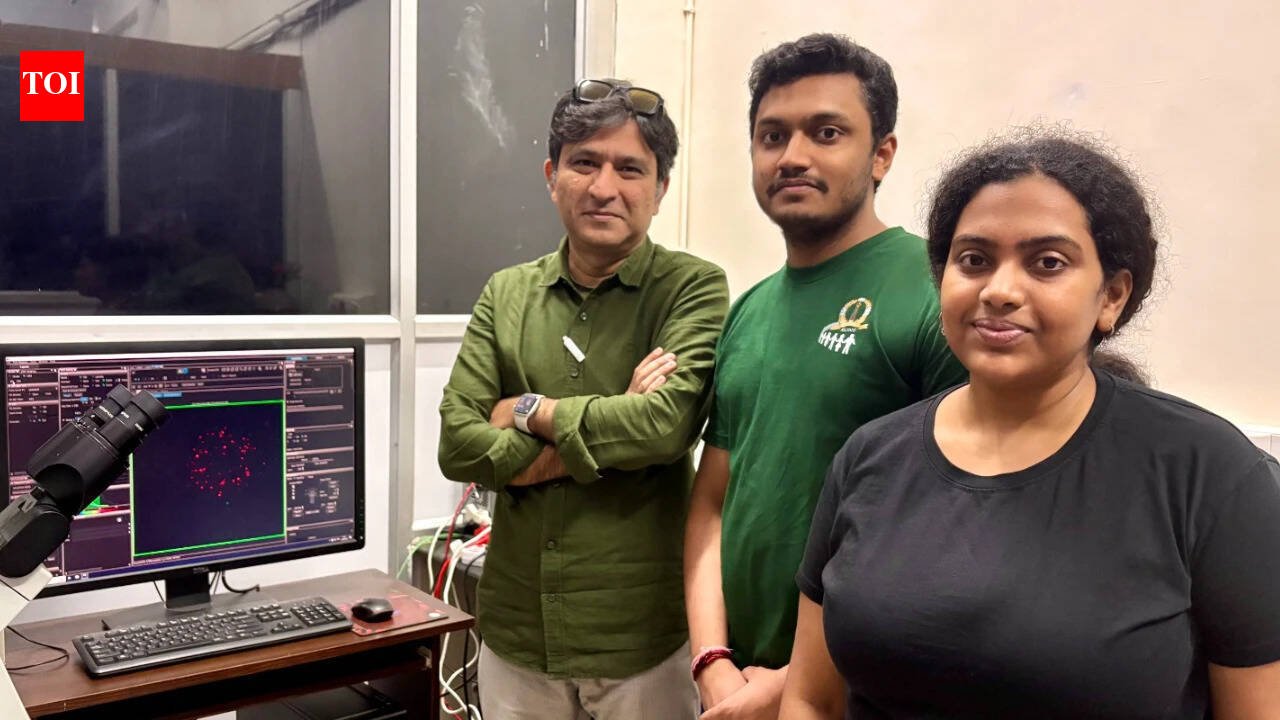
This, in turn, triggered the formation of microtubules, the tiny structures that make up much of the spindle.“This provides a novel way to trigger and activate an artificial Aurora A kinase complex – Aurora A fused to light-sensitive plant proteins, which is sufficient to induce microtubule nucleation,” Vignesh Olakkal, a PhD student in Sachin Kotak’s lab and first author of the study, said.Researchers then asked whether the technique could actually compensate for a missing centrosome.
They chemically removed centrosomes from human cells, which normally causes problems during cell division.
They then introduced the light-controlled Aurora A system.When blue light was applied during cell division, Aurora A clustered and triggered the formation of microtubules.
The cells were able to rebuild their spindles, effectively rescuing the division defects caused by the loss of centrosomes.Join conversation Share your thoughts in the comments Be respectful · TOI community guidelines The technique may also help in cancer research.
Aurora A is overexpressed in many solid tumours and is already targeted by some drugs.
But because the enzyme acts on several different proteins, it can be difficult to determine exactly which of its functions should be blocked.“In many solid tumours, Aurora A kinase is overexpressed, and that’s why there are drugs targeting it.
But Aurora A kinase has multiple targets.
Now, with our strategy, we can find out what the Aurora A kinase-specific targets are, independent of the centrosome, as far as microtubule nucleation is concerned.
Then we will hopefully be able to find other targets of Aurora A kinase and design drugs,” Kotak said.