In the two cities of China, in Nanjing (Jiangsu province), Changsha (Hunan province), the rapid modernisation and technology driven life does not seem to make history disappear, instead, they co-exist side by side.
Amid the tall glowing high-rise buildings, and flashing flights of the 3-D billboards, history of the people is still preserved in its original form.

The Jinggang Ancient Town | Photo Credit: Shrabana Chatterjee
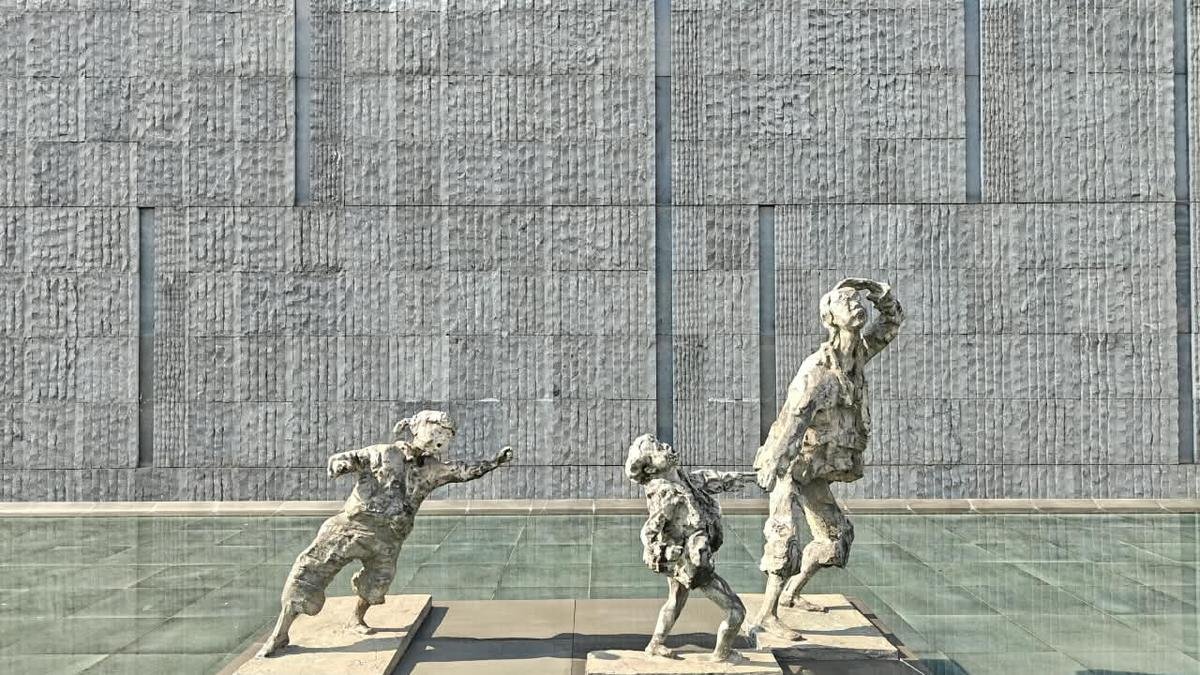
One of the best examples of this preservation is in the war memorial of “Memorial Hall of the Victims in Nanjing Massacre by Japanese Invaders“ where the skeletons of thousands of people are still preserved the way they were found, including many of children. Amid the high rises of the high-tech city lies the war memorial, cradled right in the heart of the city as thousands gather there every day to remember the people before them who sacrificed their lives for the country.
“There was another construction going on here. But when they discovered so many bodies of people killed in the Japanese massacre, they stopped construction, preserved it and built the museum here,” said the guide in Nanjing who helped understand the artifacts and showcases at the museum.

The vibrant city of Changsha | Photo Credit: Shrabana Chatterjee
According to the Chinese officials, over 300,000 people were killed in the Nanjing massacre and their names, photos are still preserved in these halls. The footprints of the survivors and their photos have also been imprinted on the roads and walls of this memorial hall.
The memorial is a reminder that rapid urbanisation has not necessarily meant the erasure of difficult histories. In the middle of a modern city, the memory of those who died continues to occupy a physical and emotional space.
A similar blend of history and technology is also seen in Changsha at the “Yuelu Academy“, a university in the heart of the city, on the west bank of the Xiang River. With a history of 1000 years, Yuelu Academy is a famous institution of higher learning, and one of the top four learning centres in ancient China. This 10 century old university is preserved in one of the highest tech driven cities of China even though many new modern learning centres have cropped up all across the country.

The footprints of the survivors of the Nanjing massacre, which have been preserved at the Memorial Hall of the Victims in the Nanjing Massacre by Japanese Invaders | Photo Credit: Shrabana Chatterjee
The local English-speaking Chinese guide in Changsha also said that many of the old inscriptions have been preserved on the walls of the Yuelu Academy. Even the historic structures, like the halls, and buildings of this academy have been restored in its original shape to pass on to the next generation.
In most places they have used technology to preserve history and work in sync with the culture and not replace one with the other. As new-age high rises and flashing billboards throng the lanes of China, the old buildings, pagodas, and city walls from centuries ago also remain thriving amid the flashing lights of the new developments.
Like in the “Hunan Museum“, the Han Dynasty Tombs Exhibition the tomb of Lady Xin Zhui (died around 168 BCE), has been recreated to replicate the original wooden structure of the massive tomb with the help of new technology to preserve history for the newer generations.
Away from the museums and institutions, the preservation of traditional culture takes a more lived form at Jinggang Ancient Town, around 50 km from Changsha.
This quaint town offers life at a slower pace to replicate the older days of China. Traditional buildings, puppet shows, boat rides, street plays, and traditional lanterns hanging on the streets as time stands still. Here, preservation is not confined to objects behind glass. Elements of traditional culture are brought into public spaces and presented as part of the town’s living heritage.
In Nanjing and Changsha, the past does not appear to exist in opposition to the future. They sit together, in memorial halls surrounded by high-rises, in a millennium-old academy frequented by modern-day students, and in ancient towns where traditional performances continue under the glow of electric lights. The contrast is perhaps less about choosing between old and new, and more about how the two continue to occupy the same streets.
This reporter was a part of a media delegation from Kolkata to China in mid-August