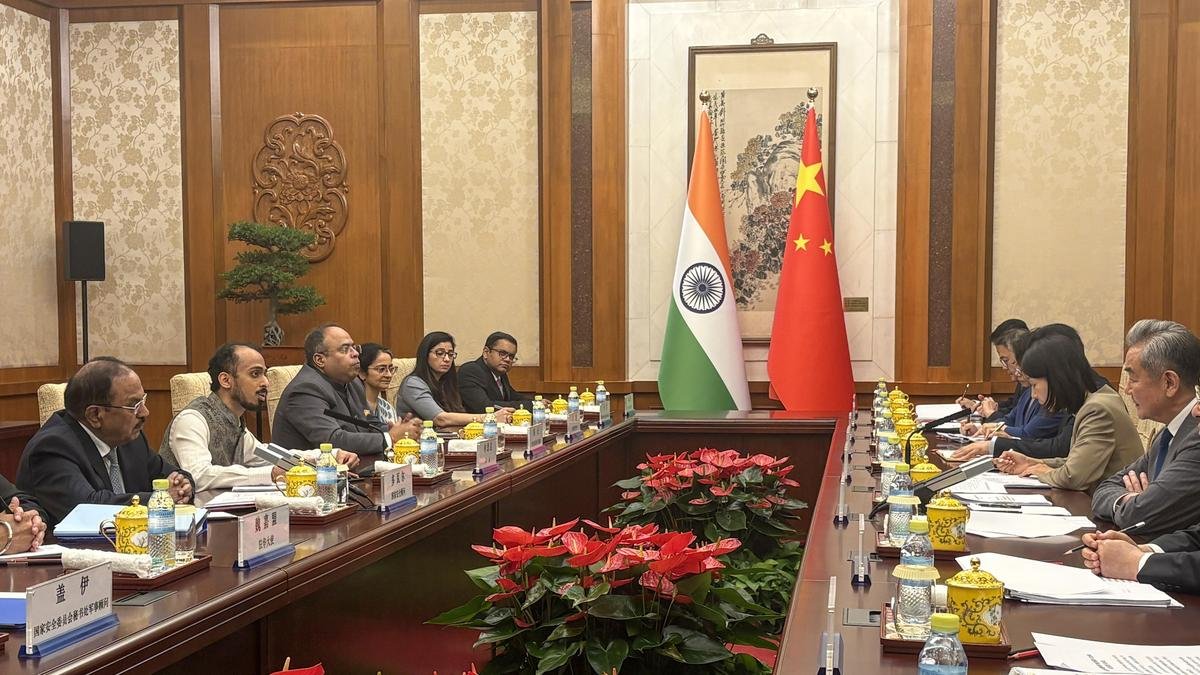
India and China on Tuesday (August 25, 2026) said they had discussed advancing talks on delimiting parts of the disputed border, as National Security Advisor Ajit Doval and China’s Foreign Minister Wang Yi met in Beijing.
A statement from the Indian Embassy in Beijing said both sides had “discussed ways to further expand bilateral cooperation, maintain stability and ensure peace and tranquility in the border areas, and make progress on boundary delimitation, while sustaining the ongoing work on transboundary cooperation.”
China’s Foreign Ministry also highlighted progress on border delimitation in a statement issued after Tuesday’s (August 25, 2026) 25th round of talks between the two Special Representatives on the boundary question, saying both sides “held in‑depth discussions on advancing border delimitation negotiations, strengthening border management and control, improving mechanism building and promoting cross‑border cooperation.”
Neither side provided details on which parts of the Line of Actual Control (LAC) were being explored for possible delimitation. At last year’s SR talks, both sides agreed to set up a working group to explore “early harvest” border delimitation in some areas along the LAC.
Mr. Wang said besides resuming the SR talks last year, institutional mechanisms between the two countries were resuming and both sides have been “working hard to maintain peace and tranquility in the border areas.” At last year’s talks, he noted both sides “reached a set of common understandings on delimitation, on border management, mechanism building and cross border cooperation.”
“Over the past year, our two sides have worked to deliver them on the ground and have made good progress,” he said.
The Chinese statement said the two sides “reaffirmed their commitment to the 2005 Political Guiding Principles, and, in a spirit of mutual respect and mutual understanding, will leverage the Special Representatives’ mechanism to pursue a fair, reasonable and mutually‑acceptable package solution to the boundary question.”
Mr. Doval and Mr. Wang, who is a Politburo member, spent several hours in each other’s company on Tuesday (August 25, 2026), first during “small group” discussions that both sides described as detailed and went on for more than 90 minutes, then during larger delegation-level talks in the evening. Earlier on Tuesday (August 25, 2026), Mr. Doval called on Chinese Vice-President Han Zheng.
Both sides were positive in their descriptions of the on-going normalisation of relations. Mr. Doval said Prime Minister Narendra Modi and Chinese President Xi Jinping had given “a clear and positive direction” to the India-China relationship which has been “steadily returning to normalcy”. He noted that this round of talks was “very important particularly in the wake of the BRICS Summit to happen shortly.” Mr. Xi is expected to attend the September 12 meet in New Delhi, on his first visit to India in seven years.
“I am happy over the past year our relationship has been steadily returning to normalcy,” he said. “The normalcy we have witnessed in our relationship has been a direct result of both sides maintaining peace and tranquility in the border areas.” He said both sides “extensively talked about… how to effectively reinforce and further consolidate our efforts to maintain peace and tranquility in the border areas.”
The Chinese statement quoted Mr. Wang as saying “China and India should draw lessons from history, place the boundary question appropriately in bilateral relations, and keep moving forward without stagnating, backtracking or veering off course.” He also called for “gradually building a positive narrative on China-India boundary affairs, making dialogue, peace, consultation and cooperation the mainstream and injecting positive factors into the sound and stable development of bilateral relations”.
“China stands ready to work with India to guide bilateral relations from a strategic and long‑term perspective, enhance communication, deepen mutual understanding, resolve differences, overcome obstacles, become good‑neighbourly friends and mutually‑beneficial partners, and achieve the ‘Dragon‑Elephant Dance,’” he said, adding that the “China India relationship has gone beyond the bilateral scope and taken on global and strategic significance.”