The 60-day window for the United States and Iran to reach a final agreement expired Monday with no deal announced, as President Donald Trump hardened his rhetoric toward Tehran and his administration prepared what Treasury Secretary Scott Bessent has described as an unprecedented new phase of economic pressure.
"They should put up the white flag of surrender," Trump told Fox News chief foreign correspondent Trey Yingst in a phone interview Monday. Trump said he was in no rush to reach a deal and also confirmed a direct back channel with officials from Iran’s Islamic Revolutionary Guard Corps.
The June memorandum of understanding committed Washington and Tehran to negotiate a final deal within a maximum of 60 days, extendable by mutual consent. Reuters reported Monday that the interim agreement quickly unraveled over a dispute involving control of the Strait of Hormuz. Trump declared the pact "over" on July 7 and Tehran later said it was suspended.
The deadline now puts a central question at the heart of Trump’s Iran strategy: whether the United States can turn military and maritime pressure into political concessions by squeezing Tehran financially rather than escalating again on the battlefield. Before the war, roughly one-fifth of the world’s oil and liquefied natural gas moved through the Strait of Hormuz, making the standoff a threat not only to Tehran but to global energy supplies and U.S. fuel prices.
TRUMP SAYS IRAN DEAL ‘LARGELY NEGOTIATED’ AS 84-DAY WAR NEARS POSSIBLE END
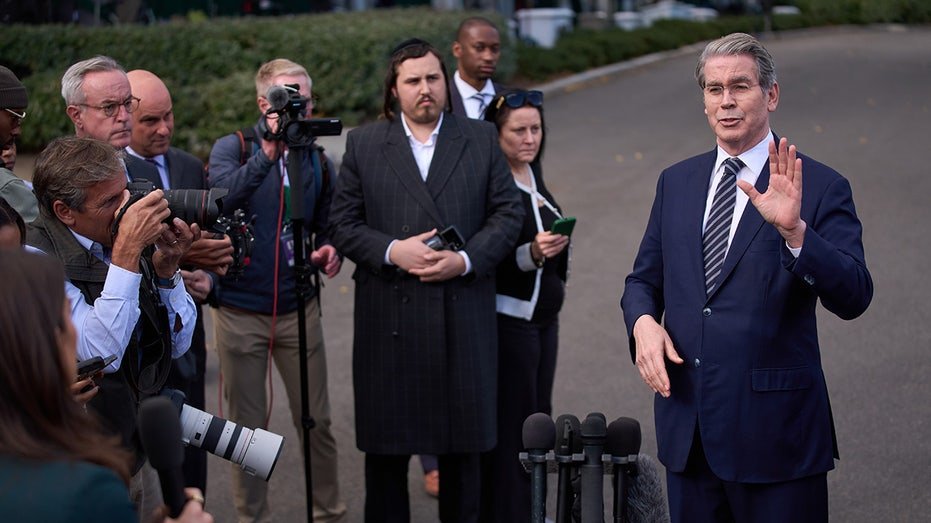
"Watch this space for more announcements coming next week because we are going to apply measures like have never been seen in the history of economic isolation of a country," Bessent told Newsmax on Aug. 13.
In comments provided to Fox News Digital on background, a Treasury spokesperson said, "Economic Fury has left the regime desperate for cash," arguing that the campaign has constrained Tehran’s ability to generate and move revenue and pushed it further toward shadow-banking networks and cryptocurrency to evade sanctions.
Average Iranian oil loadings had fallen from 1.8 million barrels per day before the war to less than 500,000 barrels per day over the previous month, The Associated Press reported Aug. 11, citing Treasury figures. AP also cited an IMF projection that Iran’s economy would contract 5.4%.
IRAN’S DEEPEST WEAKNESS IS GETTING EXPOSED THROUGH AMERICA’S MAXIMUM PRESSURE CAMPAIGN
Miad Maleki, a former Treasury sanctions analyst and senior fellow at the Foundation for Defense of Democracies, told Fox News Digital that the pressure is real.
"The numbers are brutal," Maleki said, citing inflation, the collapsing rial and reduced oil traffic. He described the current campaign as "a maximum pressure campaign on a steroid."
Reuters reported Monday, citing Iran’s Statistical Centre, that consumer prices in July were 87.9% higher than a year earlier and food prices were up 128%. President Masoud Pezeshkian acknowledged last week that Iran was selling less oil and collecting less tax revenue from struggling businesses.
Maleki argued that what distinguishes the current campaign from previous rounds of sanctions is the combination of financial restrictions and a physical blockade. "What really started, I would say, as Economic Fury, has now turned into maximum pressure on steroids," he said, arguing that Tehran is being squeezed not only in its ability to export oil but also in its ability to bring critical goods into the country.
He pointed in particular to Iran’s gasoline deficit and weakening government revenues as vulnerabilities that could become increasingly difficult for the regime to manage. In November 2019, a sharp increase in government-set gasoline prices triggered nationwide demonstrations that rapidly broadened into anti-government protests. Reuters reported at the time that Iranian officials said roughly 200,000 people participated in the unrest, while thousands were arrested.
"The regime is very scared of another 2019," Maleki said, arguing that Tehran has been reluctant to significantly raise retail fuel prices because of the potential political consequences.
But history also illustrates the limitation of Washington’s strategy: economic pain can bring Iranians into the streets without necessarily forcing the regime itself to concede.
IRAN’S REVOLUTIONARY GUARD SIDELINES PRESIDENT AS MILITARY GRIP EXPANDS
The larger question, Maleki said, is who ultimately absorbs the pain.
Iran’s economic system, he argued, includes powerful foundations and elite networks tied to the IRGC and the supreme leader that were built long before today’s sanctions architecture.
"That elite network has spent about three decades insulating themselves from exactly this kind of pain," Maleki said. "And historically, the regime always burns the population clock before really having to absorb any of that pressure themselves."
Maleki said pressure can force "tactical concessions," but broader concessions depend on whether the financial pain reaches IRGC-linked foundations, oligarchs and regime elites rather than remaining concentrated among ordinary Iranians.
Washington is already near "the ceiling on sanctions with Iran," he argued, meaning the next phase may depend less on new legal tools than on enforcing existing restrictions against foreign enablers, including Chinese refineries, Hong Kong shell traders, exchange houses, shadow-fleet tankers and cryptocurrency channels.
So far, the pressure has not produced a final deal. Reuters reported Monday that a senior Iranian official threatened military escalation within weeks if Washington does not fully implement the interim agreement.
"The worst is still ahead for the Iranian regime," Maleki said, arguing that payment-cycle delays mean the full fiscal impact of reduced oil exports may not be felt until the fall.
The Associated Press and Reuters contributed to this report.