President’s tariffs have hurt fishers, loggers and others in a state with deep bonds to Canada – will voters show their displeasure in the midterms?
It was an ideal summer to cut trees.
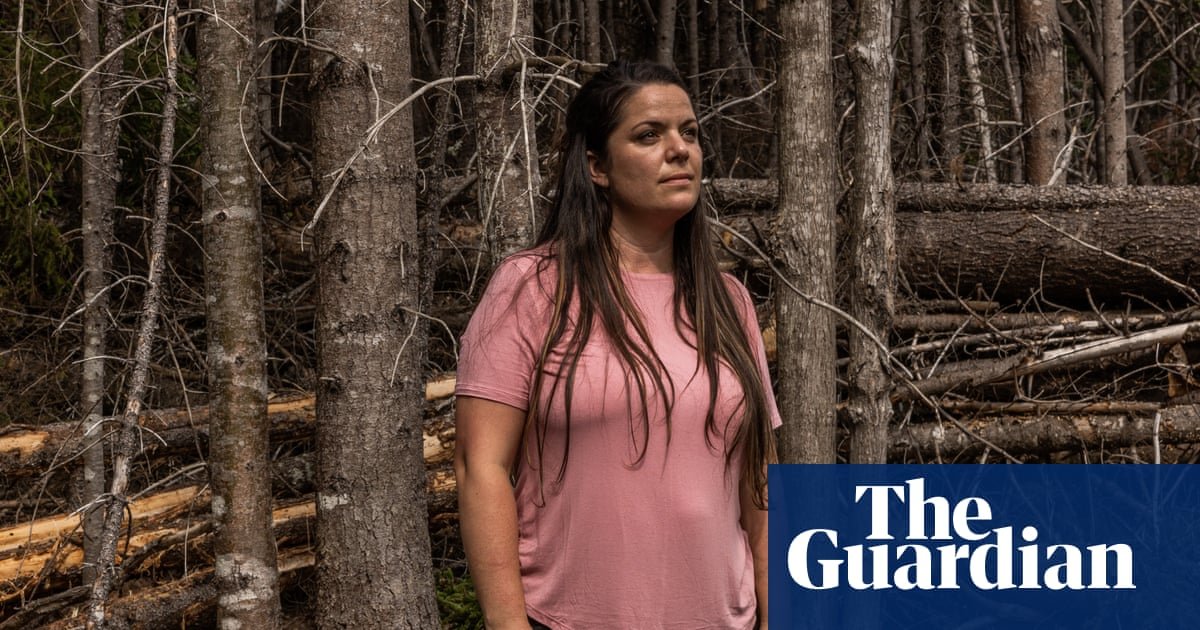
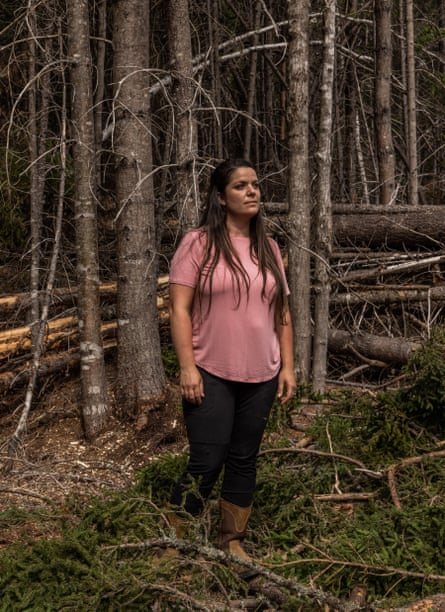
The weather in Maine’s Penobscot county – one of the most heavily forested counties in a state dense with trees – was warm and dry. Yet even as the county’s wood had grown to an ideal size to harvest, the machines Molly London typically uses sat idle.
London and her husband, Alex, who started a logging business nearly 10 years ago, had been waiting weeks for replacement machine parts that were no longer stocked locally because tariffs had made them too expensive.
By August, she and her husband decided to shut down their business, WW London Woodlot Management Company, exhausted after years of fighting ever-climbing costs.
“It just didn’t feel right any more,” she said. “We’ve been losing for a long time, and this is just getting worse.”
For centuries, Maine’s economy has been inextricably tied to logging. Penobscot styled itself the “lumber capital of the world” in the 19th century, and today, hulking timber lorries still take up half of the road when they charge down Maine’s rural interstates. The aroma from spruce and fir trees can be smelled through a closed car window.
Logging’s health is a crucial bellwether for the overall state of its economy, and things are looking bleak in the midst of a trade war with Canada and record-high diesel prices.
Democrats are hoping the frustration will finally unseat Republican Susan Collins, whose loss is crucial in helping the party win a majority in the US Senate. But after the fallout of Graham Platner, who dropped out of the race in July amid sexual assault allegations, the party has been scrambling to make up for lost time.
In his first campaign ad, Troy Jackson – formerly the state’s senate president who lost a bid to be the state’s governor earlier this year – immediately labeled himself as a “fifth-generation logger”.
“Susan Collins is just a rubber-stamp for the wealthy elite in this country,” Jackson said in another campaign ad.
Sara Gideon, a former state representative, had run similar attack ads in 2020, telling voters that Collins is “Not For You Anymore” – an attempt to tie her to Trump and the wealthy elite.
It didn’t work. Though the state voted for Joe Biden, it re-elected Collins at the same time, though no public polls had showed her with a lead in the race.
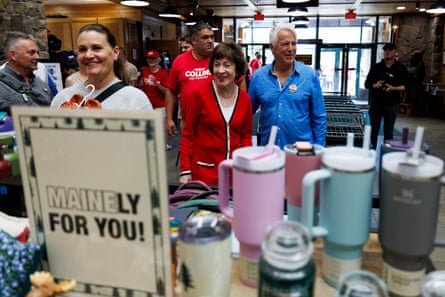
This election, Collins continues to highlight that she is a girl from Caribou who hails from a lumber family. Her seniority in the Senate has also given her power: Collins has been a senator for 29 years, making her the fifth longest-serving senator, and is the chair of the Senate’s powerful appropriations committee.
“I am a county girl,” Collins said, while sat on a pile of potatoes for a recent campaign ad featuring Mainers saying the senator is “just like us”.
The state, with a population of 1.4 million people, leans Democrat, driven by strong liberal support along its coast, and has not voted for a Republican president since George HW Bush in 1988. Unlike their more liberal counterparts down south, Mainers pride themselves on having a more independent streak.
While it’s still unclear how voters in the state will turn out in the midterms – Collins and Jackson are currently neck-and-neck in the polls – some voters have been feeling left behind.
“It feels like the things that were promised to get into office now don’t come through,” London said. “I think this area is definitely feeling the impact of that.”
Generational bonds
Maine’s economy is deeply intertwined with Canada, sending roughly 40% of its exports to its northern neighbor, according to the Maine International Trade Center.
But their relationship goes far beyond trade. This is a state where Canadian and American flags can be seen flying side by side, where entire towns cater specifically to Canadian tourists.
“There are generational bonds. We share our largest border with Canada. A lot of Mainers can trace their history through Canada,” said Patrick Woodcock, the president of the Maine State Chamber of Commerce. “There’s a business relationship as well, but also familial. … We have a little bit of a shared destiny together.”
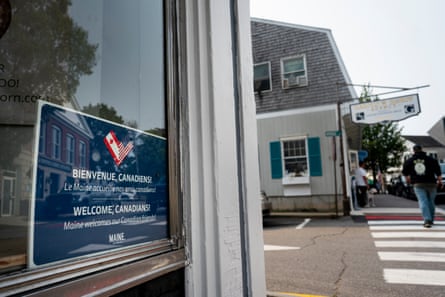
That relationship has been sorely tested by the breakdown in relations by Trump’s trade war. After negotiations between the two countries broke down at the 11th hour, Trump announced a 50% tariff on select Canadian goods that began 22 August.
In response, Canada introduced its own retaliatory tariffs, ranging from 15% to 50%, targeting $20bn worth of American imports with levies that took effect earlier this month.
For Maine loggers, this means many of the parts and equipment they usually buy from Canada and other countries have been hit by tariffs, said Dana Doran, the executive director of the Professional Logging Contractors of the Northeast. Loggers report seeing prices for equipment, parts and trucks go up between 30% and 50%, since Trump’s tariffs were first announced.
“Those prices have not come down. That for them is more directly impacting them day to day, and their cost of doing business,” Doran said.
The US is also “exceptionally reliant” on Canadian lumber mills to process wood used for housing, Doran said, but increasing duties imposed by the US court of international trade – not Trump – have led to a dramatic decline in Canadian-manufactured wood coming back into the US.
But still, demand for wood has declined as homebuilding has slowed considerably over the last few years, he added.
“When interest rates drop and the economy changes, and building construction comes back, will we have enough manufacturing? I would say we don’t,” Doran said.
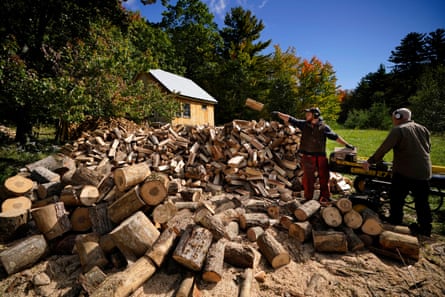
Even without the recent trade war, Maine’s logging industry has been buckling for years.
Loggers are facing increased costs across the board and a shrinking workforce. The industry in Maine is mostly made up of small, family-run businesses that have been passed down from generations, Doran said. But many longtime owners are now urging their kids not to go into family business.
Even when London and her husband started their business in 2017, they were warned they were embarking on an uphill battle.
“We knew a lot of the guys that had been doing it for generations,” she said. “And they all told us we were crazy.”
Still, they were excited about the chance to combine both their skills – Molly London earned a master’s in forestry and years in the field while her husband had experience hauling and trucking – to create a family business that they hoped would leave a legacy and give them a chance to work in the outdoors.
“We just liked the idea of going to work in the woods. We thought it would be really fun and exciting,” she said. “And it was. That was part of why we stuck it out so long, because we really enjoyed what we did.”
But after Covid, costs kept rising. Everything from tires, fuel and payroll for their employees started to squeeze the company.
“It just was getting harder and harder for us to make it work every week,” she said. “This year in particular, the tariffs made it just – it was impossible.”
At the same time, costs at home were increasing, too. Like many Americans who have been forced to delay medical care or treatment due to rising costs, the Londons could no longer afford their family’s health insurance, and dropped their coverage in 2025, so that they could continue affording to offer it to their crew members. It’s been years since the family indulged in what was once a Friday night ritual, dinner at a local pizza shop; instead, they eat at home. And for the first time, their kids participated in the free food programs at their schools this summer, because groceries have gotten so expensive.
Many loggers turned out for Trump in the last election. London credits this to Trump presenting himself as someone looking to “fight against the man,” someone who would lower grocery and gas costs and rid Washington of corruption.
But that feeling is gone, she said.
“If you read the news,” London said, “it doesn’t seem like the Trump administration cares. It doesn’t seem like anything’s going to change any time soon. And it’s at some point, we have to just see this for what it is.”
Challenging headwinds
As the logging industry has declined in recent years, other treasured industries in the state have also been struggling because of recent price increases.
Justin Allen Liddy, from Fort Clyde, Maine, has been catching and selling fish for 29 years. With fuel prices reaching over $5 in some parts of the state, he now only fills up his vessel, the Captain Lee, halfway with gas before he goes out to catch fish, to keep expenses down. Even then, his gas bill reaches up to $2,500 for each trip.
David Turin, a longtime Portland chef and restaurateur, also cited price increases across the board at his restaurants at the same time Americans are drinking less and eating out less frequently.
“I have never experienced a time with more challenging headwinds than right now,” he said. “The whole financial dynamic that has worked for generations in our industry just is broken down, and so everybody’s trying to figure it out.”

Maine’s population is also the oldest in the country, and as an increasing share of the workforce hits retirement age, the state needs to recruit more young workers to keep its economy growing, said Quincy Hentzel, the CEO of the Portland regional chamber of commerce. But many young people are struggling with the high cost of living in Portland.
“Our biggest challenge to getting the workers here is the cost of housing,” she said. “You can be an employee of any level – you could be an SVP who’s trying to get recruited here by one of our larger global companies, or you could be a sous chef at a restaurant. Everyone is having significant challenges finding affordable housing.”
By some estimates, the country needs upwards of 4m new homes to help make housing more affordable, according to data from Redfin. Maine needs at least 80,000 more housing units. But housing construction has remained sluggish in recent years, in part because construction costs have gone up significantly across the country.
“Commercial construction costs in Maine have more than doubled in the last decade, greatly exceeding nearly all other inflation metrics,” said Jonathan Culley, a managing partner at Redfern Properties in Portland.
Interest rates are also hard the US Federal Reserve raised rates last week, amid stubbornly high inflation that remains above their 2% target. Even if rates eventually drop, and housing construction picks up again, the US is not equipped to handle the manufacturing that is needed to build more housing, Culley said.
“We don’t have the manufacturing capacity in the United States to keep up with housing demand, if interest rates drop,” he added. “We absolutely do not.”
Doran, of Maine’s logging trade association, said the Trump administration doesn’t seem to be asking the right questions – about American manufacturing, but also the affordability crisis at large.
“The Trump administration is not talking about, what package of incentives do we need to incentivize American manufacturing?” Doran said. “What are we doing about electricity costs? What are we doing about healthcare? Will we have enough people to go to work at these facilities? Can we ramp up fast enough? To me, that is an entire conversation that is not happening.”