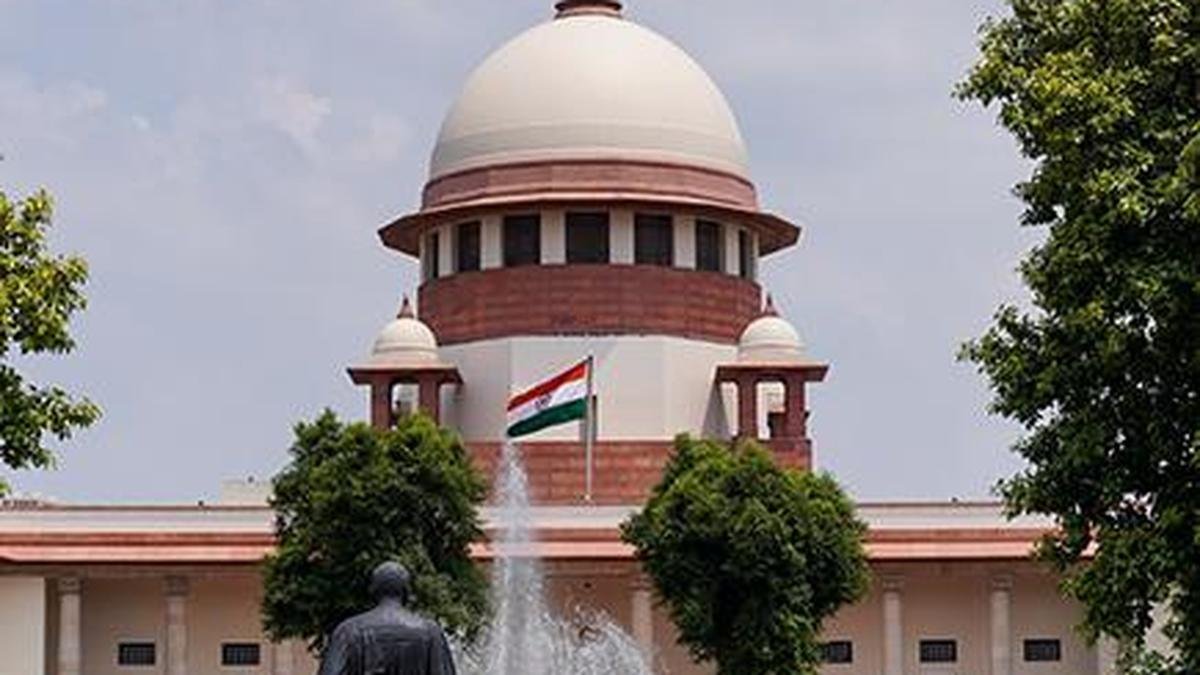
The Supreme Court on Thursday (September 10, 2026) said a judicial officer raising his voice at judges in court amounted to “gross indiscipline”, while declining to stay criminal contempt proceedings against a senior Maharashtra judicial officer accused of an “outrageous” and “unpardonable” outburst in a packed courtroom.
A Bench of Justices Vikram Nath and Sandeep Mehta was hearing a plea by Dilip S. Ghumare, Secretary and Senior Legal Adviser in Maharashtra’s Department of Law and Judiciary, challenging the Bombay High Court’s September 1 order initiating contempt proceedings against him.
“A judicial officer cannot shout against the judges in a court... He should repent for his words. This is gross indiscipline. Even a senior bureaucrat does not dare to raise his voice in the court,” the Bench observed.
The contempt proceedings stem from an incident in which Mr. Ghumare allegedly raised his voice in the courtroom and blamed the Bombay High Court administration for vacant judicial posts. The High Court had said that the officer’s “unwarranted outburst” and “aggressive demeanour” amounted to “contempt ex facie” under the Contempt of Courts Act, 1971.
On Thursday (September 10, 2026), senior advocate Vikas Singh, appearing for Mr. Ghumare, sought a stay on the contempt proceedings, pointing out that his client had already tendered an apology and subsequently sought voluntary retirement.
Mr. Singh told the Bench that Mr. Ghumare was required to serve a three-month notice period and had since been posted nearly 1,000 km away in a Naxalite-affected region. He argued that the officer had merely pointed out that only 385 of 1,100 sanctioned judicial posts had been filled and that it was for the High Court to process the remaining appointments.
The Bench, however, declined to stay the contempt proceedings, but restrained the High Court from passing a final order. It also issued notice on the officer’s plea and listed the matter for September 28, allowing the High Court proceedings to continue in the meantime.
The Bench also advised Mr. Ghumare to appear before the High Court and tender an unconditional apology. “Our advice to you is that you should go back to the High Court and seek an unconditional apology. Let the High Court consider your request,” it said.
The controversy arose during the hearing of a public interest litigation filed in 2013 by RTI activist Vihar Durve concerning the creation and filling of posts in fast-track courts dealing with offences against women and minor girls.
The High Court, which had earlier found affidavits filed by Mr. Ghumare “unsatisfactory”, was examining an August 27 affidavit on 179 new posts for fast-track courts. When Additional Government Pleader Priyabhushan P. Kakade was unable to provide a clear response to the Bench’s queries, it asked Mr. Ghumare to clarify the position.
Instead of responding, Mr. Ghumare allegedly “launched into an aggressive, high-pitched tone (bordering on shouting)” and blamed the court administration, the High Court said, noting that the incident took place in a packed courtroom.
Describing his conduct as “manifestly unbecoming of any judicial officer”, a Division Bench of Justices Ajey S. Gadkari and Kamal R. Khata said Mr. Ghumare’s remarks amounted to a “deliberate and unwarranted assault upon the dignity and authority” of the court.
Advocate General Milind Sathe was called upon to assist the court. While distancing himself from Mr. Ghumare’s conduct, he requested the Bench to consider an apology from the officer, who was present in the courtroom.
The High Court, however, refused to accept the apology, observing that doing so in the circumstances would send a “deeply troubling message” to the public.
“To permit this would convey to the public at large a deeply troubling message: that one can commit an otherwise inexcusable act with impunity in open Court and then sheepishly, in a theatrical manner, not meaning a word of it, offer an apology,” the Bench had said.