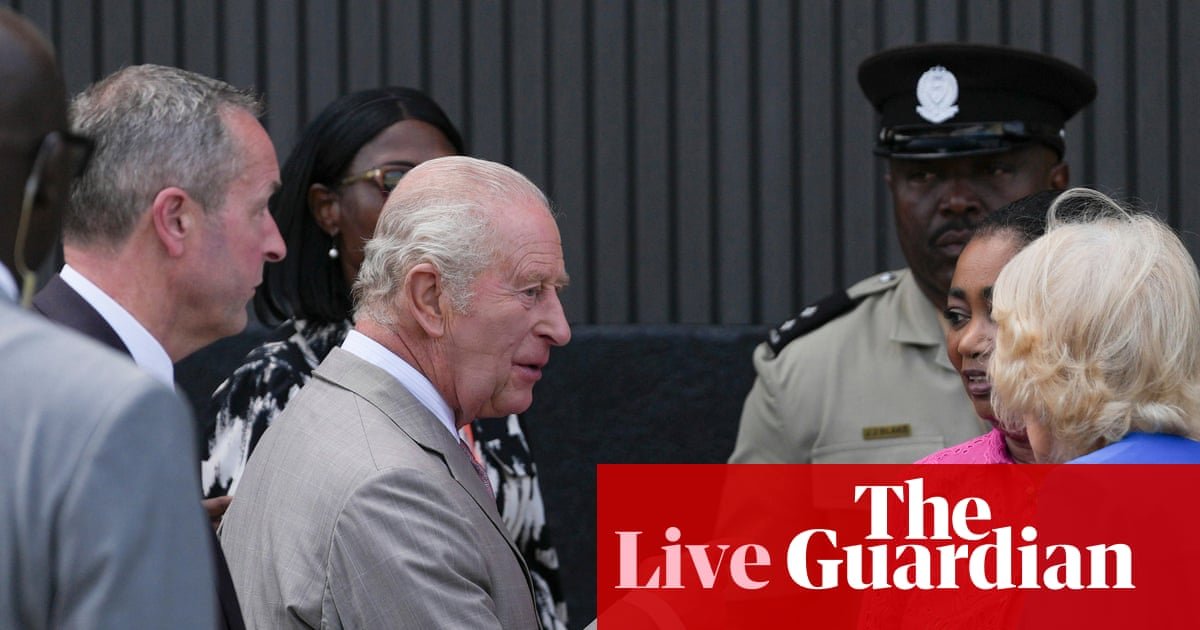
Speech by Charles marks formal opening of Commonwealth Heads of Government Meeting (Chogm) in Antigua
9m agoCharles says Commonwealth can draw on 'collective ingenuity of third of humanity' to address problems creating global crisis
17m agoCharles says slavery history 'fills my heart with horror' - but he avoids apology, and stresses 'evil need not have last word'
34m agoKing Charles speaks at Chogm opening ceremony
1h agoBadenoch says Tories would remove ILR concession for care workers announced by Shabana Mahmood
1h agoVeterans minister committed minor rules breach with attempt to influence James McMurdock probe, committee says
1h agoHow Carla Lockhart's resignation from DUP exposes widening divisions in unionism
2h agoPM opens slavery apology talks with Commonwealth as King also set to raise issue
2h agoEx-Reform UK MP cleared after committee overrules parliament's standards watchdog over N-word rules breach
4h agoMSPs call for 'much greater transparency' from Swinney about how Scottish government will fill £5bn funding gap
4h agoBadenoch says pupils must be taught 'good and bad of our history' - but says it's 'lie' to claim wealth came from slavery
4h agoBadenoch says, if she was PM, she would only visit China in return for British prisoners being released
4h agoBadenoch says purpose of slavery apology 'is to make us look weak'
4h agoBadenoch says dynamic alignment with EU regulations 'red line' she could never accept
5h agoBadenoch says she thinks Burnham's revised EU deal on food exports might 'make things worse, not better'
5h agoMahmood does not contest claim care worker ILR U-turn will mean DWP saving billions less than under original plan
6h agoDeal finalised to remove Brexit checks on food and animal products
6h agoBurnham says he has not proposed return to EU freedom of movement, and that voters 'need to be boss' on Brexit rethink
Charles ended his speech urging Commonwealth leaders to “recommit … to a Commonwealth in which our young people can look to the future with greater confidence and purpose”.
Charles said he was glad climate proposals were being considered at Chogm.
Here in the Caribbean, as in so many parts of our Commonwealth, climate change is not some distant prospect. It is an alarming reality. As we know, large ocean states have contributed little to the causes of climate change, and yet they are among those bearing the greatest cost. If we mobilise climate finance through the private sector and with the leveraging capacity of the public sector, we can drive investment into climate resilience. Nature herself is an essential form of capital that sustains our prosperity and well-being. And yet we have persisted for too long to live off nature’s capital, rather than her income. To restore nature is therefore not to choose our environment over our economy. It is to invest in the very foundations of our economy, not to mention our security.
Here in the Caribbean, as in so many parts of our Commonwealth, climate change is not some distant prospect. It is an alarming reality.
As we know, large ocean states have contributed little to the causes of climate change, and yet they are among those bearing the greatest cost.
If we mobilise climate finance through the private sector and with the leveraging capacity of the public sector, we can drive investment into climate resilience.
Nature herself is an essential form of capital that sustains our prosperity and well-being. And yet we have persisted for too long to live off nature’s capital, rather than her income.
To restore nature is therefore not to choose our environment over our economy. It is to invest in the very foundations of our economy, not to mention our security.
Charles said Commonwealth values have never been more important.
What unites this extraordinary and unique group of countries even more deeply is our values of democracy and the rule of law, of respect, equal dignity and human rights, of sustainable development, of peace and security. These values have never been more important, contested as they are on so many fronts, and they guide us to action.
Charles says the need for the Commonwealth is “more compelling than ever”.
All around us, trust between nations is under critical strain as international norms and systems are tested to their limits. Brutal conflict stalks our world, destroying lives and casting long shadows across the globe. Technology is transforming our societies and our economies at dizzying speed, with little certainty about where it might lead us. As I consistently tried to emphasise, climate change is no longer just a terrifying prospect, but a catastrophic reality which threatens our very way of life. Nature is under constant attack and critical natural systems are collapsing. And in each of our countries, for too many people, the opportunity to fulfil their own potential lies far beyond their reach. Each of these challenges, each of these, is a challenge of the highest order. Together, they comprise the crisis of our time. The Commonwealth cannot provide all of the solutions. It does, however, offer an unparalleled opportunity to work together across our societies and our economies, through our businesses, our institutions and our communities. It allows us to draw on the collective ingenuity of a third of humanity to address the challenges confronting us all.
All around us, trust between nations is under critical strain as international norms and systems are tested to their limits.
Brutal conflict stalks our world, destroying lives and casting long shadows across the globe.
Technology is transforming our societies and our economies at dizzying speed, with little certainty about where it might lead us.
As I consistently tried to emphasise, climate change is no longer just a terrifying prospect, but a catastrophic reality which threatens our very way of life. Nature is under constant attack and critical natural systems are collapsing.
And in each of our countries, for too many people, the opportunity to fulfil their own potential lies far beyond their reach.
Each of these challenges, each of these, is a challenge of the highest order. Together, they comprise the crisis of our time.
The Commonwealth cannot provide all of the solutions. It does, however, offer an unparalleled opportunity to work together across our societies and our economies, through our businesses, our institutions and our communities.
It allows us to draw on the collective ingenuity of a third of humanity to address the challenges confronting us all.
Charles carries on with his remarks about history. (See 2.50pm.) Turning to the slave trade, he does not issue an apology – but he says slavery history “fills my heart with horror”, and he stresses the importance of addressing the “wrongs of the past”.
Our history inspires us, can appal us, yet it can always teach us. We cannot change the actions of those who came before us. We can, however, learn from the past. The transatlantic trade in enslaved persons still casts a shadow over these islands, and other members of our Commonwealth. As I have said before, that shameful chapter of history is one that fills my heart with horror and my soul with the most profound personal sorrow. And yet, history also teaches us that evil need not have the last word, that character and courage can combine to overcome the most monstrous injustice, as they did with the determination to end the international trade in enslaved people, in which the Royal Navy played such a leading role. The more I have furthered my own understanding of the issues through listening, learning and looking, the more committed I have become to finding ways for us to work in modern partnership to address the wrongs of the past – with action for the future through improving access to education, investing in jobs and opportunities, encouraging intra-commonwealth trade, and inspiring vital climate resilience measures across the world. I have always felt that there is so much that can be done to help lift up those who struggle against hardship and disadvantage. I have always tried to play my part in doing just that. For as any sailor navigating the seas knows, we cannot command the winds, least of all where the winds of yesterday have delivered us. But we can choose how we set our sails.
Our history inspires us, can appal us, yet it can always teach us. We cannot change the actions of those who came before us. We can, however, learn from the past.
The transatlantic trade in enslaved persons still casts a shadow over these islands, and other members of our Commonwealth.
As I have said before, that shameful chapter of history is one that fills my heart with horror and my soul with the most profound personal sorrow.
And yet, history also teaches us that evil need not have the last word, that character and courage can combine to overcome the most monstrous injustice, as they did with the determination to end the international trade in enslaved people, in which the Royal Navy played such a leading role.
The more I have furthered my own understanding of the issues through listening, learning and looking, the more committed I have become to finding ways for us to work in modern partnership to address the wrongs of the past – with action for the future through improving access to education, investing in jobs and opportunities, encouraging intra-commonwealth trade, and inspiring vital climate resilience measures across the world.
I have always felt that there is so much that can be done to help lift up those who struggle against hardship and disadvantage.
I have always tried to play my part in doing just that. For as any sailor navigating the seas knows, we cannot command the winds, least of all where the winds of yesterday have delivered us. But we can choose how we set our sails.
Charles says they are all their because of their history.
None of us, of course, would be here today were it not for our history, which has shaped us in myriad ways. History is not ours to choose or to change. It is bequeathed to us in complex synthesis by forebears we can never know. Our inheritance includes both their achievements and their failures, the good they did, as well as the wrongs. History can be hard to compass, viewed as it is through the prism of time, which can both clarifying and distorting. And yet its consequences resonate with contemporary force.
None of us, of course, would be here today were it not for our history, which has shaped us in myriad ways.
History is not ours to choose or to change. It is bequeathed to us in complex synthesis by forebears we can never know.
Our inheritance includes both their achievements and their failures, the good they did, as well as the wrongs. History can be hard to compass, viewed as it is through the prism of time, which can both clarifying and distorting.
And yet its consequences resonate with contemporary force.
Charles thanks the people of Antigua and Barbuda for their hospitality.
For one of the smallest nations on Earth, your impact in the world is tremendous. And I think there is great truth in the saying, “Small island, big vibes”.
For one of the smallest nations on Earth, your impact in the world is tremendous.
And I think there is great truth in the saying, “Small island, big vibes”.
At Choghm, King Charles is now speaking.
He starts by saying he and the Queen are delighted to attend this 28th Chogm.
He says he has been attending these meetings for almost 30 years.
It is even more sobering to think that 30 years ago, most people had never bought anything online. Many had never sent an email, and connecting to the web involved a rather alarming series of screeches from a telephone line. In fact, in those days, the internet was so new people referred to it as the information superhighway. I suspect that 30 years later, many of those early users, some in this room perhaps, are still trying to remember their first passwords.
It is even more sobering to think that 30 years ago, most people had never bought anything online. Many had never sent an email, and connecting to the web involved a rather alarming series of screeches from a telephone line.
In fact, in those days, the internet was so new people referred to it as the information superhighway.
I suspect that 30 years later, many of those early users, some in this room perhaps, are still trying to remember their first passwords.
Sunder Katwala is also one of the experts questioning the idea that Shabana Mahmood’s care workers U-turn will lead to the government missing out on a chunk of savings worth £10bn – because, he says, those savings never existed anyway. He says:
Minister does not contest inaccurate/untrue claim about impacts of government policy: there was no saving of billions under the original plan at all. It was a government-created myth that has bounced back
John Springford from the Centre for European Reform is saying the same thing.
This debate is ridiculous. The £10 bn figure should have been zero. The loss of deterred workers who would be net contributors will be similar under the new proposal. And either way, punitive, retrospective rule-changes are tools of illiberal governments.
As explained here, the Home Office justifed its £10bn figure in a document it published earlier this year. The IPPR published a critique of it yesterday.
Earlier this year, Jonathan Portes, a professor of economics and public policy at King’s College London, produced his own analysis saying that the ILR proposals Mahmood published in November last year would save just £600m.
Back to Kemi Badenoch’s announcement about ILR (see 2.16pm), and Sunder Katwala from the British Future thinktank argues that she has changed her tune on retrospective legislation.
“We have a principle. We don’t believe in making things retrospective” - Kemi Badenoch, 30th October 2025 “If somebody is granted ILR by the Labour govt, and not a net contributor, we would review and stop their ILR”, - Kemi Badenoch, 3rd November 2026
“We have a principle. We don’t believe in making things retrospective” - Kemi Badenoch, 30th October 2025
“If somebody is granted ILR by the Labour govt, and not a net contributor, we would review and stop their ILR”, - Kemi Badenoch, 3rd November 2026
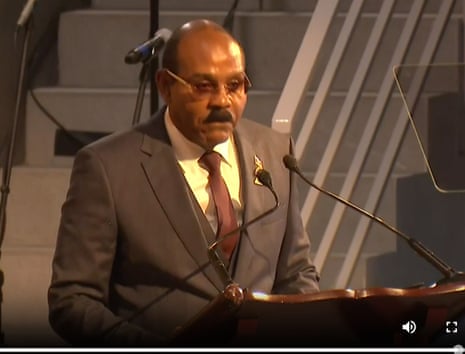
Gaston Browne, the prime minister of Antigua and Barbuda, is speaking now at the Chogm opening ceremony, where he is the host.
He says this could be a particularly consequential summit.
There are some who question whether or not the Commonwealth remains relevant. Our answer must not rest on history or sentiment alone. It must be demonstrated through results in the opportunities we create, the partnerships reforge, and the tangible improvements we deliver in the lives of our people.
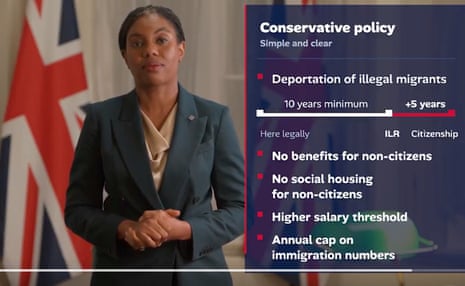
Kemi Badenoch has signalled that, if the Conservatives win the next election, they will remove the indefinite leave to remain concession for care workers announced by Shabana Mahmood yesterday. In a post on social media, she said:
Shabana has made a serious mistake surrendering to Labour MPs. So I’m putting people on notice - when we get into government we will scrap this weak policy. Immigration is too high. Labour are making a bad situation much, much worse.
Shabana has made a serious mistake surrendering to Labour MPs. So I’m putting people on notice - when we get into government we will scrap this weak policy.
Immigration is too high. Labour are making a bad situation much, much worse.
The policy announced yesterday actually significantly tightens ILR rules, compared to what they say now, but by “weak policy”, Badenoch is referring to the concessions. She makes this clear in a video she has posted setting out her policy.
At the Commonwealth summit, the opening ceremony is getting underway with a prayer.
Politics live with Andrew Sparrow