Workers should start with a moratorium against building until our livelihoods and communities are protected
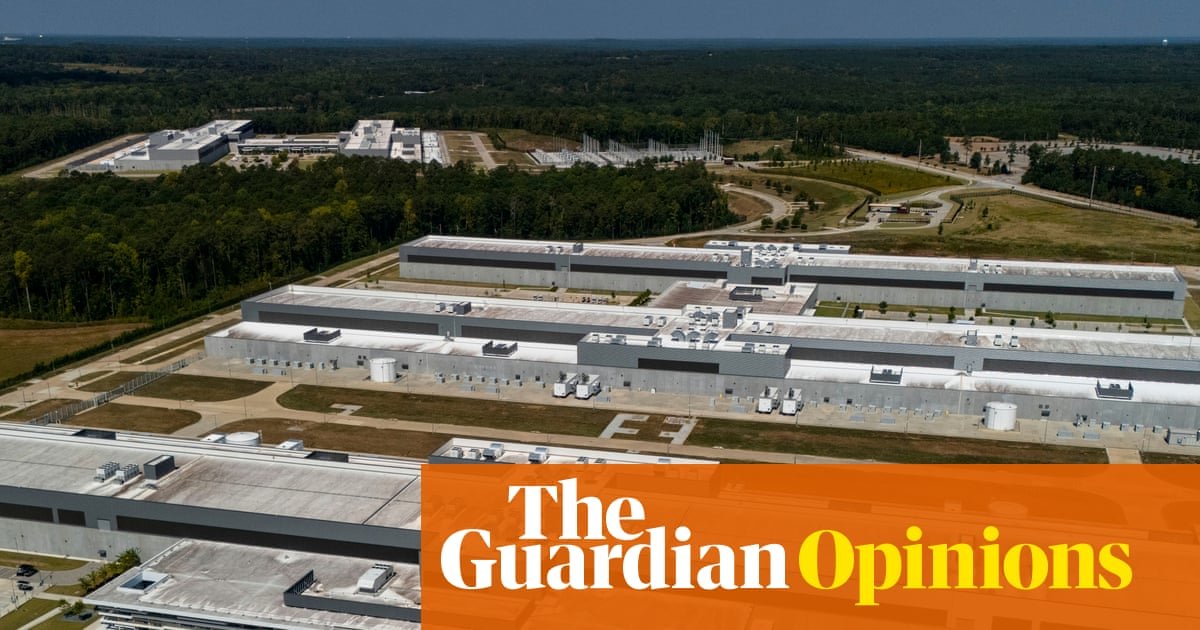
For the surging number of Americans who now live alongside constantly humming computer-filled mega-warehouses, it is clear AI datacenters come with significant drawbacks.
Opposition to datacenters grows on both sides of the political aisle as developers plan to invest $8tn to build them in the coming years. The bet is massive – roughly a quarter of our country’s entire GDP – but AI CEOs think it will pay off because they believe this technology will allow businesses across industries to rake in profits by cutting out their largest expense: labor. If all goes according to their plan, AI data centers will enable corporations to redistribute workers’ salaries to themselves.
This is why I have been so concerned to see the North American Building Trades Unions (NABTU) sign agreements with corporations such as Blackrock, Meta and OpenAI to collaborate on this massive data center expansion. While I applaud the NABTU’s success at securing well-paying temporary jobs for their members, these deals ignore the fact that all workers, including construction workers, are part of a class whose replacement is the explicit purpose of AI, and that data centers themselves produce a minuscule number of long-term jobs. With these deals, union members will build the factories of computerized labor that put millions of other workers out of jobs – potentially even themselves.
Until strong regulations are enacted that ensure our livelihoods, community and planet are permanently protected, unions should focus on passing the Artificial Intelligence Data Center Moratorium Act, introduced in Congress by Bernie Sanders and Alexandria Ocasio-Cortez, and support statewide moratoriums like the one recently signed by the New York governor, Kathy Hochul. Once we have achieved a moratorium, the labor movement must unite around a set of demands to ensure workers across industries receive our fair share of AI’s potential benefits.
Trump-funding, anti-union tech billionaires tell us they are leading an AI revolution that will fundamentally transform our global economy. I say we take them at their word, get organized and seize the change for the common good. Not only would a moratorium give us the opportunity to negotiate a worker-centered framework for technological development, but it would also put pressure on lawmakers to urgently conduct reviews of data centers’ impacts and get regulations on the books. The AI revolution means nothing but loss for the average person if its benefits are concentrated among the already-wealthy. In a survey of the Office and Professional Employees International Union’s membership last year, we found members are already being adversely impacted by AI in myriad ways ranging from layoffs to surveillance to being punished for errors created by AI models.
New York’s decision to halt permit-issuing for up to a year while the state creates a regulatory framework is a practical, although insufficient, first step. This step came after a datacenter in Rockland county received $77m in tax breaks and created only one permanent job – the largest taxpayer subsidy relative to jobs created in United States history. In Virginia, which currently hosts more datacenters than any other state, a study found that datacenters produce less than 1% of the permanent jobs – largely for technicians and security guards – per dollar invested, compared with other industries.
Beyond the meager ratio of job creation to investment, we should not allow corporations to balloon our energy consumption while wildfires, superstorms and extreme heat ravage our country. In my home state of Texas, just 335 AI datacenters already consume enough electricity to drive up rates for the rest of us. At least 248 more are planned, creating a gas-fired power plant boom. Of these, the largest is expected to consume as much electricity as 2.75m homes – more than Houston, Dallas, San Antonio and Austin do combined.
With this, I ask readers to consider if they truly want the future AI companies are crafting for us under the guise of inevitability. If you don’t already have one, would you want a datacenter in your backyard? Do you want to live in a world where jobs involving human ingenuity, sensitivity and creativity are replaced by algorithms?
Should we not dream of something more for ourselves? Of safe and sustainable union jobs that build infrastructure serving the many, not the few? If unions worked together rather than pitting our members against each other, we would not be begging billionaires for temporary jobs that will poison us and our children.
I know a future is possible in which the thousands of office, manufacturing and healthcare workers I represent in cities such as Amarillo, Texas; Lansing, Michigan; and Ashburn, Virginia, have their economic and social needs met. But we are not on that path right now. Whether it is through higher wages, shorter workweeks or eliminating dangerous tasks, workers must get their fair share of whatever benefits AI produces, and lawmakers must ensure the datacenters powering it are built sustainably, with community consent and a well-paid workforce. At the end of the day, our data fuels their algorithms, our taxes fund their development and our communities host their hardware. The least we should demand is our fair share.
Tyler Turner is president of the Office and Professional Employees International Union and is based in Fort Worth, Texas. OPEIU is a union of 90,000 workers in industries ranging from tech and healthcare to higher education and non-profits – industries disproportionately impacted by the rise of artificial intelligence