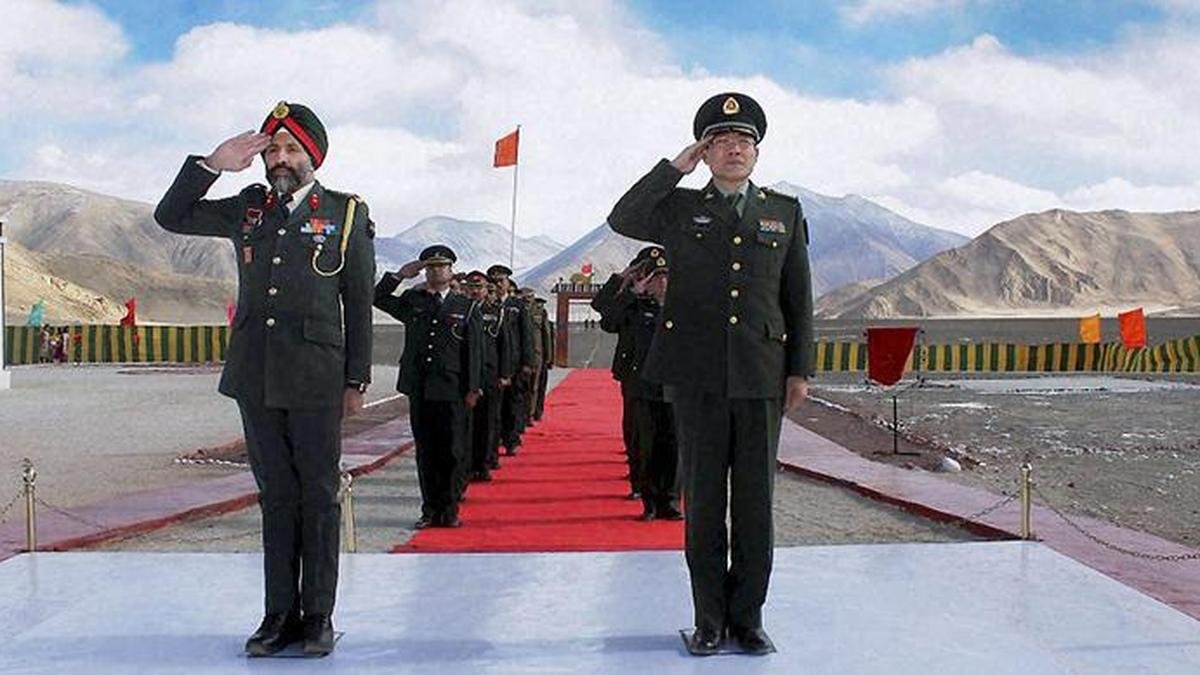
India and China are yet to announce the locations of the two additional Border Personnel Meeting (BPM) points along the Line of Actual Control (LAC).
However, government sources said that at least two rounds of meetings between local commanders of the two countries have been held at Kepang La in Arunachal Pradesh’s Upper Siang district over the past year.
India, China to push for ‘early and substantial harvest’ of border delimitation According to an eight-point outcome document released by both countries on August 26 following the 25th round of talks between the Special Representatives (SRs) on the Boundary Question, India and China have also agreed to establish two additional meeting points to hold General-level or Senior Highest Military Commander-level meetings.
India was represented at the talks by National Security Adviser (NSA) Ajit Doval, while China was represented by Wang Yi, a Member of the Political Bureau of the CPC Central Committee and Director of the Office of the Central Commission for Foreign Affairs.
India, China open door to clarifying LAC perceptions At present, there are five BPMs in the western and eastern sectors—Daulat Beg Oldie and Chushul in Ladakh, Nathu La in Sikkim and Kibithu and Bum La in Arunachal Pradesh.
According to a Ministry of Defence statement in 2019, the BPM mechanism has evolved into an important interface where local issues get discussed and resolved, thereby fostering confidence among the Border Guarding Troops.
“This ensures prevalence of peace and tranquility along the LAC (Line of Actual Control).” ‘Structural differences have not disappeared’: Chinese strategic affairs scholar on India-China ties A government source said that a year ago, the Chinese People’s Liberation Army (PLA) had suggested that Kepang La in Tuting be declared a mutually agreed meeting point for flag meetings and other high-level interactions.
The source said Kepang La is a place of religious significance for people on both sides of the undefined border, and locals are allowed to visit the Chorten, a Buddhist holy site.
Kepang La Pass was used by Chinese troops to enter India during the 1962 war, in which at least 11 Indian soldiers were killed in action.
“A suggestion from the Chinese commanders to designate Kepang La as a BPM was made last year.
However, a final decision is yet to be taken,” said the source.
India and China share a 3,488-km land border from Ladakh to Arunachal Pradesh, portions of which remain undefined.
Arunachal CM denies Chinese incursion but says concerns need to be verified Recently, a fact-finding committee constituted by the People’s Party of Arunachal (PPA) had alleged Chinese intrusions in the Taksing area of Upper Subansiri district, describing them as “gradual, persistent and well-calculated”, while pointing to gaps in year-round Indian patrolling along the LAC.
While the Indo-Tibetan Border Police (ITBP) is the primary force responsible for guarding the India-China border, operational responsibilities in most disputed areas are determined by the Army.
Army sources have denied allegations.
Kharge seeks Govt. answers over alleged increased Chinese activity on Arunachal Pradesh border The committee, headed by former Minister and PPA Chief Adviser Kahfa Bengia, visited Taksing on July 10 and interacted with residents of Taksing, Maza and Galemo, as well as Army personnel stationed in the region.
In its report, the committee cited local accounts claiming that Shera-5 Point, an Indian patrolling point, has remained inaccessible to Indian troops since a confrontation between the Arunachal Scouts and the PLA in 2023.
According to the report, Indian troops withdrew from the point after the incident, while PLA personnel allegedly returned to dismantle signs of the Indian presence and subsequently prevented Indian patrols from accessing the area.
The committee also said that Nanga Pahar, traditionally used by local Nah and Mara communities for hunting and yak rearing, has effectively become a restricted zone for residents, which it claimed has aided Chinese advances towards the Indian side.
The panel identified seasonal patrolling as a key vulnerability, noting that Indian patrols are largely confined to April-October because of harsh winter conditions, while PLA activities reportedly continue throughout the year.
It urged stronger and more sustained border surveillance to prevent recurring intrusions.