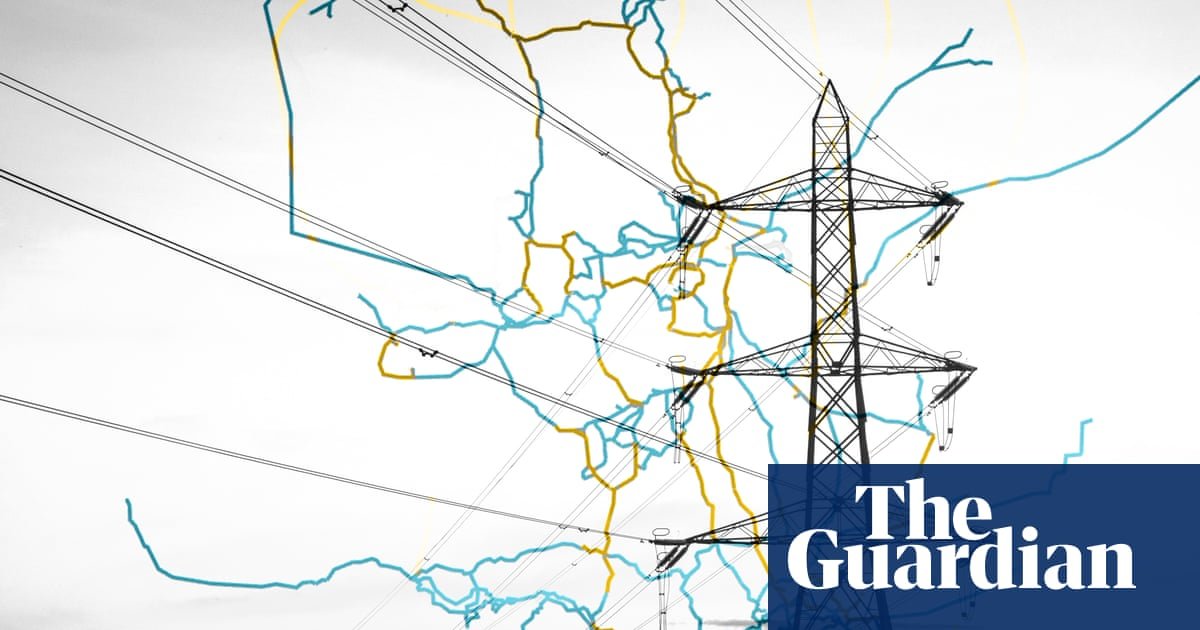
Thousands of miles of new power lines are needed to deliver climate targets and energy security, but bills will rise in the short term and opponents are mobilising Guardian graphic.
Source: OpenStreetMap, Neso Beyond 2030 recommendations Britain is embarking on one of the largest overhauls of its electricity grid in generations – a megaproject in which five times more infrastructure will be built by 2030 than was constructed during the previous three decades.
Tens of billions of pounds are being spent on new pylons, subsea cables and converter stations to connect a growing fleet of wind and solar farms and carry clean power to where it is needed.
It comes after successive global shocks – Russia’s invasion of Ukraine, then the Iran war – have exposed the vulnerability of the UK’s energy system to international market volatility and galvanised plans to bolster domestic low-carbon generation.
The cost of electricity in the UK has surged in recent years, far beyond that of comparable countries, largely because expensive gas-fired generation sets the price most of the time.
This volatility has accelerated efforts to transition away from fossil fuels, in the hope homegrown renewables can shield UK households from future shocks.
Yet that green drive is now being limited by Britain’s ageing grid, which, after decades of underinvestment, is often unable to transmit the new energy being generated.
“If we don’t have enough transmission network capacity, we won’t be able to make full use of renewable energy resources.
We will then be more dependent on fossil fuels, with greater vulnerability to fossil fuel price shocks and higher CO2 emissions,” said Keith Bell, professor of electronic and electrical engineering at the University of Strathclyde.
Unblocking these bottlenecks will require well over 4,000 miles of new power lines by 2041, alongside significant improvements to cables already in place, Guardian analysis of official recommendations shows.
Much of that expansion will be visible, cutting across the countryside and bringing construction to rural communities along the way.
It has prompted protests, with some residents claiming they face an “energy invasion” owing to the scale of the planned infrastructure.
Household energy bills are to rise in the short term to pay for the grid transformation, at a time when politicians are pledging cost-of-living support.
Britain’s National Energy System Operator (Neso) recently estimated that £64bn of investment will be needed for transmission projects by 2030 and a further £89bn beyond that – more than £150bn, which will be largely paid for by surcharges on household bills.
While these investments will eventually help lower costs by reducing reliance on expensive gas generation, on Friday the National Audit Office warned the government that dozens of grid projects risked delay, potentially placing further strain on consumers.
But a failure to build also has costs – as the below visual explainer sets out.
Existing transmission network Britain’s grid is showing its age.
The last overhaul was during the 1950s and 1960s, when high-voltage cables were rolled out at scale amid growing demand for electricity in the postwar period.
Since then, major transmission upgrades have been few and far between, despite changes to how energy is generated.
Bottlenecks are now common, limiting the rollout of renewables.
Nowhere is this more true than in Scotland, where the wind industry is booming.
More than 300 windfarms with a combined capacity of 15GW are now installed in Scotland, compared to just 5.7GW a decade ago.
This is enough to power millions of homes.
Some sites are colossal.
The biggest in terms of capacity is Seagreen, where 114 turbines are generating power 17 miles off the Angus coast.
The Seagreen offshore windfarm under construction in 2023.
But much of Scotland’s wind power is effectively wasted.
The grid lacks the capacity to transmit all of the excess energy being generated by Scottish windfarms south into England, which has more people and higher demand for electricity.
The key bottleneck is at the border, known technically as the B6 boundary .
“Wind power deployment in Scotland has been outpacing grid investment, preventing a growing share of this clean energy from getting to where demand is,” said Rich Collett-White, an energy analyst at Carbon Tracker.
Wind power wasted per year in Scotland (terawatt-hours) Guardian graphic.
Source: Montel, Curtailed renewables in GB and Ireland in 2025 Bottlenecks like these are costly, firstly because that energy still has to be found elsewhere.
It is often gas plants south of the border that step in, firing up whenever renewables cannot be harnessed by the grid.
This not only increases emissions, but exposes the UK to any volatility in gas prices internationally.
Adding to this are curtailment costs.
When the grid is at capacity, and windfarm operators are forced to shut down, their losses are paid for by the government as part of price guarantee schemes.
Scotland has therefore become a massive focus of grid upgrades.
A collection of projects known as the Eastern Green Links are particularly important.
Described as ‘electricity superhighways’, these subsea cables will be the longest in Britain, connecting Scottish windfarms on the east coast to areas across England.
There are six separate links, with the first two now under construction and due to be completed by 2029.
Once finished they will transmit a total of 4GW of renewable energy, bypassing the current border bottleneck.
The final link is due for completion in 2041.
But it is not just Scotland that is pushing the grid to the limit.
There are bottlenecks looming in England too – notably across the east coast.
This region has become a growing hotspot for wind generation, with big sites like Hornsea and East Anglia ONE windfarms harnessing North Sea winds.
The Sizewell nuclear power plant in Suffolk is also set to expand, after the Labour government gave final approval to Sizewell C in 2025.
It will add a further 3.2GW of capacity once completed in the late 2030s.
An rendering of Sizewell C nuclear power plant in Suffolk.
Credit: EDF More subsea cabling is part of the answer, with the Sea Link interconnector one of the most high profile.
This 90-mile cable will connect Kent and Suffolk, carrying renewable and nuclear-produced energy between the two and avoiding any bottlenecks in London.
The project is already far along in the planning process, and is now awaiting a final decision from the government.
But Sea Link has become controversial in the areas where it is to make landfall.
In Suffolk, the cable connects to the mainland grid on land near several nature reserves on the coast near the seaside town of Aldeburgh and the River Alde estuary.
Many local residents are opposed to the project, arguing it adds to the “cumulative impact” in Suffolk from a confluence of energy projects, including Sizewell C, which they claim is disrupting communities and threatening nature.
A protest against energy projects in Suffolk in November 2025.
In 2024 he featured in a short film, Coast, in which he argued that the National Grid had failed to explore the use of brownfield sites or more innovative offshore solutions that would not require extensive landfall.
Your browser does not support the video element.
Actor Ralph Fiennes in a 2024 campaign video criticising grid plans in Suffolk Other parts of Britain’s grid expansion are entirely on land – forming so-called ‘pylon corridors’.
Two large projects nearby are already active in the planning process, one corridor from Norwich to Tilbury and another from Grimsby to Walpole .
Both are crucial to transmitting energy brought onshore by projects like Sea Link and the Eastern Green Links.
But they also face some of the fiercest opposition, with local residents particularly concerned about the visual impact on the countryside.
The National Grid has already made a concession to locals in Lincolnshire.
Last year, it revised down the size of pylons on one stretch of the corridor that is near the Wolds National Landscape - from 50 metres in height to less than 40 metres.
Original: 50m Revised: 37m 1.75m Guardian graphic.
Human scale reference via Wee People Yet resistance remains - and has political backing.
Reform UK controls Lincolnshire county council and pledged to keep fighting the pylons even after the size revision.
But experts say only so much can be avoided with mitigation.
“At some point, existing routes need to be re-built with higher capacity lines – which often means much bigger towers, or ‘pylons’ – or new routes are needed,” said Bell.
“Given their visual impact, it’s inevitable that pylons attract opposition.
However, the alternatives that many campaigners call for – going underground or taking lines out to the coast and then subsea – are, on average, four to five times more expensive.
“That means higher electricity bills than would otherwise be the case.” This is just a snapshot of the dozens of battles expected to take place over Britain's grid during the next decade.
In an attempt to fend off opposition, the government recently announced discounts of £250 off annual energy bills for households living close to new pylons.
But questions remain around how easily the UK will pull off its grid transformation – and at what price.
Grid upgrades will be largely paid for through household energy bills, coming on top of electricity prices that have risen sharply after global energy shocks.
The energy regulator Ofgem has announced that the energy bill price cap will rise by 4% from October to its highest level in three years, driven by increases in wholesale gas prices.
On the day of the price cap announcement, the energy secretary, Miatta Fahnbulleh, was challenged about whether “the drive towards net zero” was also costing people more.
She replied: “Absolutely not.” But Fahnbulleh went on to acknowledge that paying for upgrades would be unavoidable, saying: “For a decade and a half, under the last government, we didn’t invest in our energy system, we didn’t invest in the grid, and we’re going to have to deal with that.
So for the grid to operate properly, we’ve got to upgrade it.” Andy Burnham has attempted to reduce energy bills since entering Downing Street, with his first big policy announcement being a cut to VAT on them from 5% to 0%.
In the absence of further government intervention, rising network costs will soon add an extra £130 to a typical household’s energy bills by 2030, according to one forecast.
Ofgem has pointed out that households would still be paying more by 2030 if grid upgrades were not undertaken, due to the cost of curtailing renewables.
“While upgrades will require investment, failing to invest would also increase costs for consumers through higher constraint and balancing payments caused by grid bottlenecks,” a spokesperson said.
Many experts also agree that spending more on grid upgrades now alongside growing the UK’s low-carbon power capacity will lead to lower energy costs in the future.
Neso forecasts that full decarbonisation that meets the UK’s net zero targets could lead to energy spending falling from more than 10% of gross domestic product to less than 5% by 2050, owing to the wider use of cheaper renewables and lower waste.
Spending falls further than in a scenario with far less decarbonisation, in which the UK falls short its legally binding 2050 target, though it is initially higher because of the investment needed to increase renewable capacity.
The long-term costs of Britain's green energy drive Forecast of total energy costs in the UK as a share of GDP (%) Scenario with full decarbonisation Scenario with limited decarbonisation Guardian graphic.
Source: forecasts taken from Neso's Future Energy Scenarios 2025 report.
The scenario with a full decarbonisation is described as the 'hollistic transition' pathway, where net zero targets are met through a mix of electrification and hydrogen.
The scenario with a limited decarbonisation is described as the 'falling behind' pathway, where some decarbonisation is undergone but not enough to meet net zero targets.
Cost figures includes spending on energy-using assets including vehicles and heating systems Some argue there are ways to reduce the sharpness of this investment “hump” through a different approach to grid upgrades.
The Conservatives recently claimed transmission costs could be reduced by focusing on a smaller number of large nuclear and gas plants over many renewable sites, in turn reducing the number of new cables.
Others dispute those findings, pointing out that emissions would be higher – building nuclear sites requires large upfront costs and has proven to be difficult in recent years – and that gas prices are likely to exceed the assumptions used in their analysis.
Neso forecasts full decarbonisation would have a sizable benefit: shielding against energy shocks.
It has modelled the hypothetical impact of a 2022-style energy shock after Russia’s invasion of Ukraine on a fully decarbonised energy system in the UK.
The original shock cost an extra 1.8% of GDP – equivalent to tens of billions of pounds.
In a full net zero transition scenario it would have been closer to an extra 0.3%, more than six times smaller.
How energy shocks would hit the UK under net zero Change in energy costs (as % of GDP) after 2022 fossil fuel shock, actual v Neso forecasted scenarios Guardian graphic.
Source: Neso's Future Energy Scenarios 2025 report, Economics Annex “Our analysis suggests that delivering net zero by 2050 could halve energy-related spending, whilst also providing greater protection from global price spikes in the process,” a Neso spokesperson said.
However, experts say getting to that point will require more than just new cabling projects.
“Transmission is only one piece of the puzzle, though – greater storage, demand flexibility, and potentially green hydrogen production would all help drive down curtailment costs and cut dependence on expensive gas,” said Collett-White.
“A better, not just bigger, grid should be the goal.” With the geopolitical landscape looking increasingly turbulent, ministers may be convinced that making households pay for a better grid – and the protection it affords – will be worth it in the end.
A spokesperson for the Department for Energy Security and Net Zero said: “Decades of underinvestment in the grid has left us overexposed to fossil fuel markets and unable to realise the full potential of clean, homegrown energy to lower bills for households.
“That’s why we’re building a decarbonised energy system that can bring down bills for good.” A spokesperson for National Grid said: “Investment in upgrading the grid is supporting jobs, skills, and supply chains across Britain, while creating opportunities and benefits for local communities.
“We work closely with local people, consult extensively, and consider all technology options as we develop proposals for the infrastructure needed to support a secure energy future.”