"We believe that this disaster should be seen as a warning signal to the risk that climate change poses to Nepal," Shisir Khanal said in an interview with AFP nearly a week since the tsunami-like wave of freezing water, rocks and debris carved a trail of destruction.
Nepal flash floods: A wake-up call against infrastructure building spree across Himalayas, warns geo-scientist C.P.
Rajendran More than 1,000 bodies have been recovered, and nearly 4,500 people are missing in Nepal as well as across the Chinese border in Tibet.
Mr.
Khanal invited international support based on climate justice rather than charity, noting that his largely rural nation of 30 million people contributes a fraction of global greenhouse gas emissions compared to industrialised nations.
"We call upon the international community to take the changing climate in the Himalayas in an urgent light," he said.
"The support to Nepal should not be just seen from an angle of aid or charity, but should be seen from a perspective of climate justice as well." The disaster has affected people's lives but also public infrastructure, the minister said, underlining the need for long-term support to help Nepal adapt to and mitigate the growing challenges of climate change.
Nepal struggles to preserve recovered bodies as flood toll touches 788 While the exact cause of the glacial collapse is unclear, climate change is causing glaciers to melt worldwide, increasing the risk of such disasters.
Scientists say the Himalayas, the world's highest mountain range, are melting faster as global temperatures rise.
"We have to seek not just the preservation of mountains, but also seek support for adaptation and mitigation of the challenges that climate change is bringing to Nepal — and this region as well," he said.
"In the longer term, it will have even further impact downstream, in the entire South Asia, as the ice melts." Identification number tags are seen on the bodies of flash flood victims as Nepalese police personnel carry out a mass burial in Kathmandu, Nepal, September 1, 2026. | Photo 'Resilient nation' Glaciers in the wider Himalayan and Hindu Kush ranges are a crucial water source for around 240 million people in the mountainous regions, as well as for another 1.65 billion people in the South Asian and Southeast Asian river valleys below.
"It impacts the entirety of Himalayan region's civilisation," Mr.
Khanal said.
"We are a downstream community for China, and an upstream community of India, and the Himalayan rivers impact all of us," he added.
The glacial collapse has highlighted the need to speed up data sharing mechanisms to alert of any similar catastrophes, said the Minister.
"Since the disaster, China has shared a lot of data, especially for this region where this particular disaster occurred," he said.
"This disaster does give more impetus and urgency to us to build the mechanism in a much significantly faster timeline." While Nepal is now in mourning, Mr.
Khanal said people should still come to visit.
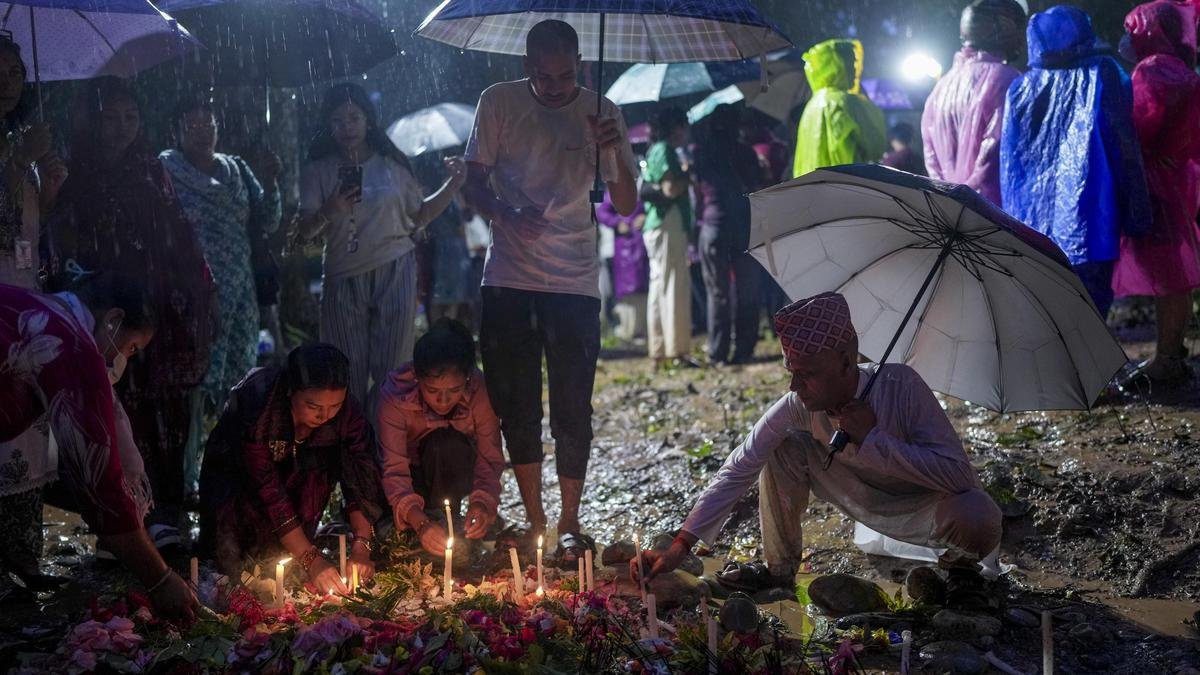
"We're in a moment of sorrow and grief," he said.
"But this is very resilient nation...