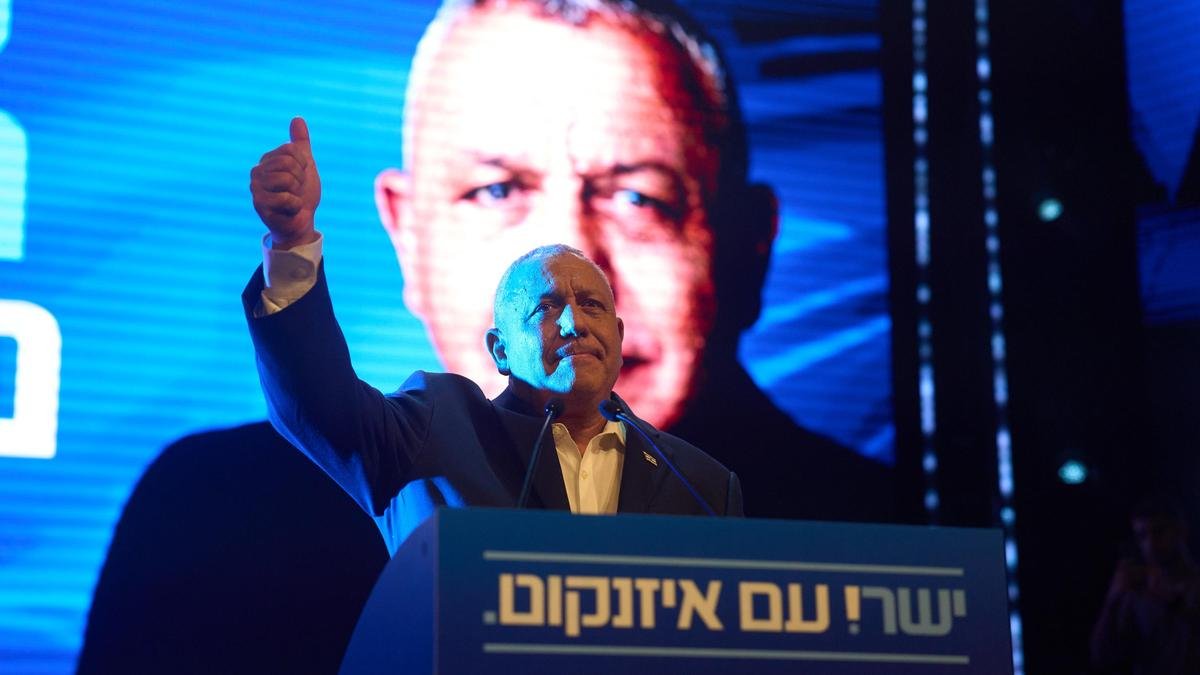
As Israel gears up for its parliamentary elections on October 27, a one-year-old party has emerged as a significant contender.
The Yashar (Hebrew for ‘straight’) party has garnered widespread support as per the opinion polls reported by Israeli media outlets, some of which place the party ahead of Prime Minister Benjamin Netanyahu’s Likud party.
In most projections, Yashar led with at least 20 of 120 seats in Knesset, Israel’s parliament, while Likud trailed behind.
Channel 12 News and Channel 13 News put Yashar at 23 and 22 seats, while Likud followed with 20 and 19 seats respectively.
According to the poll published by Maariv, Yashar was projected to win 25 seats while Likud trailed with 19.
While the polls did not point to a clear winner, Yashar consistently emerged as a leading party.
Netanyahu plans ‘broad national govt.’ after Israel vote Gadi Eisenkot, who leads the centrist party and is a former member of Prime Minister Netanyahu’s cabinet, projects himself as everything that Mr.
Netanyahu is not.
Mr.
Eisenkot, who held his first electoral meeting less than three months ago on June 30, is now as popular as the Prime Minister.
This growing support for Yashar and its leader is strongly buttressed by the public sentiment following the October 7, 2023, Hamas attack, which has emerged as one of the central issues for voters.
While Mr.
Eisenkot has promised strategic wars rather than endless ones while maintaining Israeli sentiments on Palestine’s two-state solution and Iran, Mr.
Netanyahu is losing his appeal amid mounting challenges, including corruption charges, allegations of negligence regarding warnings of the Hamas attack, diplomatic tensions and declining ratings.
According to Dahlia Scheindlin, a policy fellow at the Mitvim Institute and a strategy consultant and public opinion expert for political and social campaigns in Israel, “The main aspect driving Yashar is the voters — the same specific constituency that is centrist-leaning right, security-minded, patriotic, but not far-right or extremist in Israeli terms.
They supported Gantz in 2023-24, then they supported Bennett in 2025, then Eisenkot seemed like a credible, fresh politician who could win, so they shifted to him.
After that, the figure of Eisenkot, a trustworthy former Chief of Staff and a bereaved father (and uncle) who projects something straightforward (as per his party name), by contrast to Netanyahu.” She added that the appeal cannot be attributed to just his promise of an inquiry commission into the events of October 7, 2023, as most parties seem to promise the same.
A soldier who lost a son to war Mr.
Eisenkot served in the Israel Defence Forces (IDF) for 41 years.
The 66-year-old made his debut in politics in 2022 alongside Benny Gantz, another former Army chief.
Four days after the October 7 Hamas attack, he was invited by Mr.
Netanyahu to join his war cabinet, where he served till June 2024.
He was and continues to be a strong critic of Mr.
Netanyahu’s handling of the Gaza war.
Besides his political stances, Mr.
Eisenkot also has a familiar appeal that Israelis, who have borne the brunt of a prolonged conflict for nearly three years, can sympathise with: one of a soldier who has served his country and has lost a son and two nephews to the war.
While these factors connect him with the public, he still echoes Mr.
Netanyahu when it comes to select foreign policies.
He shares Mr.
Netanyahu’s sentiments with respect to matters such as the two-state solution and views on Iran.
That is, irrespective of who comes to power, Gaza and West Bank are bound to see little change.
His party’s 10-point goals, published on its online platform, carry a focus on both national and domestic issues.
The mentioned goals include ensuring the existence of the state of Israel as the national home of the Jewish people while preserving its character as a Jewish and democratic state and strengthening Israel’s national security and positioning it as a strong regional power.
Its domestic goals include strengthening theIDF, ensuring that every citizen serves in the military or national service, reducing social gaps within the country, and strengthening governance and solving economic issues such as the high cost of living.
Obstacles for Eisenkot The road ahead for the party is not without obstacles.
“Both coalition math and Eisenkot’s inexperience will be a problem for the coalition-building/bargaining phase, and for keeping such a coalition together,” explained Ms.
Scheindlin.
Eisenkot currently lags in international appeal which Netanyahu commands while dealing with foreign media.
Regarded as the author of ‘Dahiyeh Doctrine’ — an Israeli military doctrine that calls for the use of disproportionate force and deliberate targeting of civilians and infrastructure — Mr.
Eisenkot has previously earned Israel international condemnation.
Ms.
Scheindlin commented, “He can if he chooses to, and there will be a great deal of expectation and anticipation if he replaces Netanyahu.
But he will also have to take steps regarding the Palestinians that will earn criticism at home, and he will have to learn how to face that without caving in.”