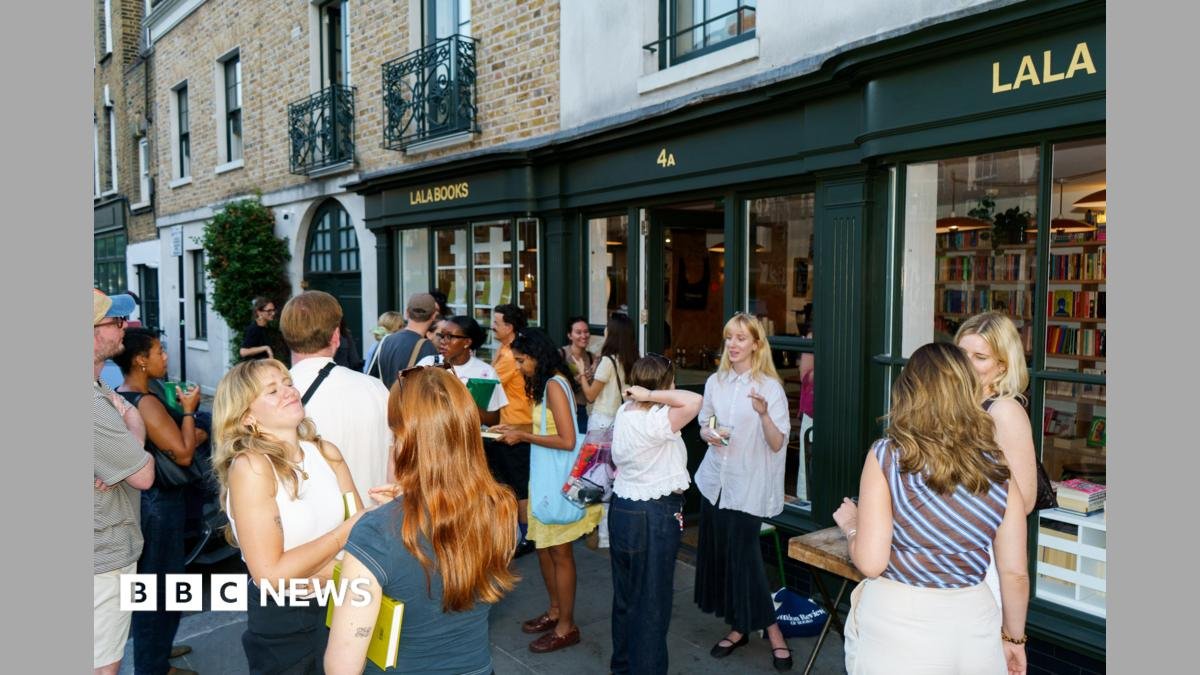
Image source, Lala Books Image caption, Lala Books operates a pay-it-forward scheme funded by donations from the community ByRosa RahimiReporting fromLondon Published 3 minutes ago Maybe you've come across a sign like this before.
It reads: "If you need a little something, but circumstances are challenging for whatever reason, take a heart and hand it to us at the counter, no explanation needed." These are known as pay-it-forward schemes.
It's when people can donate into a pot of money that can be claimed by others to cover the cost of things like a coffee or a book.
Amid the rising cost of living, schemes like these have the potential to offset the burden of small costs that can feel increasingly expensive.
But how often do they get used?
And do people feel comfortable using them?
Image caption, Host Cafe runs a "suspended coffee" scheme Host Cafe, in the heart of the City of London, is home to one of these schemes.
Based in the St Mary Aldermary church, cafe manager Barbara Gornicka says there aren't many set rules: it can be used by anyone who feels like they need the cost of their drink covered that day.
Instead of coming up to the counter and asking for a free beverage, people are also welcome to take one of the polymer clay hearts on the drinks board.
"This is to keep people from maybe being embarrassed, especially if there's a larger queue.
Not everyone can just outright say: 'Can I have a free drink?'" explained Gornicka.
Image caption, Customers can take a polymer clay heart up to the counter to claim their free drink, no explanation needed One regular is Paul Atherton, who was awarded the Freedom of the City of London earlier this year and has been dealing with homelessness for 17 years.
"I wouldn't have survived in this city if I didn't have the ability to sit, use Wi-Fi, and grab a coffee and feel like a part of society," he said.
Atherton, who is a filmmaker, author, and social campaigner, called schemes like this "life-changing".
After accounting for £160 a month in storage costs, Atherton says he lives on £4 a day.
Image caption, Paul Atherton called schemes like these "life-changing" "If these things didn't exist, you'd be outside of society.
A cup of coffee on my current benefits is more than what I get on my daily allowance." Prof Joan Costa-i-Font, an economist at the London School of Economics calls schemes like this a "drop in the ocean".
"It's better than no coffee," he said.
"But it's not really solving the structural problem.
It's a sign of kindness.
I would say all these are signals of kindness." It can also be difficult to advertise the scheme, says Gornicka, who wants it to be used more often and by people from different backgrounds.
"My goal eventually for the scheme is not to only exist for people who absolutely cannot afford a coffee, but for people to feel secure in that they can use it – even if they definitely could afford a beverage." 'I feel bad – a lot of people say that' There is a similar sentiment south of the river at Lala Books, an independent bookshop in Camberwell operating a similar scheme.
Owner Danielle Moylan says their fund can be used by anyone to claim fully or partially the cost of a book or a magazine at her store.
The scheme is especially popular with young people in the community, who are feeling the squeeze with rising rents and the cost of living – though using it can come with hesitation.
Image caption, The scheme at Lala Books is funded by the community and allows customers to claim all or part of the cost of a book "'I feel bad' – a lot of people say that, or you can tell they don't think it's for them.
Or they might not be in quotes poor enough to use it or disadvantaged enough." But Moylan says that's not the purpose of the scheme, which exists for anyone who might feel like they don't have quite enough money to pay for a new book.
"It's just there for you to feel comfortable enough to take a book home with you," she explained.
While people can simply come up to the till and ask to use the funds, they've also come up with a more discreet method.
At a box in the back of the shop, there is a stack of envelopes filled with gift vouchers that can be picked up by anyone.
Moylan says they look exactly like their regular gift vouchers: "We wouldn't know the difference." Image caption, A sign in the back of the shop guides people to a box of gift vouchers Image caption, The vouchers look exactly like any other gift voucher Do they worry if this no-questions-asked approach could lead to people taking advantage of the scheme?
Moylan responds with a resounding no.
"That's sometimes the pointy end of running a scheme like this, and that's just something you have to accept as part of a community fund." She has had one customer tell her they used the scheme to buy a book for their friend's birthday.
In another instance, the scheme was used to supply 30 books for a local primary school.
"There's something nice about the idea that people in Camberwell and Southwark are giving money – that then is going to buy books for kids who live around the corner," said Gillian Lewis, the parent who saw Lala's scheme and thought of the school books idea.
Moylan added: "We even get people who might use it one week when they feel like they don't have just quite enough money to get the book that they want, and then like two months later they'll come back and say they want to donate into it now." Listen to the best of BBC Radio London on Sounds and