Tens of thousands of police deployed and roads barricaded as PTI party demands release of jailed former PM
Leaders from Imran Khan’s party have vowed to go ahead with a nationwide demonstration in Pakistan to demand the former prime minister’s release, even as the government deployed tens of thousands of police to Islamabad, barricaded highways and issued arrest warrants to try to stop the march.
The state has taken extreme measures to prevent Khan’s Pakistan Tehreek-e-Insaf (PTI) party from proceeding with the march, due to take place over the weekend. It was announced after mounting concerns of the treatment of Khan, who has been in jail since 2023 on corruption charges.
On Friday, deliberation continued among PTI leaders over whether to begin the march on Sunday and move slowly towards Islamabad to “exhaust the government” or whether to delay until next week.
Analysts said the protest could present a major challenge to the military-backed government, which is widely regarded as weak, illegitimate and unpopular, while Khan remains a popular rallying figure. The ruling coalition is led by the prime minister, Shehbaz Sharif, but the army chief, Field Marshall Asim Munir, is widely seen as the country’s de facto leader.
This week, dozens of PTI leaders and ministers have been detained or given with arrest warrants, while Khan’s three sisters were arrested on Monday and remain in jail, charged with posing a “grave threat” to security.
Among those facing arrest is Sohail Afridi, the chief minister of Khan’s home province of Khyber Pakhtunkhwa, PTI’s stronghold where thousands of supporters are expected to join the march to the capital.
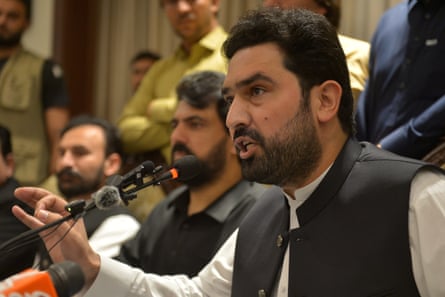
Afridi said the PTI would carry out the march unless the government made significant concessions over Khan’s treatment and conditions in jail, including a fair hearing for Khan’s cases.
“The government is panicking – that’s why they have put Islamabad under siege, that’s why they are abducting our ministers,” he said.
“But Imran Khan is the most popular leader of the country and people will come out for him. I am certain they won’t be able to stop the public power of the masses when they come out on streets and take to Islamabad.”
Afridi acknowledged the scale of the security deployment had led many to fear there could be a violent confrontation to prevent Khan’s supporters entering the capital, as had been seen in previous demonstrations.
The government has already deployed tens of thousands of security officials to Khyber Pakhtunkhwa and shut down the main highway connecting the provincial capital, Peshawar, to Islamabad.
“I know they can go to any extent to stop us by brute force, we have no doubt about it,” added Afridi. “But if we have a large number of people, they can’t open fire at us. Our plan is to bring so many people that they surrender.”
Faisal Karim Kundi, the governor of Khyber Pakhtunkhwa – a central government appointee – defended the security measures being taken against PTI as “precautionary” and accused the party of trying to create “instability and violence”.
“The state can’t allow any violent group to march on Islamabad,” said Kundi.
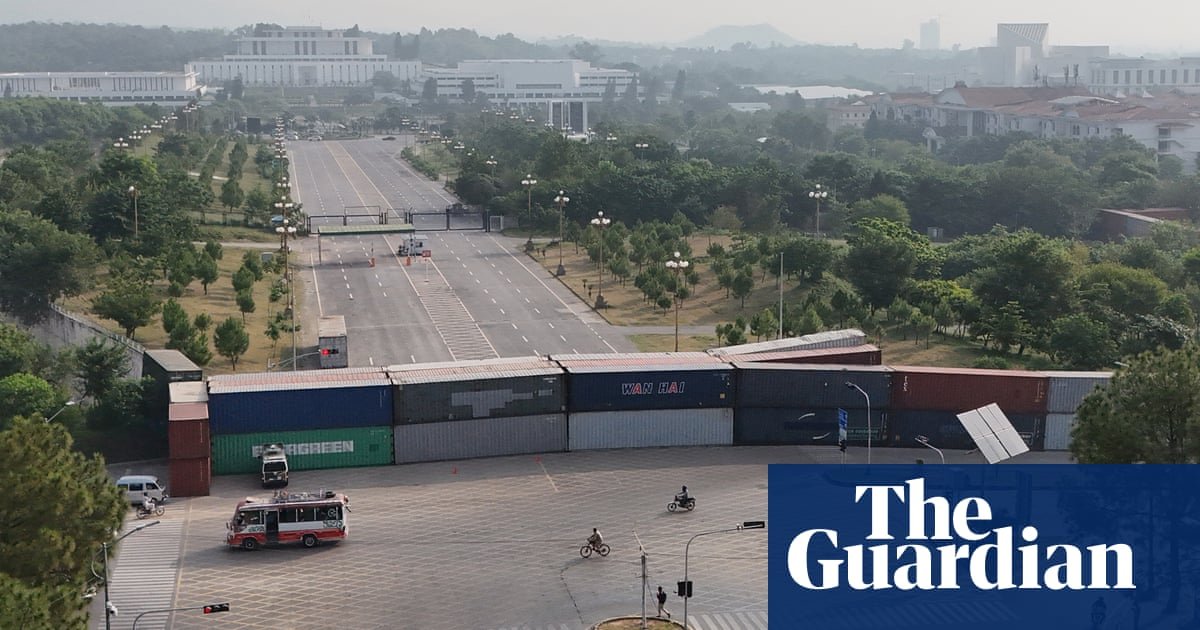
Public frustration has mounted in Islamabad as the government’s measures to stop Khan’s party supporters having any way to enter the capital has led to the city resembling a high-security fortress.
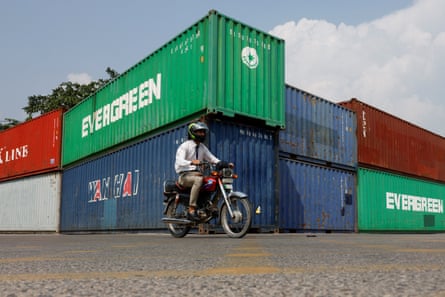
More than 1,000 shipping containers, many fortified with spikes, have blockaded roads and sandbags were placed on bridges, while a key highway into the capital was closed. Public gatherings have been banned in Islamabad and 22,000 police and other security personnel have been deployed across the capital.
The government’s shutdown has fuelled anger and frustration in the capital, with many businesses unable to get supplies.
Shahid, 76, a retired businessman, said: “The entire city is suffering. The government has shut down the whole city and we, as citizens, are helpless. I have never seen such a situation. Joblessness, inflation and insecurity has made our lives hell but does the government care? No.”
Despite the considerable efforts by the government and the military to crush Khan’s party and remove the former prime minister from the public consciousness – with media organisations instructed to not even refer to him by name – Khan is still viewed by many as the political alternative to the current regime.
The PTI alleges Khan is being held in solitary confinement and has been denied adequate medical treatment and any contact with his family or his lawyers for months.
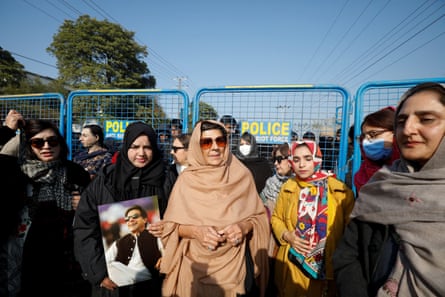
Khan denies all the charges against him and alleges he is being imprisoned due to the political threat he poses to the ruling government and the country’s powerful military. All but one of the court rulings against Khan have been overturned.
Analysts say the government and its military backers fear the PTI protest could escalate into a movement that could topple their administration, similar to protests seen in nearby Bangladesh, Nepal and Sri Lanka.
“They have an eye on what has happened in south Asia over the last five years, where country after country has seen huge protests snowballing suddenly out of nowhere and sweeping away a government,” said Niaz Murtaza, a Pakistani political columnist.
“Given the breadth of grievances in Pakistan at the moment – the performance of the government has been so poor on the economy and security while the repression is so high – that they are very nervous that the whole situation could combust very quickly.”