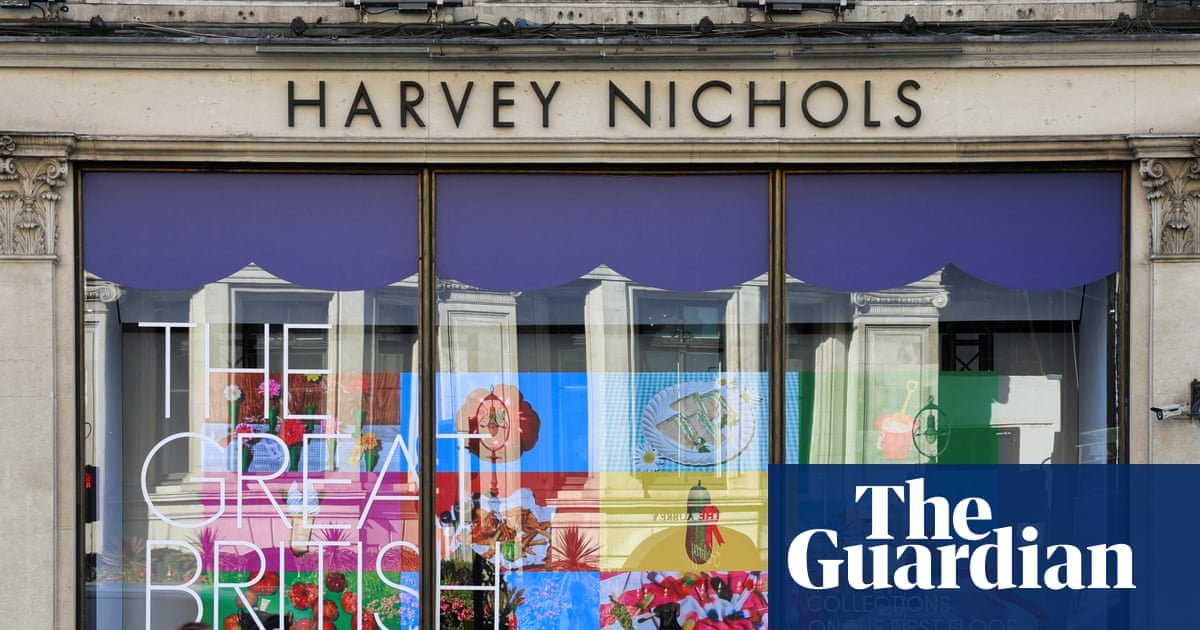
The Harvey Nichols department store in Knightsbridge, central London.
The chain has 13 stores and 1,200 staff.
Frasers billionaire bought Harvey Nichols and increased Hugo Boss stake despite tough times for high-end stores What billionaire doesn’t love to splash the cash on a luxury item?
Some may buy watches or yachts, but Sports Direct founder Mike Ashley has been snapping up entire brands.
Harvey Nichols is the latest bauble to drop into his shopping basket after his company bought the Knightsbridge department store out of administration earlier this month.
It sits beside a large slice of Hugo Boss, a chunk of Mulberry, a snippet of Burberry, the remains of Agent Provocateur and the entire Flannels and House of Fraser chains.
After a rough few years for the sellers of luxury goods – as the cost of living crisis has crunched the spare cash aspirational consumers might have had available for the occasional treat, and Asian and Middle Eastern shoppers have become less inclined to travel to Europe – Ashley’s buying spree might seem out of sync.
However, the string of acquisitions closely match the entrepreneur’s established modus operandi – picking up bargains during tough times and finding the value where he can.
Sports Direct, now part of Ashley’s Frasers Group, built its business by snapping up struggling independent sporting goods chains and bumped up its profits by getting the UK rights to ailing sportswear brands – from Head to Slazenger – and using them to decorate its own products.
Mike Ashley tends to pick up bargains during tough times and find the value where he can Live News.
Since first buying a stake in Flannels in 2012, then a menswear store in Knutsford, Cheshire, Ashley has been slowly building a luxury portfolio.
The strategy has had its ups and downs.
Flannels has expanded to about 75 stores and now sells brands from Gucci to Stone Island to Maison Margiela.
This week, Ashley celebrated lifting his stake in the German label Hugo Boss to 48%, just short of taking full control, despite opposition from the company’s board.
The Harvey Nichols deal is a classic tactic to gain access to intransigent brands, adding lustre to the portfolio that could make some designer marques previously shy of engaging with the king of discount trainers sit up.
Ashley is likely to take a pragmatic approach to the wider Harvey Nichols estate, having said he intends to convert at least some of the five UK outposts outside London to the Flannels brand.
Ashley increased his stake in the German luxury label Hugo Boss to 48% this week.
Frasers bought the business for £52m at the end of 2023, only to place it into administration months later, leaving millions of pounds owed to designer brands.
House of Fraser is another cautionary tale.
On buying the House of Fraser chain of 60 department stores out of administration almost exactly eight years ago, he set a mission to become “the Harrods of the high street”.
Today there are just five stores left trading under that name.
There are another 15 stores badged as just Frasers, some of which are converted department stores while others are somewhat smaller sites.
The Frasers name is also being used on a Luton shopping mall in the group’s property portfolio, which contains a House of Fraser discount outlet.
Such a confusing brand story is unlikely to entice large international labels to engage.
Even the Flannels chain, Frasers said in its latest annual results published in July, was “now near complete”, indicating it did not intend to add many more stores.
Frasers said in its latest annual results that the Flannels chain was ‘now near complete’.
6m.
Frasers said this included a rise in sales at Flannels, but gave no figures, so it was unclear if that was driven by adding new stores.
Luxury fashion acquisitions by Frasers do not appear to have flourished.
Jack Wills, once widely sported by partying public schoolers on their holidays in Cornwall, now has just five independent outlets, down from about 100 when Frasers bought it in 2019.
Clive Black, an analyst at Shore Capital, said that if one examined the group’s spending on upmarket brands then “from a financial perspective it has not been a roaring success. skip past newsletter promotion after newsletter promotion “The premium end of Frasers has been a burden for the wider group.
The mothership is Sports Direct and that’s what is funding the wider diversification strategy.” He suggested the strategy was more driven by Ashley’s personal aspiration to be taken seriously by these big names.
“He has developed a penchant for bling in his 60s,” Black said.
Whether “buying assets at the bottom” will lead to a benefit if and when the market improves works out “only time will tell”, he added.
Luxury market experts are also sceptical.
One told the Guardian he would not have chosen to buy Harvey Nichols as its brand had become degraded and customers had gone elsewhere.
He suggested the building’s freeholders – the Cadogan Estate – had long discussed a plan to turn Harvey Nichols into a hotel or apartments and this might be the ultimate future of much of the Knightsbridge site.
An industry insider said Harvey Nichols “just feels like its lost its way’.
The old hand suggested Ashley’s scattergun expansion may yet lead him astray, pointing to the failed retail empires of Sears and Arcadia, and Marks & Spencer’s ill-fated efforts to expand overseas with Brooks Brothers.
He suggested that running luxury brands such as Hugo Boss and Harvey Nichols might be a “bit of an overreach.
It’s very different to a volume play.” He said it was clear Frasers had a weaker business than Next, where chief executive Simon Wolfson’s buying spree is strictly limited to strong brands with effective management teams that need help to succeed online using Next’s expertise and infrastructure.
“The world of retail is littered with big organisations with an existing business that liked to acquire other brands and it doesn’t manage to succeed or end well,” the insider said.
However, he added of Ashley: “I wouldn’t bet against him.” The businessman has a long history as a gambler, famously producing a wad of £50 notes from his pocket when taking journalists through security screening on a visit to the company’s Shirebrook warehouse in Derbyshire.
He is not averse to risk but most of his business deals are underpinned by the value of stock and or property, which can be traded to raise cash if other tactics fail.
The future for Harvey Nichols and its new luxury brand stablemates might not be pretty, but Ashley is likely to make money however it turns out.
Frasers Group declined to comment.
Explore more on these topicsRetail industry Frasers Group Mike Ashley features Share Reuse this content