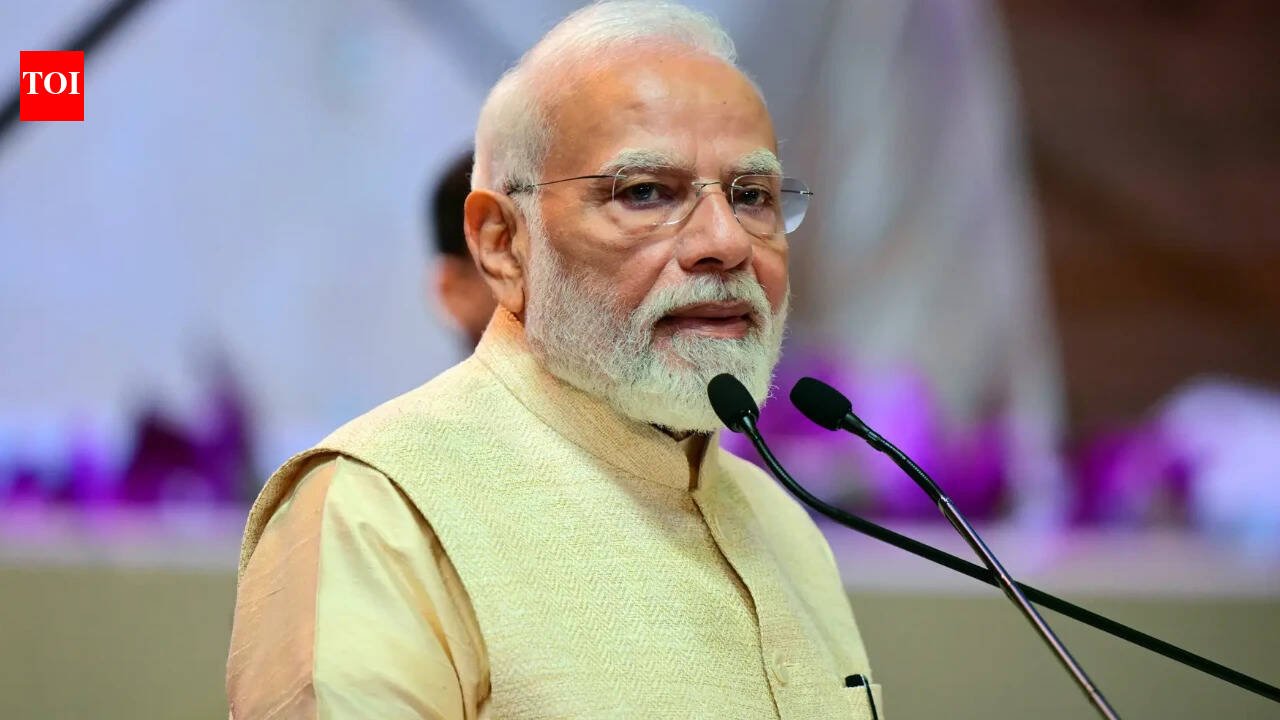
Prime Minister Narendra Modi addresses the UPSC centenary celebration at Bharat Mandapam, in New Delhi on Thursday.
Minister Narendra Modi on Thursday asked recruitment agencies like Union Public Service Commission (UPSC) to adopt selection parameters that not only test an aspirant's academic knowledge but also their motivation to join the civil services.Modi, while addressing UPSC's centenary celebrations here, explained that selecting individuals with the right inherent motivation makes it easier for the administration to adapt to rapidly changing public aspirations.
Stating that the youths recruited today will simultaneously serve as the chief architects and the primary beneficiaries of the nation's future, he insisted that every selection process be rigorously tested against the dual criteria of prioritizing the nation and the citizen.Modi said the archaic 'mai-baap' (supremacy) governance mindset of the past has made way for a modern administrative era built on the absolute principle of 'nagrik devo bhava' or 'citizen is king".
Projecting India as an increasingly urbanized nation by 2047 with a narrowing rural-urban divide, he said the traditional service delivery models will need to evolve to match the speed of an instant-delivery world where citizens demand rapid, real-time solutions powered by AI.
“This changing mindset demands new changes from our civil services as well,” noted Modi.He demanded that selection processes for govt jobs at both national and state levels be meticulously designed to recruit professionals who proactively anticipate problems and operate without unnecessary pressure or influence.
He emphasized the need for empathetic civil servants who find innovative solutions, proactively ease citizens' lives, and critically evaluate the impact of laws on the public.Cautioning the future civil servants about having to navigate new-age threats like information warfare, deepfakes, algorithmic bias, and climate justice, the prime minister instructed the recruitment agencies to adapt to these global shifts by prioritizing candidates' foresight and complex problem-solving abilities.He insisted that the examination agencies rapidly align with the nation's broader reform momentum by adopting the principle of time certainty to shorten exam cycles without lowering standards.
These would cut down the financial burden on account of coaching fees, rent, and transport, on the families, he said.The prime minister proudly noted the dramatic rise in female candidates in civil services, from a mere 3% in 1952 to over 30%today, alongside the historic appointment of three out of four women UPSC chairpersons post-2014.Join conversation Share your thoughts in the comments Be respectful · TOI community guidelines Pointing to the 45-fold increase in candidate participation since the institution's 50th anniversary in 1976, Modi reminded the commissions that the recruiting agencies are not merely picking candidates, but choosing individuals who will become the very face and representative of the government at the grassroots level.Congratulating UPSC for having been in existence for 100 years, the prime minister praised the organisation's enduring credibility despite changing generations, governments, technologies, and syllabi.
The celebrations were marked by the release of a commemorative postage stamp, a special coin, and a compilation of 100 significant case laws.Recalling the monumental challenges faced after independence, Modi paid deep homage to Sardar Vallabhbhai Patel for establishing the vital steel frame required not just to keep the country independent, but to actively govern the newly formed nation.
He acknowledged that while the UPSC has excellently discharged its historical duties, the focus must now decisively pivot toward the critical next 25 years that await the country.