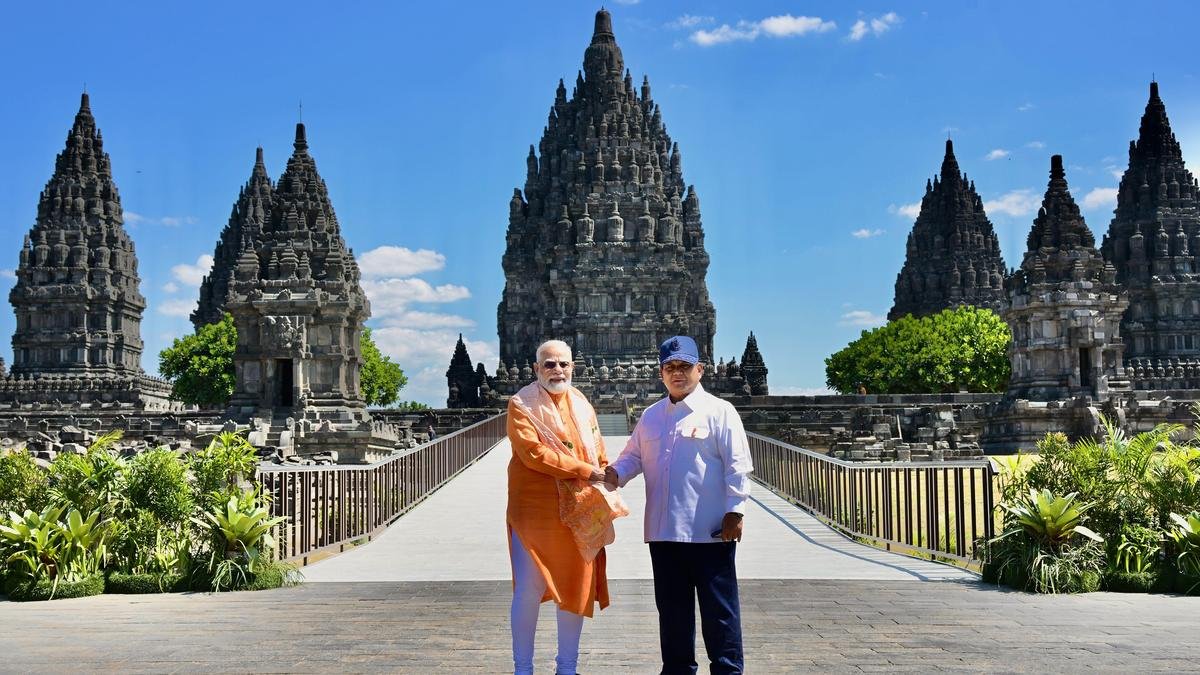
Story so far: “The winds here carry a scent of culture, a scent which connects us and we feel every moment on the soil of India,” waxed Prime Minister Narendra Modi on Wednesday (July 8, 2026) when he visited the 1200-year-old Prambanan Temple complex in Indonesia’s Yogyakarta. The visit was preceded by the announcement of India-Indonesia’s joint conservation project to restore the shrine.
Located 17 km northeast of Yogyakarta city, the 10th-century shrine has three temples dedicated to the divine Hindu trinity – Lord Brahma, Vishnu and Shiva, as well as three temples to their ‘vahanas’ - hamsa (swan) for Brahma, the garuda (eagle) for Vishnu and the nandi (bull) for Shiva. With reliefs depicting scenes from the Ramayana. Recognised as a UNESCO World Heritage Site, the complex houses two groups of buildings – Hindu temples including Prambanan and Buddhist temples including Sewu with its four pairs of Dwarapala giant statues.
Totaling 508 stone temples of various shapes and sizes in either complete condition or in ruins, the complex is home to both the largest Hindu and Buddhist temple in Indonesia. Immediately after Indonesia became independent in 1945, restoration of the temples, ravaged by earthquakes, began and was completed only in 1953.

Cultural significance of Prambanan temple to India
Built by King Rakai Pikatan to reportedly rival the adjacent Buddhist temple complex Borobudur, built by King Shailendra in the 8th century, Prambanan temple has survived several volcanic eruptions over the years from the nearby Mount Merapi. Expanded by Rakai Pikatan’s successors, King Lokapala and Balitung MahaSambu of the Mataram kingdom, Prambanan served as the royal temple and most of the state’s religious ceremonies were conducted there.
Apart from the main Shiva shrine, other temples dedicated to Goddess Durga as Mahishasura Mardhini, Dakshinamurti too have been restored through the years. Bas-relief depictions of episodes from the Hindu puranas (Ramayana and Bhagawata), creatures like kinnaras, kolamakara, asuras and scenes of social life adorn galleries around the central chamber and the symmetry and structures of the temples resemble to Pallava dynasty’s architecture.
Inscriptions at the Shiva temple show that a public water project to change the course of a river was undertaken during the construction of the temple. These are similar to the engineering style of temple builders of South-east Asia spanning the Chola and Gupta dynasties and Cambodia’s Angkor Wat complex. Moreover, the well dug in the middle of the complex is said to go down to the foundations of the temple, where King Erlangga’s ashes (who died in 1014 AD) are believed to have been deposited in a stone case – a custom also found in the Matrubhuteswara Temple at Tiruvanamala.
Victim to Mount Merapi’s volcanic fury, the rulers shifted away from the complex, leaving the temples to decay. As the Dutch East India Company came to rule the country, several pieces from the temples were transported to the officers’ gardens and homes. However, the temple and most of the original structures still remain as efforts to restore it began as early as 1918.
The Archaeological Survey of India is honoured to undertake the conservation of Prambanan Temple, a UNESCO World Heritage Site in the Special Region of Yogyakarta, Indonesia, under the India–Indonesia Collaborative Conservation initiative jointly launched by Hon'ble Prime… pic.twitter.com/jkqa2ewVOd— Archaeological Survey of India (@ASIGoI) July 8, 2026
The Archaeological Survey of India is honoured to undertake the conservation of Prambanan Temple, a UNESCO World Heritage Site in the Special Region of Yogyakarta, Indonesia, under the India–Indonesia Collaborative Conservation initiative jointly launched by Hon'ble Prime… pic.twitter.com/jkqa2ewVOd
India-Indonesia links
On December 14, 1958, India’s President Dr. Rajendra Prasad drove down to Prambanan temple on his official visit to Indonesia – becoming the first Indian head of state to visit the complex. After the May 2006 earthquake, the temple complex sustained severe damage and Indian Prime Minister Dr. Manmohan Singh offered help to conserve the shrine. Officials of the Archaeological Survey of India (ASI) visited the site and worked with Indonesian counterparts in assessing the damage and providing technological help or manpower in restoring it.
Prior to Prambanan, the ASI team was involved in restoring Angkor Wat temple between 1986 and 1993, in collaboration with the Cambodian government. Later, under Prime Minister Atal Bihari Vajpayee’s government, India signed an agreement with Cambodia in 2002 to restore Ta Prohm temple (part of Angkor Wat) – built by Khmer King Jayavarman VII and by 2012 ASI had finished the restoration.
In Laos, the ASI began its restoration work of the 11th-century Vat Phou temple, built by the Khmer royal family as a Shiva temple, in 2007. In the first phase, ASI spent 17 crores and unearthed evidence that the structure, which had been converted into a Buddhist temple, was originally a Shiva temple. The second phase of the restoration began in 2018 and has spent ₹24 crores as of 2024.
Under the Modi government, the ASI has expanded its restoration projects for Southeast Asian structures, including Angkor Wat. In 2014, India and Vietnam signed an agreement to restore ruined Shaiva temples in Mỹ Sơn, built by Champa Kings. ASI’s work on the site started in 2017 and was completed in 2013. During the process, ASI discovered a monolithic sandstone Shiva linga from the 9th century at the site. In 2016, India offered its help to restore the earthquake-damaged pagodas and the Ananda temple at Bagan, Myanmar.
(With inputs from The Hindu Archives)