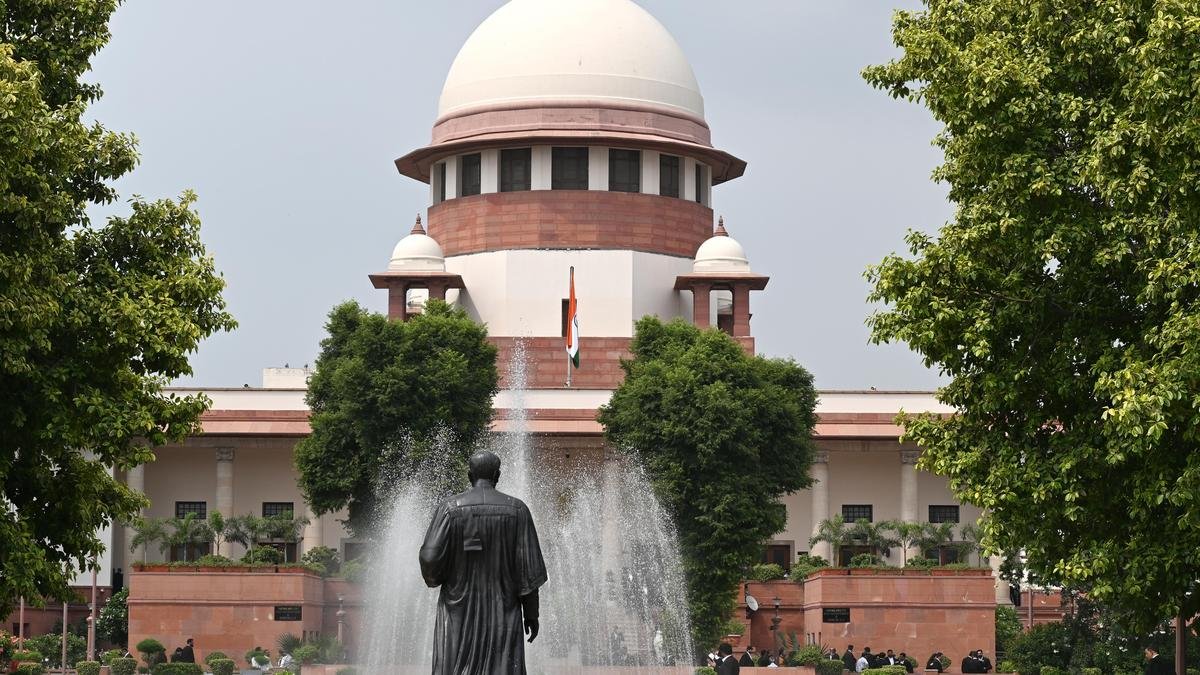
The Supreme Court on Thursday (September 3, 2026) emphasised the importance of educating elementary school teachers, saying the development and lives of children, and even the future of the nation, depended on the quality of training given to these educators.
“Though free and compulsory elementary education to all children aged 6 to 14 years has now attained the status of an enforceable fundamental right, we have not bestowed on teacher education the attention that it deserves… The development of a child, for that matter, the life of a child is integrally connected to the role of an elementary school teacher,” Justice P.S. Narasimha, heading a Division Bench, observed.
The apex court observed that there was no human resource or value higher than the development of a student’s mind and character.
“Therefore, the elementary school teachers have the most important role in nation-building and as such, they have to be treated with utmost respect and care,” the court said ahead of Teachers’ Day celebrations on September 5.
The top court referred to judicial precedents that five duty-bearers safeguard the fundamental right to elementary education recognised in the Right to Education (RTE) Act, 2009. They include the government, the local authority, the neighbourhood school, the parents/guardians, and finally, the teacher.
Justice Narasimha added the sixth and seventh duty-bearers — teacher education institutions (TEIs), as defined under Section 2(e) of the National Council for Teacher Education Act, and the National Council for Teacher Education (NCTE) itself.
“The Council is entrusted with the duty to achieve planned and coordinated development of the teacher education system throughout the country. The Council is also to ensure that the TEIs imparting teacher education function effectively, efficiently and conduct their affairs with integrity. We have no hesitation in declaring that the duties performed by the Council and the bodies that are constituted along with it, such as the Executive Committee and the Regional Committees, are perhaps the highest of all the duty-bearers,” Justice Narasimha observed.
For the RTE Act to work effectively, an academic authority like the NCTE has to lay down the minimum qualifications.
The judgment came in a challenge to the Council’s decision to call for annual Performance Appraisal Reports from TEIs.
Upholding the Council’s move, the apex court said, “we fail to understand as to how a regulatory measure of a statutory body, empowered to achieve planned and coordinated development of teacher education system in the country, could be restrained from calling upon the TEIs to file Performance Appraisal Reports”.