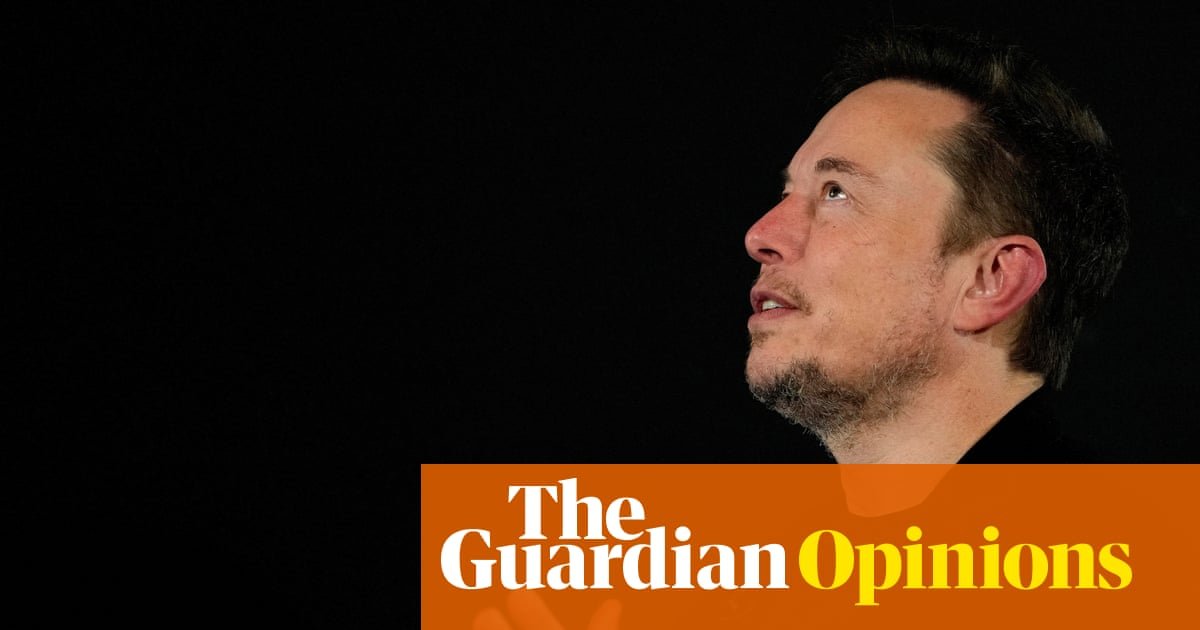
Elon Musk in London, November 2023.
Relax, everyone: Elon Musk has a mantra to make the climate crisis go away Emma Brockes It’s simple, says the SpaceX boss – according to something called the ‘Kardashev scale’, we just have to move energy production ‘off-planet’ Next time the weather gives the UK 61 days without rain and we wonder idly if this is the end, there is a term we may whistle up to soothe us.
Like murmuring the rosary, or putting our fingers in our ears and humming, this phrase is to be mumbled on repeat – “the Kardashev scale, the Kardashev scale” – a buzzy concept in tech, much favoured by Elon Musk, and precisely the thing we’ve been waiting for.
The Kardashev scale is the answer both to our impending doom and our anxiety around it – and if we decide to believe in it, we won’t have to give the climate crisis a single thought until the last drip falls from the tap.
This is the idea and it’s a familiar one to anyone who has watched tech billionaires take intractable, commonplace crises and decide that, among the measures and proposals in play, the vital missing ingredient so far has been them.
Do you remember when Jeff Bezos, rather than doing something quotidian and loserish like funding public education by ensuring Amazon pays the same tax rate as regular Americans, decided instead to reinvent preschools?
Or Mark Zuckerberg and his wife, Priscilla Chan, who also set up some schools – no expertise required, just a reach-for-the-stars attitude and a passion for change.
At the risk of sounding callous, one might even put Steve Jobs’s eschewing of traditional cancer treatment in this category; after he was diagnosed with pancreatic cancer in 2003, the founder of Apple delayed surgery in favour of his own holistic and dietary remedies.
None of these ventures has been successful.
We know what this is: the default belief held by tech billionaires that their particular brilliance is a kind of skeleton key for all human knowledge, past, present and future, rocket-fuelled by innovation and untethered from the limitations that come with the dull, plodding alternative: that of actually knowing stuff about a specialist subject.
If they offer a magic bullet for any number of problems, the appeal to the rest of us is powerful.
Who among us, when booking a flight or glancing up at another cloudless sky, hasn’t thought guiltily, oh, well, at some point someone will, like, invent a shield or something, and everything will turn out OK.
Which brings us to the Kardashev scale, named for the Soviet astronomer Nikolai Kardashev, who in 1964 invented a rubric to measure the success of any civilisation based on its ability to harness energy.
Kardashev came up with a sliding scale of energy usage on which humanity had not reached even “type I” according to his measurements – because we can neither control the weather nor fully harness the energy of the sun.
The highest level in this schema was a type III, which describes a civilisation that has harnessed the energy of the galaxy – and above that further theoretical levels, including a type IV (the energy of the universe) and type V (the multiverse) to hold up against our dimwit civilisation’s current reliance on fossil fuels.
You can see why this appeals in Silicon Valley: the Kardashev scale has a kind of nostalgic futurism about it familiar to any student of the space race or the works of L Ron Hubbard, and leans on fun terms such as “galactic”, “space-time” and “moon bases”.
If this isn’t blue-sky thinking, I don’t know what is, and Musk has launched into it.
He has suggested that a natural implementation of Kardashev’s ideas is to develop space infrastructure – in effect moving energy production “off-planet”, along with orbital datacentres – by launching millions of units into orbit to better capture the energy of the sun.
It sounds super cool.
And while visionaries need vast ambition and an ability to withstand ridicule, these proposals demand a willing suspension of disbelief from us, too.
If you don’t, for example, let your mind drift back to that time Musk had Tesla engineers design a tiny submarine to fetch those kids trapped in a cave, or to whatever it was he did at the US “department of government efficiency” (Doge) that everyone in the Republican party now seems keen to pretend never happened, you can persuade yourself that the creator of Starlink might be on to something.
The Kardashev scale, the Kardashev scale – don’t you feel better already? skip past newsletter promotion after newsletter promotion Emma Brockes is a Guardian columnist Explore more on these topicsElon Musk Opinion Climate crisis Energy The super-rich Silicon Valley Mark Zuckerberg Steve Jobs comment Share Reuse this content